

Ariel Sharon's ghost seen hovering over 620 Eighth Avenue
Nicholas Kristof stepped deep into it this past week. Israel says it is going to sue the New York Times. Which should remind of us Ariel Sharon's much-forgotten suit against TIME.
“It took me three sittings to actually read it.”
“I was shaking when I finished it.”
“The column was an outrage, but deep down, I know some of it’s true.”

Those were the sorts of responses I heard over the weekend, walking outside in Jerusalem with friends, sitting at the Shabbat table with others, as people discussed Nicholas Kristof’s now infamous “opinion” column in the New York Times, “The Silence that Meets the Rape of Palestinians.” Read the NYTimes piece here, if you haven’t (and if you can stomach it).
“Do Israelis even notice this stuff in the American press?”, those who live abroad might wonder.
In this case, they certainly do.
Here’s the YNet mention in the headlines (green box): A photo of Kristof, and the headline to its left, “Accused the IDF of raping Palestinians, and sparked an uproar.”

And here’s the fuller lead:
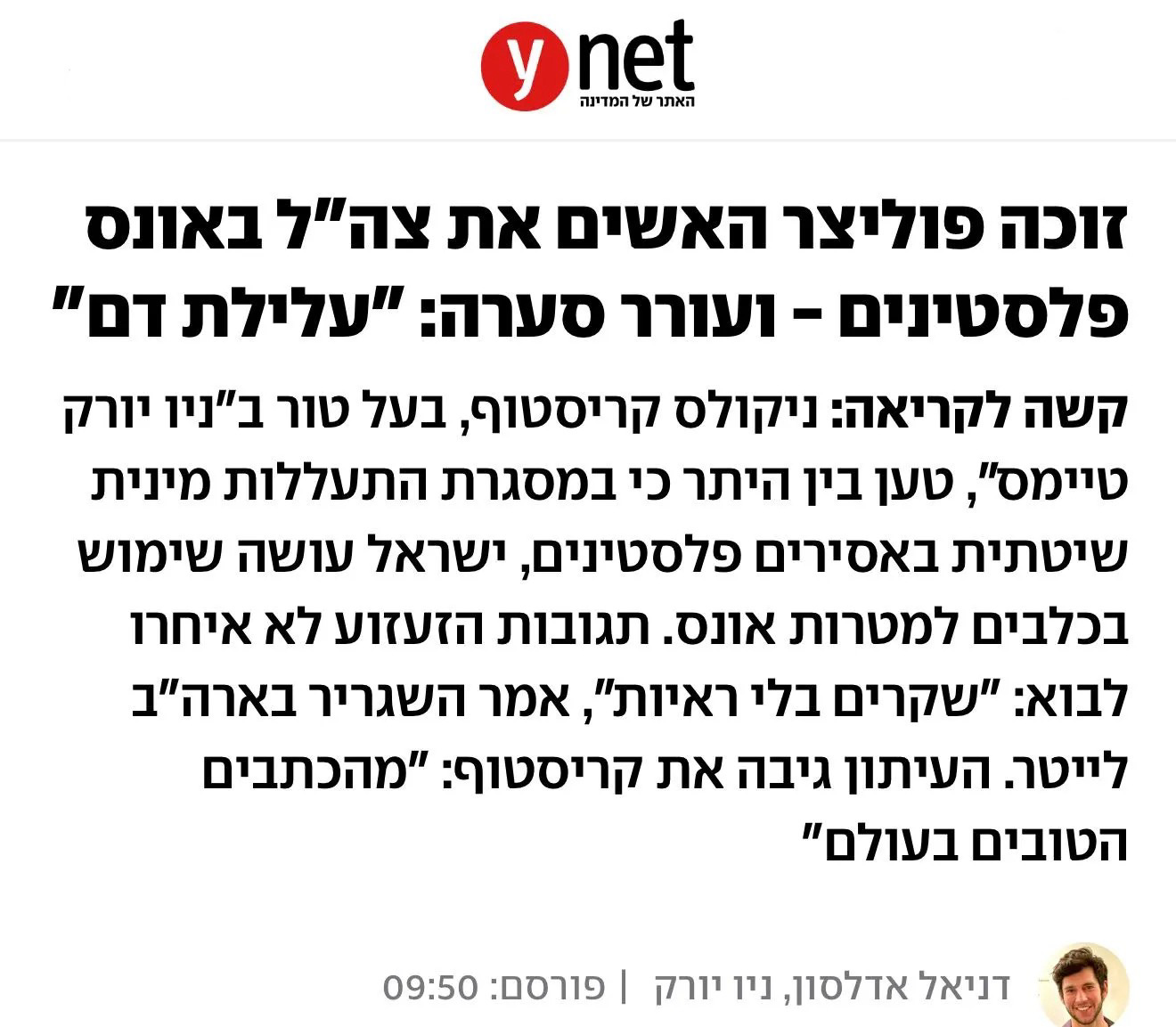
Headline: “Pulitzer Prize winner accused the IDF of raping Palestinians — and sparked an uproar: ‘Blood libel’”
Body: “Difficult to read: Nicholas Kristof, a New York Times columnist, claimed, among other things, that as part of systematic sexual abuse of Palestinian prisoners, Israel uses dogs for the purpose of rape. The outraged responses were not long in coming: ‘Lies without evidence,’ said the Israeli ambassador to the US, Leiter. The newspaper defended Kristof: ‘Among the best reporters in the world.’”
My intent today is not to add to the discussion of Kristof’s piece. There has been a tremendous amount written, some of it very good, and below, I’ll list what I think are some of the most crucial responses for those who wish to be up to date on the conversation and who wish to understand what, journalistically, was so wrong with Kristof’s approach.
The foolish response to Kristof, of course, is to deny everything. I don’t know a single thoughtful Israeli (I’m sure there are some, but I don’t know them) who thinks that nothing of this sort happens. Of course it does. (See what Haviv Rettig Gur says, quoted below.)
In the aftermath of October 7th, Israeli rage knew no bounds. The Israeli police force is in terrible shape, is under the control of a minister whose racism is much bemoaned and the force is struggling mightily to recruit new officers; police resignations have become a serious problem. And all over the world, prisons are horrible places, and terrible things happen in them. (Do you know anyone who thinks that Jeffrey Epstein committed suicide?)
But Kristof took the accusations to a new level, and the pieces I’ll refer to below respond to that.
Israel’s threats to sue the New York Times (its offices are situated at 620 Eighth Avenue, hence the title of today’s post) are likely to go absolutely nowhere, as has already been shown in several places, including Free Press, which noted that The Case of Israel vs. Kristof Is Dead on Arrival.
It struck me, though, that given our regular focus on Israeli history in Israel from the Insid, it might be worth remembering—for those who are too young to recall or for those who have simply forgotten—another famous case in which a leading Israeli sued an American publication.
When Ariel Sharon Sued TIME Magazine
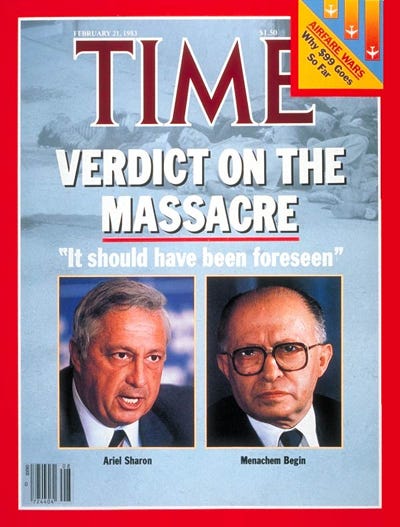
In February 1983, TIME Magazine published what it believed was a bombshell. The cover story was about the Kahan Commission, the Israeli government inquiry into the massacre at Sabra and Shatila. The previous September, Lebanese Christian Phalangist militiamen had entered two Palestinian refugee camps in Beirut — with the IDF controlling the perimeter — and slaughtered somewhere between 800 and 3,500 Muslims, depending on who was counting. The Kahan Commission had already determined that Defense Minister Ariel Sharon bore personal responsibility for failing to take into account the danger of the Phalangists’ entry into the camps.”
Sharon resigned after the commission’s findings and the ensuing political pressure.
At that point, it seemed that his career was over. (Later, of course, he became Prime Minister, pulled Israel out of Gaza and was rendered incapacitated by a stroke while still in office.)
But TIME’s story went further. Much further.
Citing what it claimed was classified Appendix B of the Kahan report, TIME alleged that Sharon had actually discussed with members of the Gemayel family — the Phalangist political dynasty whose leader Bashir had just been assassinated — the need to take revenge for Bashir’s killing. The implication was unmistakable: The implication was that Sharon may have done more than simply fail to prevent the massacre, though that broader inference remained disputed.
Sharon sued.
