

"Be-Makbil" — "And simultaneously"
On a day still unfolding, the images on Israeli TV captured better than words ever could the overflowing joy of a nation, and the unimaginable series of events that unfolded all in one day.
Watching in the moonlight before day-break
Many of us were awake all night. Some of us intentionally, some of us because even if we did fall asleep, when we woke up to check the news just in case it was happening early, we found that there was no way to go back to sleep.
These lines of Natan Alterman’s iconic poem, “The Silver Platter," which he wrote in December 1947 on the eve of Israel’s creation, capture this moment of Israel’s re-creation just as accurately as they did three-quarters of a century ago:
And a nation rises—heartbroken but breathing
To receive the miracle, the only one, there is no other

As the ceremony approaches, it will stand in the moonlight
before day-break, wrapped in celebration and fear
When from the other side emerge a young man and young woman
And slowly they strode towards the nation
Here are some images of how the nation greeted them.
Many of us have watched more hours of TV news in the past two years than we did over the previous decades. We’re used to the faces of the newscasters, somber and worried, devastated and sometimes, a bit hopeful. Today, we saw expressions we haven’t seen once since October 7:
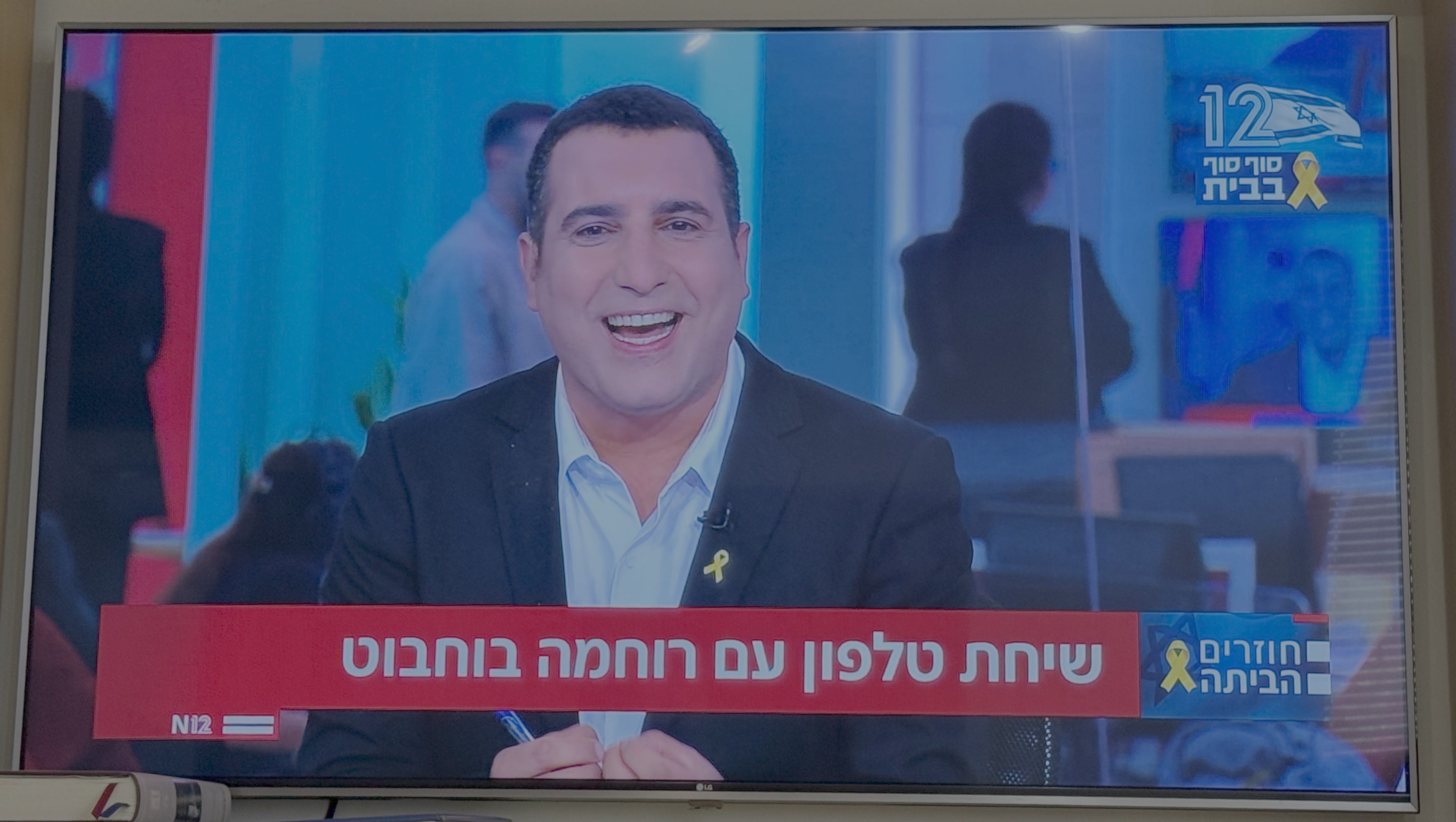
As the first group of seven, and then a second group of thirteen, were released, there was coverage of all the many ways people were spending those nerve-wracking, yet hopeful hours.
Gatherings in the home of the hostages, a massive rally at Hostage Square. When I turned on the TV at 3:00 a.m., there were already hundreds of them there … some hours later, estimates were of close to 100,000 people who wanted to witness the events on giant screens at the place that became synonymous with the public’s drive to get the hostages home.


One of the newscasters (I think it was Yonit Levi) noted that over the past two years, we’ve heard so many speeches by and interviews of the family members, and have read so many articles about and profiles of them, that we feel like we know them. Ironically, she said, the people we don’t know as well are the hostages they had worked for two years to redeem.
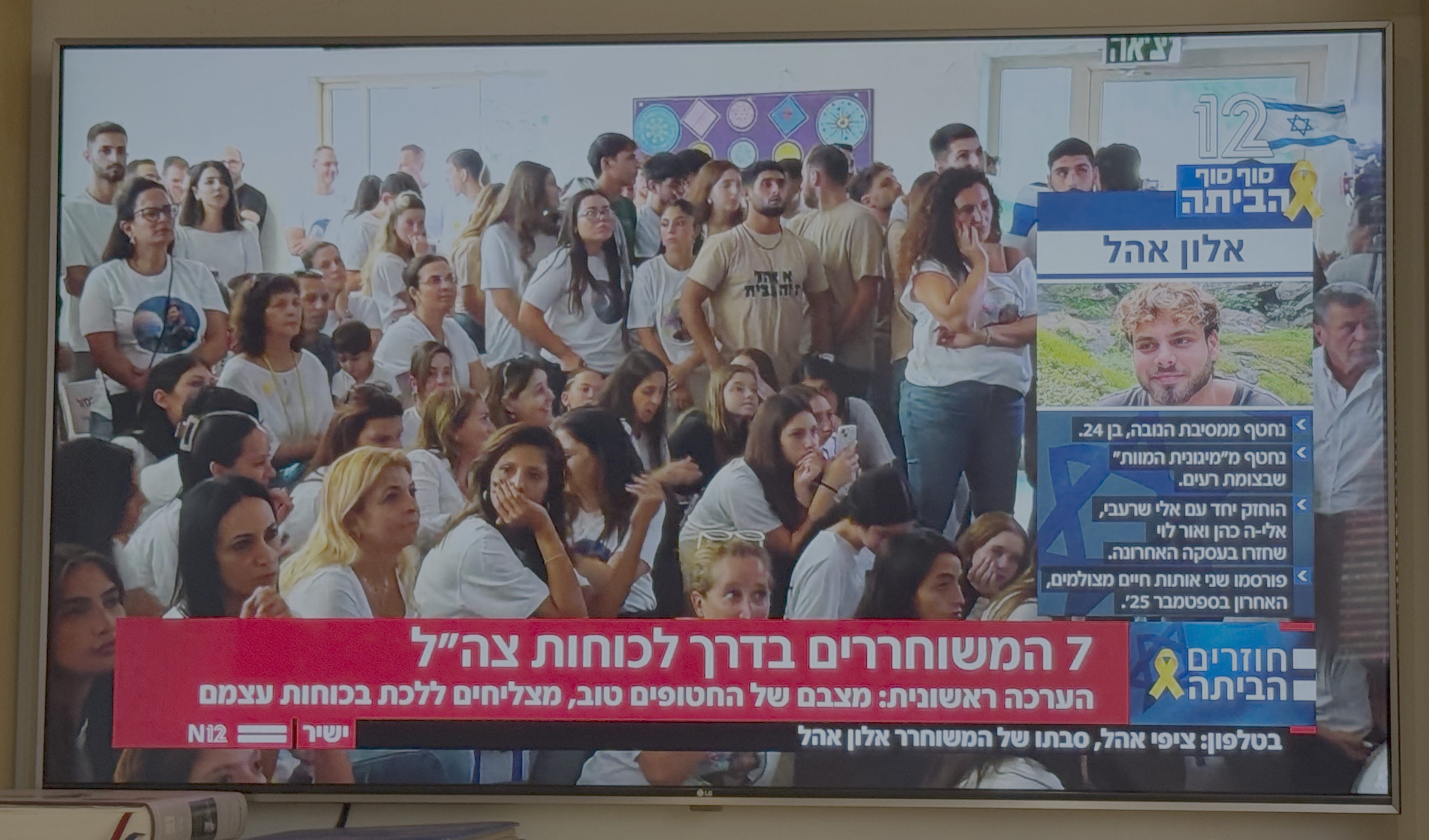
So as the news cut from home to home, there was a bit of a bio on the screen, giving “the basics” about the hostage whose family was being shown.
Alon Ohel:
He was kidnapped from the Nova Festival, 24 years old.
He was kidnapped from the “shelter of death” [DG —the one from which Aner Shapira had thrown back grenades that the terrorists had tossed into the shelter] at the Re’im junction.
He was held with Eli Sharabi, Elya Cohen and Or Levi, who were returned in the previous deal.
Two video’ed proofs of life were released, the last on September 25.
Along the road to Re’im, where hostages met a few family members (most waited at the various hospitals), and along the roads to hospitals and elsewhere, Israelis lined the streets where in places where they hoped the released hostages would be able to see them.

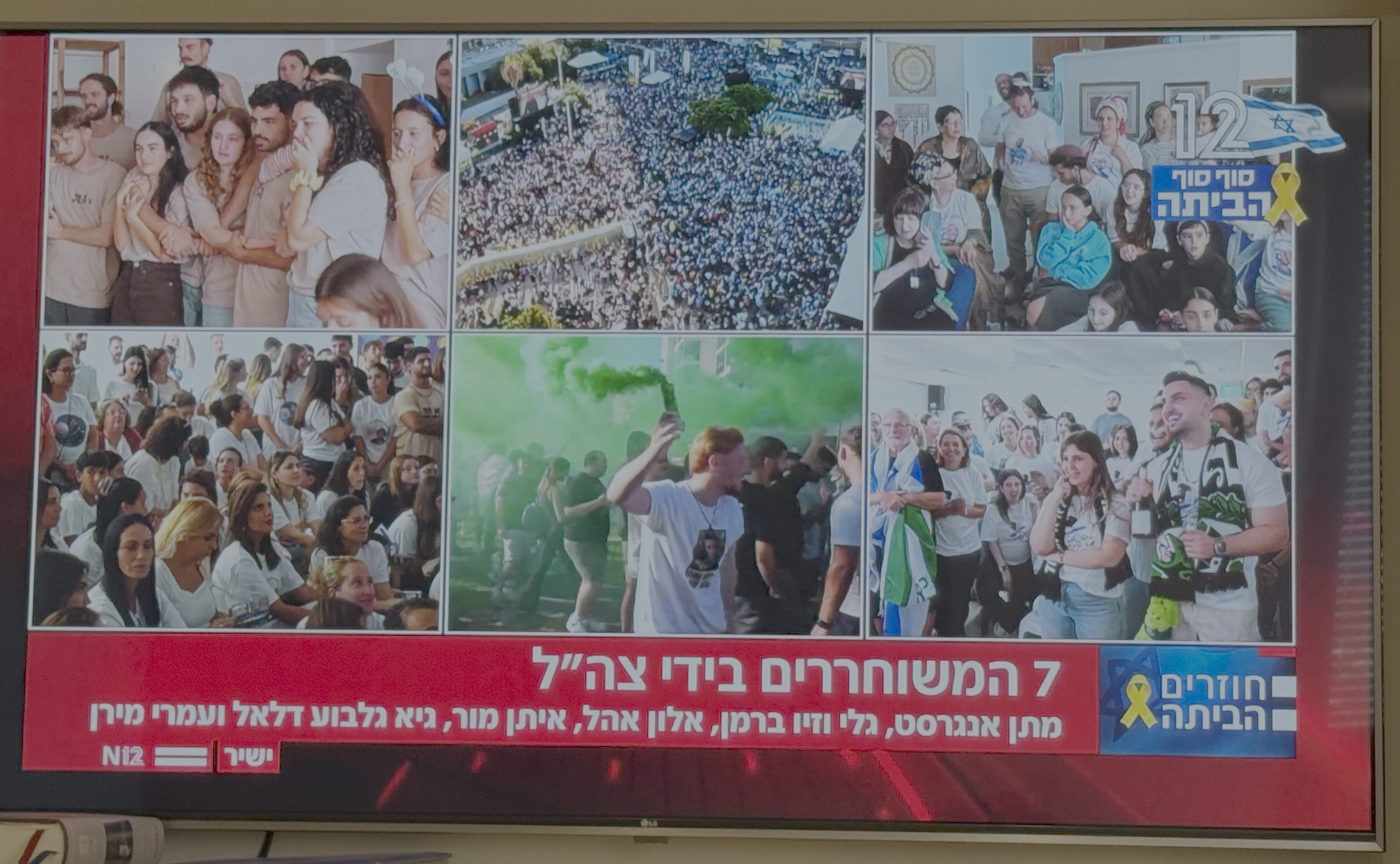
Ever since the deal was announced, there has been deep worry about what condition the living hostages would be in. As they were released, TV compared photos of them from before they were kidnapped with what they looked like this morning.
A number of people I spoke to said that those first images reminded them of images at Yad Va-shem. Eventually, though, the hostages looked better than we’d feared, once we saw them on better cameras. Every one walked out on his own.
As the day went on, though, medical authorities were already saying that their conditions “were substantially more complicated” than the initial images suggested. What that means we’ll likely learn in days to come.


Newscasters couldn’t help but point to ironies throughout the long hours. They noted multiple photos of planes, for example; the helicopters waiting to take the released hostages to three hospitals, while Air Force One made an unscheduled swoop over the beach of Tel Aviv, so Israelis could see the plane and so that the President could see the enormous sign thanking him laid out next to the water.


The word be-makbil, “simultaneously,” was used so many times that the newscasters started to smile at each other each time they said it.
Normally, they noted, a visit of the President of the United States to address the Knesset (the previous three were Carter, Clinton and the younger Bush—all three were somewhat more carefully crafted speeches 😊) would be the only event anyone was discussing. It would so dominate the news that there would be no attention given to anything else.
Today, they said to each other, they kept having to cut away from Trump’s visit to cover other events, each of which on a “normal” day would be the only story.
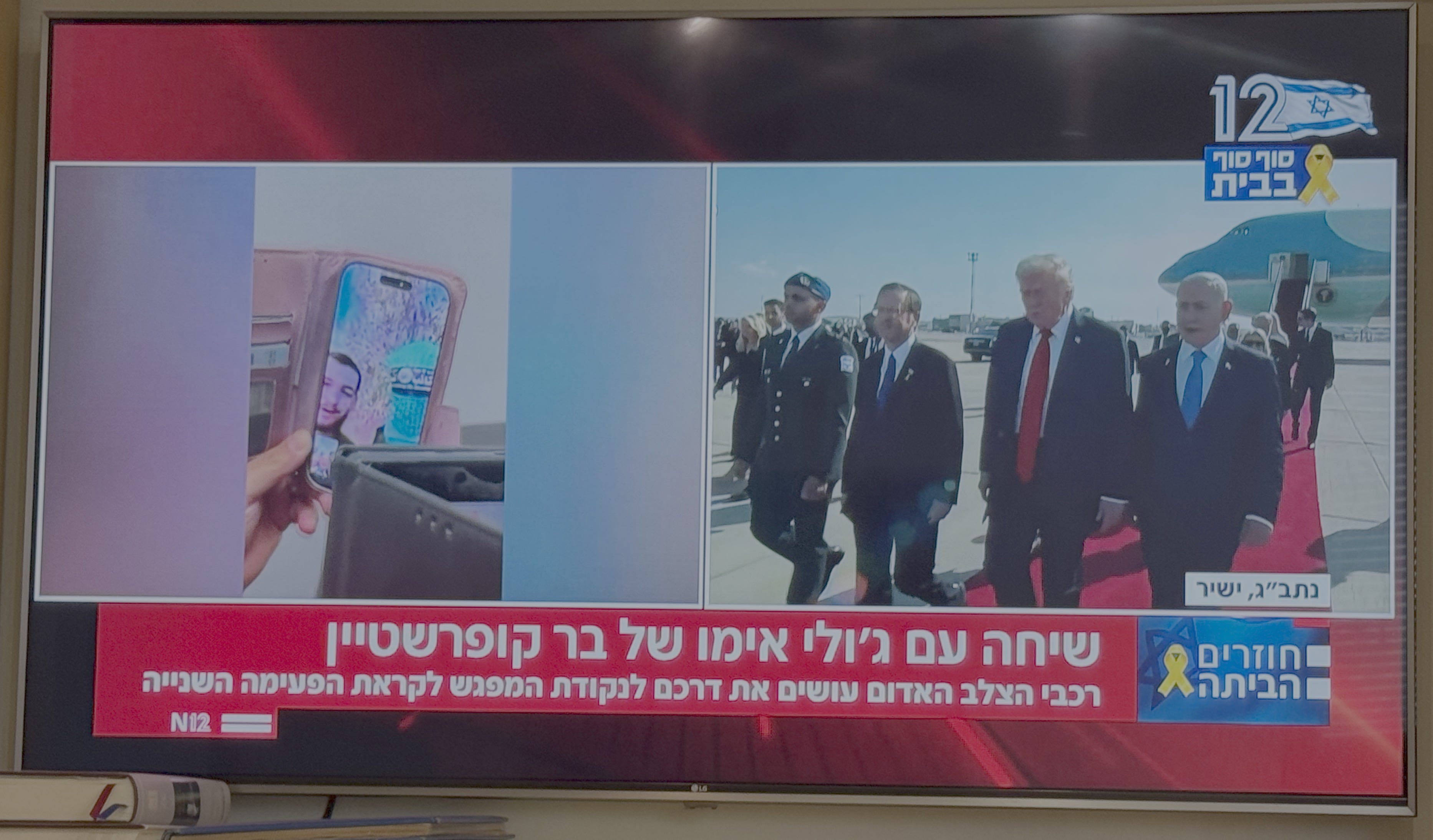
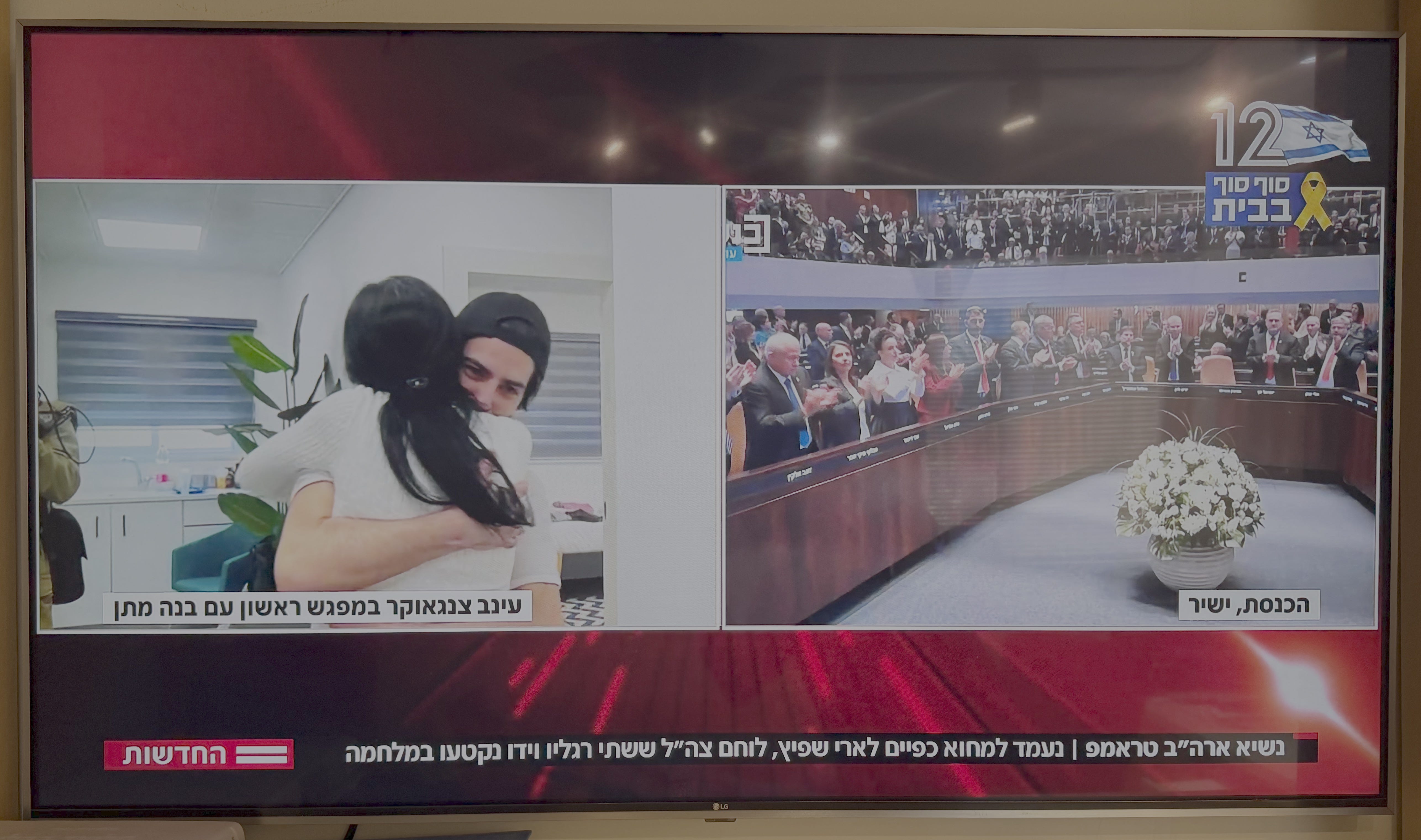
Atop the screens, where for a long time (until it no longer resonated) we had seen the phrase ביחד ננצח, be-yachad nenatze’ach, “together we will win,” there was now a new phrase: סוף סוף בבית, sof sof ba-bayit, “Finally at home.”

And yet …
Even on this day of celebration, this nation is fully cognizant of the fact that the hostages would not be home if hundreds of thousands of soldiers had not gone to war—the reservists time and again, for unbearably long periods—to battle Hamas and decisively weaken it so this deal could happen.
915 soldiers lost their lives in this war. In a country of this size, that is an unspeakably high number. Many, many thousands were wounded, some of them grievously, and have a long road ahead of them. Tens of thousands will long struggle with PTSD. The price was horrific, and everyone here is aware of that, today, too.
And we already know that later today will be heartbreaking. There will be no reunions, just coffins. It will take hours in some cases, but days in others, to confirm the identity of the remains. And horrible though it sounds, those will be the fortunate families. As one father of one deceased hostage noted yesterday in a Channel 12 interview, “either they’ll identity him by dental records, which will take a few hours, or by DNA, which will take a few days, or we’ll end up like the family of Ron Arad” — and never know what happened to him.
Unthinkable.
Thus, instead of closing with the prayer for the hostages, which we will not miss saying, it seems appropriate to conclude with El Maleh Rachamim:
God full of compassion,
who dwells on high,
grant perfect rest beneath the sheltering wings of Your Presence,
among the holy and pure who shine as the brightness of the heavens,
to the soul of those we were unable to save
who have gone to their eternal home.

Master of mercy,
bring them under the cover of Your wings forever,
and let their soul be bound up in the bond of eternal life.

The Lord is their heritage.
May they rest in peace,
and let us say, Amen.
Chag Same’ach. Wishes for a Simchat Torah more joyous than we might have imagined possible.

Tomorrow and Wednesday are Shemini Atzeret and Simchat Torah, so we will of course not be posting during those days.

Beautiful post today, simple and to the point. A lot to celebrate and a lot to still memorialize. Chag Sameach.
Todah, Daniel, for your post. It was just what I needed to read.
May Hashchina spread over Israel and the Palestinians to bring peace.
Rachel Tikva