

Drink, pray, live.
Three conversations in three different cafés first felt unbearably sad, but then left me very hopeful.


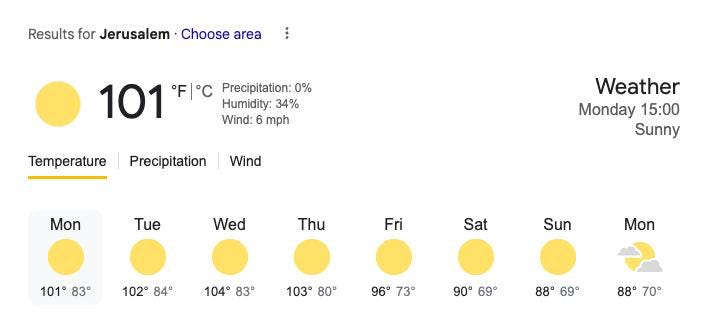
It’s been beastly hot in Jerusalem, over 100 degrees Fahrenheit for the last couple of days. How people who do not have air conditioning are managing (and there are more homes here without a/c than one might think), I cannot imagine.
The Ministry of Health has urged people not to leave their homes, but we already played that game during COVID. So for many of us, the past week or so has been spent bopping between well-air-conditioned cafés, meeting up with friends to chat over coffee as cold as we can get it.
There is, I’ve discovered, a new informal ritual to café-hopping in Jerusalem these days. You sit down, the server brings a menu, one person says, “Hi, great to see you. How are you doing?” to which the other person hesitates, inhales and then responds, “I have never, ever been so depressed.”
And then you just stare at each other for a few seconds, because “How are you doing?” was a pretty stupid question.
It's hard to pinpoint, precisely, why the mood has suddenly shifted. Maybe it’s not so sudden, or even so new – and perhaps it’s all a matter of too much time in cafés. But it’s not that hard to figure out why people are in the doldrums.
Yes, the oppressive heat is part of it.
But then there’s Gaza – reports are that if the plan to take Gaza City and large swathes of Gaza goes ahead, the IDF will have to call up 250,000 reservists. But the reservists are just utterly depleted. Some will show, some will not. And those who will show up are exhausted, physically and emotionally—yet that’s when people make mistakes. On the battlefield, mistakes can be horrifically costly.
How long will this go on? The IDF brass (which does not want to execute this plan, but yes, in a democracy, the army is subordinate to the political echelon) says that this operation could take us well into 2026. And if the goal is to wipe out Hamas (the “absolute victory that the PM has been promising since October 2023), then, we’re being told, we should gird ourselves for another five years of war. This could go on until 2030?
It's not only Gaza, or the unimaginable suffering (and deliberate starvation) of our hostages. Or the undeniable humanitarian disaster unfolding across the border. Both are so horrifying that words simply fail.
There’s also the toilet in which Israel’s international reputation now finds itself, an issue very much on Israelis’ minds (much more, one should note, than the issue of hunger in Gaza, for complicated reasons we’ll leave for another time).
Then there’s the fact that many of us have a bad case of cabin fever. We have several friends who have cancelled their plans to travel to Europe this month (August is travel month for many Israelis). Europe, of course, is also beastly hot, so if you can’t walk around outside, travel doesn’t make a lot of sense. But more than the weather, being Israeli in Europe these days is not particularly fun. Jews are being attacked in Rhodes, Athens, and elsewhere. In Paris, El Al had to move its offices outside the city because of vandalism, even as the French government decided not to renew the visas El Al security personnel need to work there, as the Israeli-French pissing match gets ever nastier (Vichy didn’t come from nowhere). Canadian Jews who have served in the IDF say they’re afraid to go home, for fear of being prosecuted. Grandparents practice with their grandchildren not speaking Hebrew when they’re outside.
Even if it wasn’t too hot to travel, where exactly would you want to go?
Remember Herzl’s promise that creating a Jewish state would end the days of the Jew’s being marginal everywhere s/he went? Oops.
Some people, though, do very much want to travel—and those are the kids (not kids anymore, of course) who’re going for more than a vacation. A lot of those café conversations have included discussions of friends’ kids who have departed “for a year or two, maybe three.” Sometimes it’s the allure of a work opportunity or being ready for a bit of adventure. Sometimes, it’s needing a respite from the pressure cooker. But sometimes, more commonly than we may wish to admit, it’s about being too exhausted to go back to reserve duty but also being unable not to go when their friends are going.
So what does one do? You realize that if you were now living in New York, or Boston, or Montreal, or Toronto, or Thailand (the places to which our friends’ kids have gone so far), then no one would expect you to show up for reserve duty. You would get to not go and at the same time not be a “draft evader.” What could be better?
What if the army is right and this war goes on for another few years (which I think is unlikely, but then again, who would ever have expected that we would be where we are now)? What if the kids’ two years abroad turn into three, which then turn into five—how many of those kids (most of whom have kids of their own) are coming back?
There’s that, too, in the first exhale you hear when your friend sits down at the table at the café.
(And a note for those who don’t live here, who don’t have kids who’ve been called up two, three, four or five times, and who haven’t seen what’s happened to their marriages, to their children, to the gleam they used to have in their eyes – I suggest not judging the people who’re making this choice.)
Back to those cafés.
Three recent café conversations struck me as particularly instructive windows onto what’s on people’s minds in these parts. The third, I’m pleased to say, left me very hopeful.
The first conversation was with a friend who’s in the finance world in Tel Aviv. Very talented and successful, she’s also taken on a central role in caring for some of the survivors of October 7. Even as we were having lunch in Tel Aviv, her phone kept pinging with messages from this survivor or that. Most of our conversation was about the work she’s doing on their behalf, the money she’s trying to raise for them, the scars and the memories they carry with them that, to this very day, in many cases, make it impossible for them to return to even a semblance of a normal, productive life.
Many things this friend of mine said during our conversation have stayed with me in the days since we met, but prime among them was a comment she made not about the survivors with whom she works night and day (in addition to being a mom and a wife and an active professional) but about one of her own kids.
If one were to (unfairly) peg her as a “type,” you’d have to call her a classic “secular, Tel Aviv, lefty.” Given that worldview, she told me, she made it clear to her kids as they were growing up that they simply had to learn Arabic in high school. “We’re going to live alongside these people forever, so you need to know how to understand them, how to speak to them.”
So her kids learned Arabic—and the army knows what high school kids here learn. One of her kids thus got nabbed for a position in intelligence in which, among other duties, he listens to cell phone conversations of Palestinians – including many in Gaza. And, he said to his mom not that long ago, “Please stop talking to me about uninvolved noncombatants. You just don’t know what you’re talking about. I listen to them all day long, and they despise us. Not most of them—all of them. And no, it’s not because of the war. This is how they felt before. It’s not a population filled with hostiles, but an utterly hostile population.”
It grew quiet at our table.
“Do you think he’s right?” I asked her. “No, of course I don’t think he’s right,” she said and sighed. “I think it’s a function of who he’s listening to. And it’s the understandable reaction of a young person who’s learning what it feels like when some of their previous worldview crumbles. But no, I’m sure that he’s not right.”
And then, after a pause: “It’s what I get for making my kids learn Arabic.”
I mentioned that conversation a few days later to a friend (this one we’ll peg as “Jerusalem, open-minded, liberally-inclined religious) with whom I met to talk about a book she’s working on. “Wow,” she said, “I’ve had this precise conversation with my husband.”
Her husband, it turns out, has done three hundred days of reserve duty, as she continued teaching and writing and caring for a big bunch of kids all on her own. He was on the ground in Gaza for long periods. On more than one occasion, she told me, he has said to her, “In every house that we went into, there were photos of their little kids, two or three years old, wearing Hamas headbands and holding two Kalashnikovs.”
