For these do I weep: For walls breached again
As Tisha B'Av draws closer, thoughts on why the day is more harrowing, and important, than ever.

Today’s essay, a reflection how how our sense of Jewish history and memory has changed because of the war in which we are mired, just appeared in the Times of Israel.
The first part of the issue is reposted below—to read the full essay, please visit the Times of Israel at “For These Do I Weep.”
Twenty-nine years ago this summer, I was in Jerusalem for a professional conference. The meeting happened to coincide with the Nine Days, the mourning period (which we observe this week) between the first day of the month of Av and the commemoration of the Fast Day of the Ninth of Av. So, not long after we arrived, people began chatting about where they planned to go for Tisha B’Av and the reading of Eichah (Lamentations).
The masses at the Western Wall didn’t appeal to me, but somehow, since I traveled to Israel very infrequently back then, being near the Kotel and thus proximate to where the destruction of the Temple had taken place made sense.
“We can go to one of the destroyed houses just outside the walls,” one colleague suggested. I had no idea what those were, but it sounded interesting. So, shortly after dark on Tisha B’Av a few days later, a small group of us hiked over towards the Old City. Rather than enter via one of the gates, we traipsed over to the southern side and lowered ourselves into a little space that seemed more like a foxhole than a house.
As we settled in, though, it was clear — there were, indeed, ancient walls all around us, not yet excavated. Plants were growing between the rocks, and the “floor” was anything but floor-like. These, our unofficial tour guide explained, were what had been houses of families who had lived in Jerusalem until everything was destroyed in 70 CE. Somewhat squished in the tight space, we stood and recited Ma’ariv (the evening service) and then somehow slithered onto the ground, and, with the few flashlights that we’d brought (phones as flashlights weren’t yet a thing), we recited Eichah.
What remains clearest in my mind about that night was sitting in the dirt of what had once been a house and wondering, “Do those people who used to live here ‘know’ (whatever ‘know’ means) that we’re back? That the Jews have returned? That we’ve made this place home, once again?”
Yes, it was supposed to be a day devoted to remembering destruction, but I found myself thinking more about rebuilding than about loss. Leaning against the ancient walls of what had once been their home, what struck me more than anything was that Jerusalem was now pulsing with life, and that 2,000 years after whoever had lived in this house had lost everything (perhaps including their lives), their house was “home” to Jews once again. In that house, we read the story of destruction, but everywhere around us were reminders not of defeat, but of something very different.
We and they were part of the same story. We, like they, considered Jerusalem home. We were seated in what they had called home and were reading a tale of woe that is certainly part of our own story, but …
Our chapter of this shared story felt so different from theirs. Theirs was a chapter of loss, ours a chapter of reclaiming. Other than a few personalities mentioned in classic texts, I didn’t know any of their names. Their generation was by now almost entirely anonymous, while ours was a story that had been shaped by hundreds of larger-than-life figures we all knew of.
They had suffered and been destroyed; we had suffered, but had prevailed and were sovereign once again. Did they “know”? Did they “derive” any consolation from our having come back?
* * *
Ironically, the fact that Jerusalem has been built, that it is so teeming with energy and Jewish rebirth, has long made Tisha B’Av challenging for me. For years, whenever we’d get to Minchah in the afternoon and recite the Nachem [“Console”] passage which is added on that day, I couldn’t help but wonder if saying it made sense anymore:
Console, O Lord our God, the mourners of Zion and the mourners of Jerusalem, and the city that is in mourning, laid waste, despised, and desolate. She mourns for lack of her children; she is laid waste, her dwellings destroyed; she is despised, her glory lost; she is desolate, with none to inhabit her. And she sits with her head bowed, like a barren woman who has not given birth.
“Laid waste”? “Desolate, with none to inhabit her”? Jerusalem’s horrendous traffic, its constant parking nightmare, and exorbitant real estate prices all suggested otherwise. Yes, I recited Nachem each year, because, well, “that’s what we do.” But I confess that something about the liturgy for Tisha B’Av made mourning the loss of Jerusalem more challenging than it might have felt without the liturgy.
* * *
If Tisha B’Av is a challenge, Shiva-Asar Be-Tammuz (the fast of the 17th of Tammuz, which falls precisely three weeks before Tisha B’Av) was always even more grueling for me. At least Tisha B’av had a good dose of communal ritual to give it a sense of substance. We all gather at night to recite Eichah. The next day, those of us who put on tefillin do so in the afternoon, not in the morning — the only day of the year on which that happens. It is customary not to wear leather shoes (as on Yom Kippur), as they are a sign of luxury. The study of Torah is forbidden (except for passages about the destruction of the Temple) because such study is a source of pleasure. We are supposed to be so deeply ensconced in a sense of mourning that we’re not even permitted to ask each other how we are; would we say to someone at a cemetery who had just buried a loved one, “Hi, how are you?” Of course we wouldn’t. On Tisha B’Av, we approximate the feeling of walking around that cemetery.
But Jerusalem of the 21st century? A cemetery?
The liturgy and other customs do help Tisha B’Av feel significant. But the 17th of Tammuz? We simply don’t eat or drink. That’s it. We just slog our way through a long, hot summer day when it feels like the sun will never set.
* * *
What do we mourn on the 17th of Tammuz? The Mishnah lists a litany of catastrophes that are said to have occurred on that day, but the main historical event that we are meant to recall is the breaching of Jerusalem’s walls by the Romans in 69 CE. Three weeks later, they destroyed the Temple (on the Ninth of Av), but on this day, many centuries ago, the Romans’ penetrating our walls was the beginning of the end. Which is why we fast on that day, too.
Even if I didn’t find the day compelling (to put matters mildly), I understood its importance. Communal historical memory is critical to an ongoing sense of peoplehood and community, and days like those are one of the critical ways that Jews perpetuate that memory.
So yes, even this more “minor” of the Fasts still matters. But the memories we’re trying to perpetuate are important, somewhat ironically, because our own story of rebirth is so very different.
* * *
When I sat down in shul on the morning 17th of Tammuz a few weeks ago, though, I apparently forgot to steel myself for a liturgy that was certain to be a slog. I forgot to remind myself to feel what I always feel — that reciting page after page would be more than mildly annoying because, while we and the ancient Jews about whom we read are parts of the same story, it’s just hard to wallow in despair over the destruction of yesteryear when the present, for all its complexity, has been one of rebuilding. Can one really sit in the extraordinary city Jerusalem now is, and still feel a deep sadness about losses of so long ago?
Unawares, I forgot to be bored, even a bit annoyed. Without noticing, I started to think about what I was reading. And then I noticed that I was wiping my eyes.
Why? Most of us are “vulnerable” to emotions that just a few years ago might not have gotten the best of us. This war has altered us in ways too numerous to count. We’re exhausted, and depleted. We’re raw. We’re depressed.
We are still trying to understand the nature of the horror transpiring on the other side of the Gaza border, about which we know much less than we need to (as an antidote to the certainty people all along the political spectrum feel, Matti Friedman’s “Is Gaza Starving? Searching for the Truth in an Information War” is essential reading); we still can’t figure out what responsibility we have for it, but we know there will be an eventual accounting that may bring us deep shame.
Even if we’re hopeful for the long term, we also know that things are likely to get significantly worse before they start to improve. Almost every day, I find myself thinking, “Thank God our parents didn’t live to see this. It’s breaking our hearts, but it would have shattered theirs.”
Most of us are shattered — but some of us are softened, too. Is it because some of the truths of which we were once so certain are no longer crystal clear? Is it that not so deep down, we feel or fear what the son of a friend of ours said to his parents as he and his wife announced they were leaving Israel: “Your dream failed”?
Is it because we can no longer count the number of funerals we’ve gone to in the last two years? The number of shiva calls to families we’d never even met? Has it been watching friends say kaddish for their sons? Or was it being at too many minyanim where there are multiple fathers saying kaddish for their sons?
Did being terrified soften us? Was it the terror of those days when our own son was called up, days when you can’t think about anything else or even tell your wife what you’re thinking about — or dreading? Or was it watching the effect of his being gone on his kids that softened us, that pierced some of the membranes we had so carefully constructed over decades of believing that Israel had created a new and different future for the Jewish people?
Or, perhaps, has it been the endless photos of those hundreds and hundreds we’ve lost, placed at the top of the front page of our newspapers so many mornings? Or was it sitting in our safe room with our kids and grandchildren, waiting to see if Iranian ballistic missiles were going to slam into us, in this, the state of the Jews that would finally make us safe?
Or was it that time, a week into the Iran war, that our almost-3-year old grandson, already accustomed to running to the safe room in the dark of the night, suddenly asked, “Why are there sirens?”
Why, indeed, are there sirens? Where do you start? How far back do you go? He’s only 3, but he’s asking. I looked at his mother (who happens to be my daughter) as if to say, “All yours.”
Most of us are changed, some of us are softened. Less certain. Humbled by the magnitude of our error in our certainty that Jewish history had changed. Exhausted by the challenge of learning to live with a heartbreak we thought — entirely incorrectly — that this country had relegated to the past.
* * *
As if calling for attention amid the very lengthy liturgy for the morning of the 17th of Tammuz, certain lines seemed to ring out.
Many young and old were captured from us.
Our city was laid waste, and fire was set within it.
For on the 17th of Tammuz, the city’s wall was breached.
…
We were cast from city to city
…
All glory and praise departed from us.
The enemy drew his sword against us to destroy.
Infants and sucklings were destined for slaughter.
On the 17th of Tammuz … sacrifices ceased.
“The city’s walls were breached.”
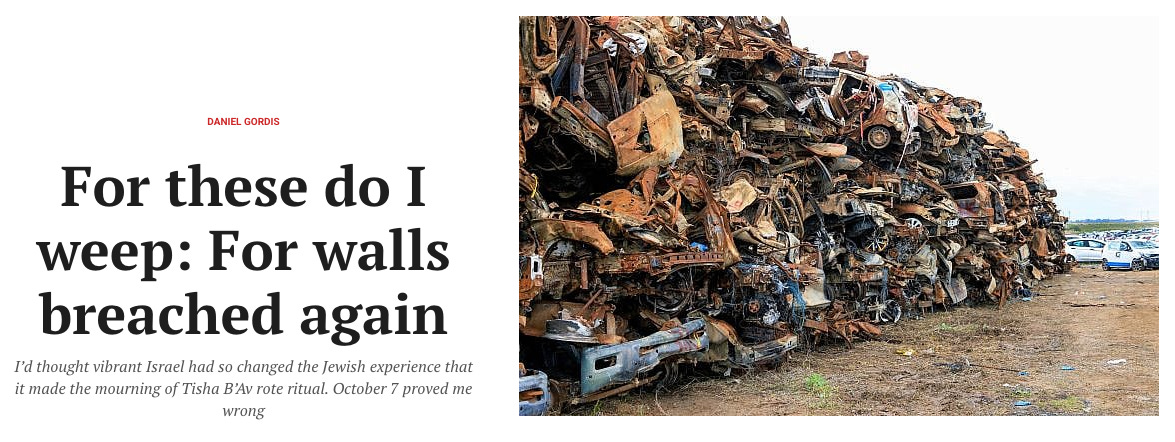
Suddenly, I wasn’t bored. When I least expected it, I was thinking not of ancient Jerusalem, but of Kfar Aza. And Nir Oz. And Be’eri. Towns, kibbutzim, where the walls were, indeed, breached, where the fences gave way to the onslaught of barbarians, where our defenses crumbled in the face of the attacks of murderers, kidnappers, rapists, mutilators, sadists. I thought of those “young people’s neighborhoods” on those kibbutzim, the homes where people were sleeping on Simchat Torah morning, but that were now burned beyond recognition.
It happened back then, but it happened again. The walls were breached. Last time, it was the beginning of the end. What about this time?
“And fire was set within it ….”
The first time I visited Kfar Aza after October 7, the soldier (in real life, a lawyer, but she’d been called back for reserve duty to show people around Kfar Aza and had been doing it for many months) told me, “It mostly looks the same as it did months ago, but it’s changed a bit, too.”
“How so?”
“The birds are back, for example.”
“The birds are back? Why were there no birds?”
“Because the smell of burnt bodies, the stench of death, was everywhere. Even outside, you smelled it with every breath. We had no choice but to be here, but the birds did have a choice. They flew away, and for months, you didn’t see or hear a single bird here. But now, you do.”
The fire even burned the air.
…. continued at link below …
The first part of the issue is reposted above—to read the full essay, please visit the Times of Israel at “For These Do I Weep.”