

Earlier this week, the IDF eliminated Saher Nidal Latfi Sakr , the terrorist who was seen kidnapping Noa Argamani on a motorcycle from the Nova music festival on October 7.
The video above is the IDF’s released recording of his elimination. We’ve added the subtitles for our viewers.

We’ll get back to that, below.
Most people who know anything about “Operation Wrath of God” know it from Steven Spielberg’s 2005 movie, MUNICH.
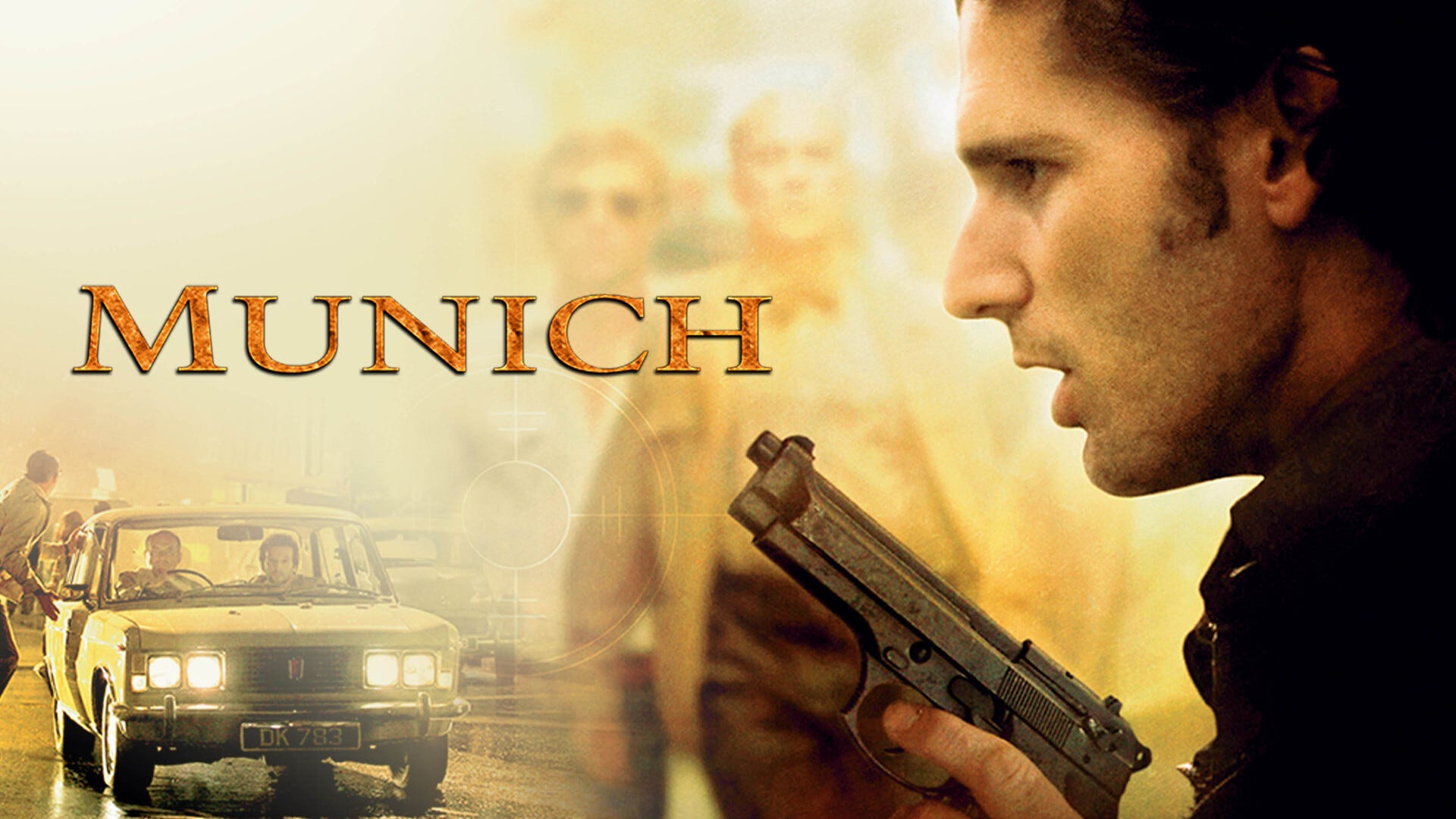
“Operation Wrath of God” was Israel’s response to the Munich massacre. After Black September gunmen killed eleven members of the Israeli Olympic team at the Olympics on September 5–6, 1972, Israel rolled out the operation, with the express purpose of tracking down and killing every one of the terrorists who remained alive.
Five of the eight attackers died in the horribly botched German rescue at Fürstenfeldbruck. The other three, Jamal al-Gashey, Adnan al-Gashey and Mohammed Safady, were captured. But a mere seven weeks later, when West Germany released all three in exchange for the passengers of a hijacked Lufthansa jet, Israel concluded that Europe would never bring the killers to justice (certain things about Europe do remain constant).
Golda Meir and a small ministerial group, usually referred to as “Committee X,” authorized the Mossad under Zvi Zamir to hunt down those responsible—whether they personally took part in the Munich attack or even if they were responsible in other ways. The goal was partly deterrence: they believed that every Palestinian terrorist operative in Europe should believe he was being watched. But the goal was also revenge.
The campaign began in Rome in October 1972 with the shooting of Wael Zwaiter, the PLO’s operative there. Then Mahmoud Hamshari was killed in Paris by a bomb hidden in his telephone. Hussein al-Bashir died in Nicosia when his hotel bed exploded. Basil al-Kubaisi was shot in Paris, Zaiad Muchasi was killed in Athens, and Mohammad Boudia died in Paris when his car was bombed.
So far, it was going smoothly.
The most dramatic operation was the April 1973 commando raid on Beirut, “Operation Spring of Youth,” led on the ground by Ehud Barak (disguised as a woman). It killed three senior PLO figures in their apartments: Muhammad Yusuf al-Najjar (Abu Youssef), Kamal Adwan and Kamal Nasser. For the Mossad and the IDF this was a huge operational success—now it was clear that Israel could pierce the heart of the PLO leadership. And Israel had demonstrated that no city was out of its reach.
The success was clouded, though, by questions regarding who was actually being targeted. Several of the dead were PLO representatives, organizers, or spokesmen whose direct role in Munich was thin or unproven. Zwaiter was a translator and Palestinian intellectual. Kamal Nasser was a poet and the PLO’s spokesman. Israel treated Black September and Fatah as one organization, which they largely were, and it treated the broader leadership as fair game. Critics both then and since have argued that the list gradually morphed from “the Munich killers” to “PLO figures we could reach.”
The Beirut raid also killed others who were not targets, among them al-Najjar’s wife and several Lebanese security personnel and bystanders. The exact “collateral damage count” is not clear.
The worst failure came in Lillehammer, Norway, in July 1973. A Mossad team shot Ahmed Bouchiki, a Moroccan waiter, in front of his pregnant wife. They had mistaken him for Ali Hassan Salameh, Black September’s operations chief and the man Israel considered the principal planner of Munich. Six members of the Israeli team were arrested, and five were convicted. The affair exposed Mossad methods and personnel, humiliated Israel diplomatically, and led to a significant pause in the European campaign. Though Israel never formally admitted responsibility for the killing, it did eventually pay compensation to Bouchiki’s family.
Salameh himself was finally killed in Beirut in January 1979 by a car bomb detonated as his convoy passed. His bodyguards died with him, but so did four passersby, including a British student and a German nun. The case was complicated further by Salameh’s reported back-channel relationship with the CIA, which some believe had been protecting him.
Yet even after all of this killing—some of it intended and some of it not—much remained undone.
Of the three Munich survivors, Jamal al-Gashey is generally believed to have lived on in hiding. The fate of Adnan al-Gashey and Safady is disputed. Some accounts say Israel killed them, while Aaron Klein’s reporting suggests that Safady was alive even decades later. Abu Daoud (Mohammed Oudeh), who later openly claimed to have planned the operation, survived a 1981 shooting in Warsaw and died of natural causes in Damascus in 2010, almost thirty years later.
Abu Iyad (Salah Khalaf), often described as Black September’s political head, was killed in Tunis in 1991 by Abu Nidal’s faction, not by Israel. Black September also struck back during the campaign itself. It killed the Israeli agricultural attaché Ami Shachori with a letter bomb in London and killed a Mossad officer, Baruch Cohen, in Madrid.
In short, the operation’s results are murky. Even if the goal was clear and initially certainly justified, things got messy.
For better or for worse, none of that has stopped Israel’s current leadership from explicitly declaring that it will kill every terrorist who participated in October 7—and the list is very, very long.
As far as we know, there’s no operation name comparable to “Wrath of God.” What has been named is the unit running the current campaign: Nili. The name is a Hebrew acronym for Netzach Yisrael Lo Yeshaker, “the eternity of Israel will not lie” (I Samuel 15:29). It also echoes the name of the Jewish espionage network during World War I that supplied intelligence to the British against the Ottomans.
The (new) Nili unit was set up right after the October 7 massacre and from the very outset, drew on experienced intelligence personnel from the IDF and Shin Bet, both regulars and reservists. Its job is to investigate the terrorists who invaded and returned to Gaza, locate them, and kill them. For a long time, the existence of this program was only an open secret.
But this past August, the IDF and Shin Bet confirmed it on the record for the first time, in interviews with Israel’s Channel 12.
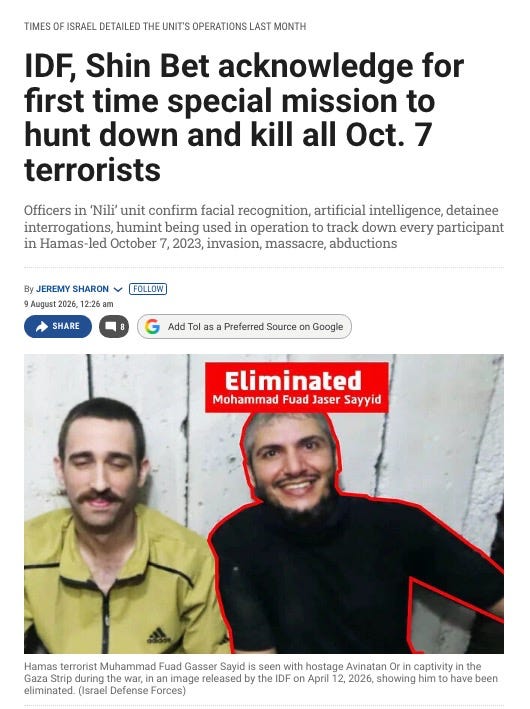
How does it work? Over nearly three years Nili has built a list of thousands of names. It uses facial recognition, AI, detainee interrogations and human intelligence. Ironically, much of the material comes from video that the attackers filmed of themselves. The list of course includes those who crossed the fence, but it also includes anyone who held or abused hostages.
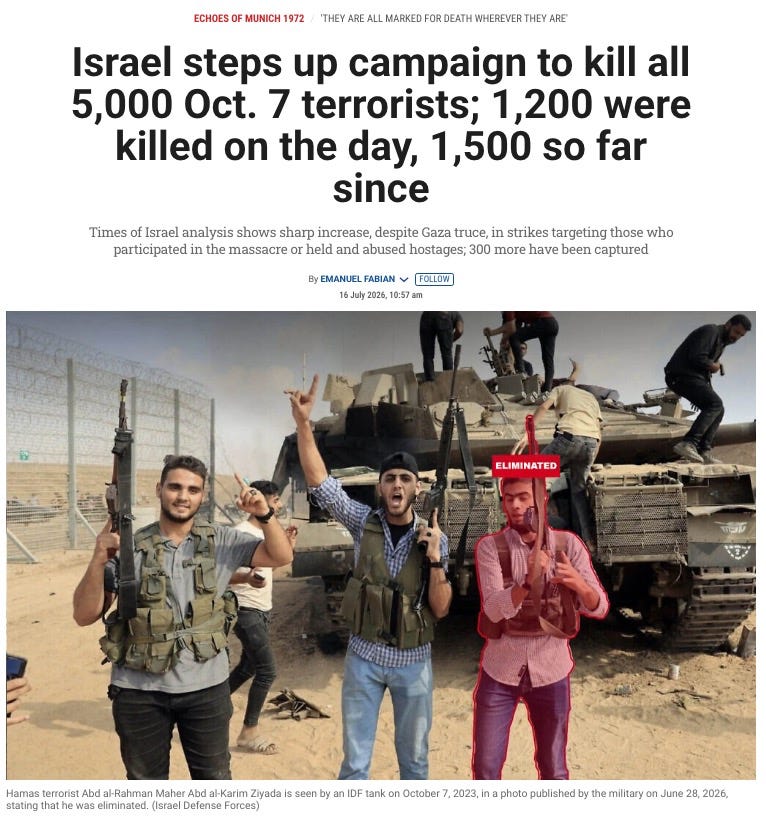
How is it going thus far? Channel 12 reported that about 2,800 people on the list have been killed, including roughly 1,200 terrorists whom Israel killed during the attack itself. Of an estimated 5,000 participants, more than 2,700 are confirmed dead, and about 300 more have been captured and await military trials.
Itamar Ben Gvir is calling for the execution of those Israel is holding. Morally, there’s virtually no one in Israel who does not agree that all these people deserve to die. But the sight of Israel hanging 300 people would obviously cause an international uproar, and might well unleash something very problematic in Israeli society. Despite Ben-Gvir, the smart bet is that we’re not going to execute them all.
Thus, roughly 2,200 of the terrorists remain alive and at large.
It’s worth noting that the Gaza “ceasefire” has not ended the campaign. After the ceasefire began in October 2025, an IDF official said Nili’s work would continue “until the last of [the terrorists is killed],” within the legal and operational framework. The Times of Israel reported in July that the effort had in fact been stepped up despite the truce.
Israel, of course, wants the terrorists to know that we’re after them. The knowledge that if they move they could die almost certainly makes them less effective in working for Hamas. And no one in Israel that I know (including those on the little that remains of the left, even the far left) will shed a single tear if these people live out their days in fear until Israel ends their lives.
All of this is the background for the video above, at the very beginning of this post, in which the IDF takes out the terrorist you see on the motorbike with Noa Argamani.
The reason that Israel releases these videos (we added the subtitles for our viewers) is so Israelis know that the project continues, and so that Palestinians also learn that no one is beyond Israel’s reach.
If one had to guess, the people on this list will be dying by the dozens for many years to come.


