It was around a Shabbat table a few weeks ago that today’s guest, Tamar Frank, and I got to talking. As we chatted, she shared her experiences in a program designed to build bridges between Israeli Arabs and Israeli Jews, as well as at a well-known American summer camp. She attended both programs hoping to foster connections across ethnic lines in Israel and across the ocean with Jews abroad.
What she discovered is that it was much harder—perhaps even impossible—than she had imagined.
As we gather at this season to formulate our hopes and prayers for the coming year, it is critical to recognize and better understand the challenges we face.
I’m grateful to Tamar for her willingness to share these stories, and I hope that when it comes time for her children’s generation to do the same, our world will be a much more tolerant place.

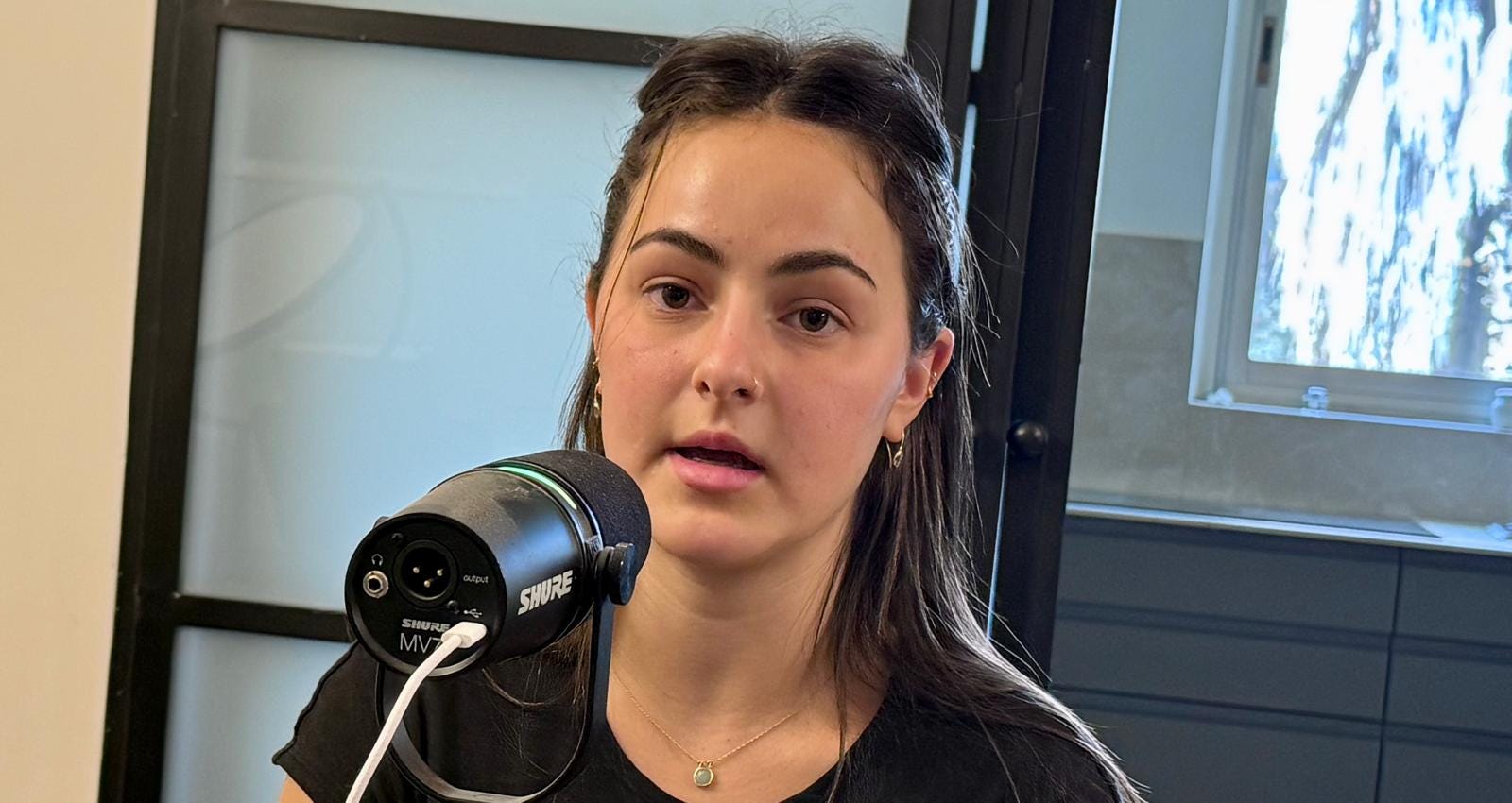
Tamar Frank was born and raised in Jerusalem. She is an alumna of the Derech Prat Leadership Institute and served as the Jerusalem Youth Organizer for the Lev Ehad volunteer organization, helping people in distress during the recent war with Iran. Tamar attended summer camp in the US as both a camper and a staff member. She is a recent high school graduate currently attending the pre-military academy Mechinat Ein Prat, and her family belongs to Kehilat Hakhel in the Baka neighborhood.

The link at the top of this posting will take free subscribers to an excerpted portion of today’s conversation.
For paid subscribers, the link at the top will take you to the full conversation; below, paid subscribers will also find a transcript for those who prefer to read, as always.

With Rosh Hashanah just days away, a quick note that we will be on a slightly reduced publication schedule through the upcoming holiday season. Weekly podcasts for paid subscribers will continue to appear on schedule, but our other regular content will be pared back as we turn our attention to preparing for and welcoming the New Year—which we pray will bring much better tidings to Israel, our region, and the world at large.

Every now and then, I try to think of ways of explaining to people how complex life is for Israelis of all ages. And there are parts of it that we, of course, all talk about. We talk about how complicated it is for the soldiers who are doing hundreds of days of reserve duty, how hard it is for their families, their spouses, their children, their businesses. We've talked about how hard it is for parents who watch their kids go off to the army and worry and worry some more. We've talked about all different kinds of things, but there are also, of course, parts of Israeli society that just don't make the press because they're just not the kind of thing that the press covers. And a few Shabbatot ago, a few Saturdays ago, we were sitting with friends who were over for Shabbat lunch, and they were at our place with their daughter, whose voice you will hear momentarily. Her name is Tamar Frank. And we were just talking. She's just graduated high school, going off to mechina. You'll hear about all that in a minute. And she shared with me 2 things that had happened in recent times, not immediately in the past, one more recent, one less recent, that struck me as being such an important window into how complex life is for Israelis in Israel when they're trying to have relationships with people who are not Jewish Israelis, and for Israelis when they go abroad who are trying to have relationships with people who maybe see the world differently and the kinds of responses that they get. And I just thought that it would be really wonderful for our listeners to be able to hear a whole side of what it means to grow up here and being a young person here, an adult here, in ways that you don't think about. So I asked Tamar if she'd be willing to have this conversation, and she very graciously agreed to. So, hi.
Hi.
How are you?
I'm good. How are you?
I'm good. I'm really glad that you're doing this. I think it's really important. Before we get going, why don't you just tell people who are listening whatever it is you want them to know about you? Like, you cannot talk about what you have done in the army yet because you did not do the army yet. So where you were raised, all that kind of stuff, whatever you want to tell people, and then we will jump in.
Okay. So hi, my name is Tamar. My parents, Adam and Lynn, met aliyah before I was born, got married here. I have 2 older siblings. We live in Jerusalem. I speak English at home. That is why I am able to have this conversation in English. I speak Hebrew with my friends. I finished high school. I'm religious. I'm going to a pre-army program, mechina.
Which one?
Ein Prat in Kibbutz Or Haner, which is on the border with Gaza. After that, I'll be hopefully drafting to the army. I'm planning on drafting to combat. Don't know where yet, but I have my hopes and dreams.
Okay. Right. We're going to talk about that combat thing a little bit more when we get towards the end. Well, I'm going to ask you this now. If we had had this conversation 3 years ago before October 7th, I mean, then you were obviously much younger. You were in the middle of high school. But let's say you had been 18 then. Would you have been— would you have been so determined to go to combat?
Not as much as I am now. Not at all.
You've got a brother who's done the Army in combat since then. Just finished. But something about the experience of the last almost 3 years has changed your desire of what you want to do in the Army?
Definitely. I mean, I want to be part of, of feeling safe here, and I want to give back to the people who were in combat, who gave us so much, and because of them we're able to be here. Obviously, the Army is amazing in every aspect and not just combat, but I feel like there's something that kind of draws me to that, especially with the hostages, feeling that I couldn't do anything. I couldn't get them back. My brother, who was in combat, felt the same, but at least he could physically try to do something. And I wanted to be part of that. I think before October 7th, I thought about it. Definitely was on my mind. I thought it was very cool, but people would have convinced me not to do it if there wasn't October 7th.
Okay, so we're not going to go into any details, but I will say that your family is very close with the families of one of the hostages in a story that did not end well, to put it very mildly. So I'm sure that that was also part of what influenced you, because it wasn't just like for many people out there, they read about the hostages, they saw the posters, they saw their images in the Ben Gurion Airport when they left or came home. For your family, this was very agonizing and very personal and very upfront. And I'm sure, you know, I have kids a little bit older than you, obviously, but raised kids your age. I'm sure that that experience had something to do with how your feelings have changed.
Definitely. No doubt.
So now we're going to talk about one thing that happened while you were in high school. Shortly after October 7th. And we're going to talk about one thing that happened really pretty much after you'd finished high school, relatively recently. So let's talk about the first one first. Let's give people a little bit of background. You're in an organization, in a program. You'll describe it however you want to describe it. Tell us a little bit that you want to tell us about what this program, organization, whatever you want to call it, did, what your role in it was, why you chose to participate in it. What you liked about it, what you didn't like about it, and then we'll come to October 7th and the aftermath.
All right. So I was in a program that brought Jewish and Arab kids from around Jerusalem together once every about 2 weeks to get to know each other, to play around, never very serious conversations. I was in this program because it was very important to my family, especially my father. He saw in it a lot of value bringing 2 different kinds of people who live in Jerusalem to come talk, to interact, which never really happens on a daily basis in Jerusalem the way it does in the program. And in the beginning, I did not like it very much. I was one of the only Jewish girls in the program. It was not very enjoyable to me. I enjoyed being with my friends a lot more. But with time, I started building relationships there and started enjoying it.
And who were these Arabs? What's their profile, the kids that were in it with you?
So the— there were Muslim Arabs, Christian, Armenian, all kinds of different Arabs. I learned a lot about that in the program, not from the program itself, but with just interacting with the kids, the ones who spoke English at least.
What grade were you when you started this?
If I'm not wrong, 7th or 8th grade. I was in the program for quite a while.
for like, what, 4 or 5 years, something like that? Okay, so you started in 7th or 8th grade and then you went through. Okay, so you did not like it that much, but then began to make friends. And let us say October 6th, if I had stopped you and asked you and said, how do you feel about it? What would you have said at that point?
I would have said that I am enjoying it. I am going to be a counselor this upcoming year. And soon, a week or two after October 7th, I was supposed to have my first team meeting.
Of counselors, I guess. And the program would have started after the holidays, I guess, or something like that.
Exactly. And I, I chose to do that at that point. That was the first time my father said that it's your decision if you want to be in the program or not.
Like, you've already paid your dues. You asked you to do the program. You went to the program. We're done. If you want to continue, it's your choice. If you don't want to continue, it's also okay. And you were planning to continue?
Yes. And I want to make it clear that the friends I had in the program, they weren't Jewish. They were Arab. And that was the first time I ever would say that I had Arab friends.
And how'd you feel about that?
At the time? Weird. It was— no, it was always weird because friends from home, when they found out I go to this program, they found it weird.
Friends from home meaning Jewish?
Jerusalem. Jerusalem kids from my school. I'm in a program that means like— a program that really changed my life was Derech Prat.
And explain what that is in a quick quick word or two?
Derech Prat is a program that is pretty much mechina for high schoolers. It is a lot of learning, it is a lot of volunteering, traveling, it is a lot of Zionism. It brings kids together from all over the country, both religious and non-religious, but all Jews.
Okay. And you liked that?
I loved it. I still do.
The content there is great, right?
Amazing.
Right. So the content of this other program that you did, which is the one between Jews meeting Arabs of Christian, Muslim, Armenian, whatever, There, the content wasn't so, as we say in Hebrew, miyodei amah, like, so-and-so, aye, aye, aye, which I guess is Yiddish or something like that. But you felt like there was value in it in terms of meeting these people and having them get to know you, I assume, and having you get to know them. Would you say that your relationship between, let's say, you and the Muslims was different than you and the Christians or you and the Armenians? I mean, if you had, like, if I could spy on you, so to speak, and get inside your head, did you feel differently about those different groups? And if you did, Why? And if you didn't, okay.
I definitely felt differently. I didn't know at first that there was a difference between them. With time, I realized that the kids I was friendliest with were Christians. They also were the ones who spoke English. The Muslims didn't speak much English. We had some kind of translator. We used our phones.
So you didn't speak Arabic and they didn't speak Hebrew. And there was like a little translation thing. I think it's important for our listeners to know, because people who don't live here might not know this. Israeli Christians are very, very, very well-educated. And there are Christian private schools in Jerusalem that are amazing. I mean, if you're thinking like, you know, American private schools, not yeshivot, but just, you know, Dalton, all that kind of stuff. These schools that are really, really first-rate. Christian Arabs in Israel have those kinds of schools, and they have those kinds of schools in the Galilee also, where there's a strong Christian population. And the education that young Muslim Arabs get is typically not as good. And there's a whole array of reasons for that. There's also a socioeconomic disparity. The Christians tend to be much better off economically, in large measure because they're better educated. But then because they're better educated, they get— and it's sort of a self-perpetuating cycle. So you felt more comfortable with them, first of all, because they spoke English. Were there other reasons that you felt more comfortable around them?
I think looking back, they looked more like me.
That's interesting.
They were more— they dressed like me, they talked like me, in English at least.
And in what way did the Arab girls and the Christian girls— I mean, the Muslim girls, I'm sorry, the Muslim girls— and the Muslim girls weren't wearing hijabs, were they?
There was one who did.
Okay, but most of them didn't?
No.
So if I were to, like, you know, do a lineup, you know, a police lineup, and half of them were Christian girls and half of them were Muslim girls, How are they dressed differently?
I think the Christian girls definitely dress more upper class.
I mean, the Muslim girls wore pants, right?
Yes. Yes, I think so. The Christian girls, I still see— I still follow them on Instagram, and they wear the best, like, brands that I don't have in my closet, and they go on the best vacations, and they post all this on social media. And the Muslim girls, I think they're from a— they're— they don't live that same life.
Okay, so you just had a natural, a greater natural affinity, whether it was culturally, socioeconomically, you know, even if it's clothes or music or whatever, with the Christian kids more than the Muslim kids.
There was one girl from the Muslim girls who I couldn't exactly interact with because we didn't speak the same language. But her brother translated between us and we would always—
He was on the program or he was a counselor?
He was on the program. He was younger than her, which was very interesting. Maybe males get better education. I don't know. But we would always smile to each other, and she was super, super sweet. She was the only girl wearing a hijab on the program, and we traded each other's Instagrams, and we became kind of like, like friends without really knowing each other.
Friendly, maybe.
Exactly, friendly. And we were actually— there was a picture of us hugging each other on like one of these programs that became the picture like when you look up the program on the internet, that is the picture you see.
Oh, wow. Because you became like literally poster children. I mean, so you and this Arab girl, she was wearing a hijab, you said, right? Okay, so that is perfect. I mean, you cannot get any better visual than that for what the program is trying to advertise. Okay, so it is all good. You are not bosom buddies because you cannot really speak the same language, but you have an affinity towards each other. You have learned how to kind of figure it out and you feel comfortable-ish with each other. And all good. Then you are supposed to become a counselor in this program, which is going to start right after the Jewish holidays. That's when all programs here start. Everything starts after the holidays. And obviously, before the end of the holidays comes October 7th, which is almost exactly 3 years ago from the time that we're having this conversation. I mean, it's just a couple of months shy of 3 years. And this young woman, who is the person that you're hugging in all of the PR photos for this program, something happens.
So on October 7th, we wake up from sirens very scared. It's weird to have sirens in Jerusalem. My brother gets called up. He doesn't leave until the following night, but it's very scary. We find out that a friend of ours who was just over the previous night is missing. He was at the Nova Festival, and we get very scared. I don't open up my phone yet, but because I'm religious, but I start hearing what's going on and I get very, very scared. And then Shabbat comes out. I open my phone, I see what's going on. I get really scared. I obviously, the night of October 7th, I had no idea how the world is going to accept. I don't even know what the word is, but how they're going to receive this information, what side they're going to be on. Sadly, that's the way it works. There are sides. And I didn't imagine that someone that lives so close to me, lives here in Jerusalem, who's Arab, but my friend, would see the situation so differently. Because I opened my phone, I entered Instagram, and she posted a story of her dancing with a friend on the street, and she wrote, finally, in Arabic.
Just to make sure everybody understands, like, an Instagram story is like a video. So, I mean, for people that are a certain age and above who are listening to this, they're not going to know that story on Instagram equals video. So there's this video. Was it a selfie or somebody else took it of her? Do you know?
She, like, put it on the ground.
Okay. She kind of set it up and then she was dancing and she put in Arabic, finally, meaning finally what? We got them? We killed them? You don't know, but something along those lines, I guess.
I don't want to know.
Okay, that's fair enough. I think that's actually probably wise. Okay. You're shocked, you're stunned, you're whatever. And of course, it's important for people to remember a couple of things. First of all, your world is imploding, right? I mean, my son also got called up that day. I did turn on my phone on Shabbat, even though normally, of course, we don't use our phones on Shabbat. I did, like after the 3rd or 4th siren. It was just ridiculous. And I didn't know what was going on. And I also didn't know if my son was going to get called up. So, and we heard rumors of people said there's people wounded on a kibbutz. I mean, how could that possibly be? I mean, kibbutzim are protected. I mean, we had no idea. And then you said, well, you know, after Shabbat you turned on your phone that you were scared. Well, people might say, well, okay, but you're in Jerusalem. I mean, it's sad, but why are you scared? People have to remember there's 1,000 terrorists inside Israel we haven't caught yet. And we're talking about a 40-minute car ride. I mean, it was not out of the question. My son called us, he lives in the Tel Aviv area, said, bolt your door. And I remember saying to him, Avi, it's an hour from here. And he said, no, Abba, it's 20 minutes from East Jerusalem. And you don't know where they're coming from next. Bolt your door and get a lock for your mamad and all of that. So, I mean, people should remember that even though we think of it now as the Gaza envelope, those of us in Jerusalem had no idea what was going to happen next, how it was going to play out. Okay. You read this, you see this video of her. How do you respond to it?
I responded, there is no way.
You wrote her that?
Yes. I was shocked.
In English you wrote her, or in Hebrew?
In English. Looking back—
Because you went back through your phone recently to look back and see what had happened, right?
Yes. Looking back, I would have responded in a different way. But I said, there is no way.
What did you mean by that?
There's— I, I meant there's no way that you're celebrating this in any way.
Like, I find that hard to believe.
Yes, I was absolutely shocked, and I wanted to believe that I missed something. It's her birthday, I don't know. But when she responded to my message with a laughy face, I understood that I just can't.
Right. Were you guys ever in touch again?
No.
So I just want to let that hang in the air for a minute. I mean, here is this program that you go on. The whole idea is to build relationships, to get to know each other a little bit. All of a sudden, she— I mean, you may not be her best friend, but she has this Jewish woman, i.e., you, who she knows and likes and has exchanged through her brother, the translator. You guys are friendly. And even when you call her on it, like, I can't believe that you would say that, she could have written back and said, I don't know. I mean, it's about the soldiers and not you. I mean, she could have said a gazillion different things, but she didn't. She just sent you a laughy face, and that's the end of that. What about you and the program?
So the following day, I called the head of the Jerusalem chapter, And we had a lot of—
Programs all over the country?
I have never heard of it anywhere else.
So why is there a Jerusalem chapter?
Because from what I understand, there are other chapters either around Israel or abroad.
Oh, okay.
I am not sure. So I call him. We have a very long conversation. Pretty much I explained to him what happened. And he said that this has happened before. in 2014 in Tzuk Eitan, a previous war, and where the certain population posts something that the other population disagrees with and it causes some kind of—
Friction.
Yeah, friction. It's a good word for it. And he pretty much said, Tamar, this is why we have so much programming around misinformation on social media. And not posting things that are wrong. And he said that when we get back to the program, they're going to talk more about that. But he never said that they will program about what happened on October 7th. He never said that what she did was wrong. It, it hurt me and it also annoyed me that the only solution to this is don't post things on social media. Because that's not the problem. The problem isn't that I saw it. The problem is she lives, I don't know, 20 minutes away from me and believes a totally different story and is told something totally different. We live 2 different lives that now, looking back, I don't know how we could have ever been friends when we believe— when it's so different, when the stories we're told are so different.
And do you have any friends from this program? I mean, among the Arab kids, Muslim, Christian, Armenian, do you have any friends that you're still in touch with?
No. There was one Christian boy who, after October 7th, would write to me a lot about my friend who was a hostage, saying that his family is praying for them, praying for my brother. I'm not in touch with him anymore. He posted on his Instagram something that disappointed me as well around a year and a half ago.
Okay, so I just want to ask you one additional question about this whole thing. These coexistence programs are really about the future, right? I mean, they want you to have friendships with people your age now because it makes the world a better place. But I think it's really about an investment in the future and the hopes that because you have a positive experience in this kind of a program, it'll ripple effect beyond you and beyond your generation into generations now. And I'm just curious, based on this whole experience, that you had pre-October 7th, post-October 7th, the conversation with the director and all of that, where does that leave you feeling about your level of optimism or lack of optimism about the capacity for young Jews and young Israeli Arabs or Palestinians? They're not really Israelis. Young Palestinians in East Jerusalem, wherever, to have a more meaningful future together?
So I'm glad you're asking me this question. After my experience in this program, my opinion definitely changed. It kind of destroyed my hope in making relationships with Muslims, Arabs in Israel in the future, sadly. It would break my parents' heart to hear that, even though they have— it would break my—
They might listen to this too. They probably will.
It would break my grandma's heart to hear this because every time I have a conversation with her— this past summer I was with her and I told her, Bubby, we can't have a two-state solution. I don't trust it. I don't believe it. And it's because of these connections and relationships I had in this program where these are the kids of people who want the peace. These are the people who are fighting for it, and we're so different, and we have such different narratives. And that's the exact reason why we can't live together, in my opinion. That's very political, but I wish I were to believe differently, and I wish I would have trust and have hope, but it's been destroyed.
So I just think, and I want to just sort of, I mean, we're going to move on to the next thing that happened, you know, a couple of years later. But it's the, it's sort of when you hit the dead end with these, what do you call these, the coexistence programs. My son was on one. He did one and had actually, he did a different one, but it had a very, very profound impact on him. And that's, I think I told you, it was a different program where they brought together Jewish and Palestinian kids from Israel. white and Black kids from South Africa and Protestant and Irish kids from Ireland. And he actually became very close friends to this very day. I mean, the South African Black kid who he became very friendly with flew to Israel for Avi's wedding, and Avi went to South Africa a couple of times. I mean, they're really still very friendly. I've met him. I may not have met his wife. I mean, they're friends of our family at this point. But interestingly enough, he became friendly with a Black kid from South Africa, not from any— not with any of the Palestinian kids. There's just something that— and he really wanted to. That was why he went on this program. He was very much, I think, where your dad wanted you to be. I mean, he's very similar to your dad in that regard. Or was, I would say, is a better way to put it. So we bump up and I think people talk with a tremendous amount of hope and optimism about these coexistence programs, which are very well-intentioned. But I thought your story was really important for people to understand that there are just some bridges that these programs are not going to be able to bridge.
And you end up without the friendships that you thought maybe you would have or developing, and you end up with really painful memories. I mean, this, you know, you came over with your family for Shabbat, and we are sitting in the living room, we are talking before we went to the table, and boom, this just comes out. And it means it is lodged somewhere in your heart. I mean, it sits there like a stone in your heart, and it came out. It came out, actually, because, uh, we started talking about your summer, right? Which is the second episode that we're going to talk about here. You were at a camp, which I guess we'll call a religious Zionist camp. American camp, religious Zionist camp. And you're going to be a counselor, I guess?
Yes, I was a counselor.
Okay. So you head off to the wild blue yonder, you get on a plane, you go to America, you show up at camp. And?
And—
So this is like this summer, this is like a few weeks ago, a couple months ago, right?
Yeah, I just got back. I just got back right before I had this conversation with you that same week. And my co-counselor and I were building some kind of program for our 10-year-olds.
Your co-counselor is an American?
An American girl from the Bay Area, my age. She's 18. She's very well-educated, a friend of mine who I've known for years. We were campers together at this camp.
Oh, I didn't realize that. You've known her for a long time?
Yeah, I've known her for a long time.
Okay. I didn't realize that. Okay.
I knew her before October 7th and after October 7th, and we were building a program for our campers with a couple other male counselors who were on the mishlachat with me.
That's the Israeli delegation to camp.
Yeah. And the guys are post-Army. And for them, it was really important to build this one program, which was kind of like— they wanted to call it IDF, IDF training. And they wanted to teach the kids the values of the army, like teamwork and working hard and pushing each other. Things that should be great for 10-year-olds to learn. And as we were having this conversation, everyone Israeli except for her, I see her kind of shutting down, getting sad, kind of squinting.
Panim chamutzot, as we say here, like a sour face. It does not really translate into English, but you can see that something is happening inside that she is uncomfortable.
And she also said she does not want to do it. And our— the woman who is in charge of our tzevet, our group, kind of overruled it, said that we are going to do this. And I think she did kind of shed a tear. And then she walked out and I saw her had a conversation with another American. And looking very disturbed. So later, after we put the kids to sleep, we were sitting on a couch and I brought it up and I said, hey, let's talk about what happened. You want to tell me why you were having a hard time, why you didn't want us to do the army program? And we started having this very long conversation about how she doesn't— she supports Israel's right to exist, but she doesn't support the IDF in any way.
Because we're going to exist very easily without the IDF. It's going to go really well.
Yeah. Doesn't make sense.
So what'd you say?
So obviously we had a very long conversation. She gave me a bunch of information that— asked her why, why give me a reason why you don't support the IDF. She said all kinds of things that were false statistics, stories, and I'm sure maybe some of the things she's heard are true and I maybe haven't heard them. But I offered to show her some of my sources, to teach her a bit. She brought up a number of innocent civilians in Gaza who were killed that I don't believe that number. And I asked her if I could show her the numbers I've seen. Or I also said that there's a guy on, at camp, an Israeli who's after the army, who had a really hard army service in Gaza, who has shared with me that he's happy to talk to the Americans about his, his experience because it really was difficult and can teach you a lot. And after I asked her if she'll listen to that, she said no. She said she doesn't want to see it. She doesn't want to hear it. That she doesn't want to change her opinion. That it's her summer and she doesn't want to think about that.
Okay. Not exactly a luxury that Israeli kids have of not thinking about it for a whole summer. Okay. Did you have a response to her?
I was upset.
Why?
I was upset that she's saying her opinion. She has a very strong opinion but isn't open to hearing something different. It's something that I would expect, honestly, from Americans who live in a different world than I do, that can choose and pick what they hear. I knew coming in that they're very different than me, but I hear all sides. I live in Jerusalem. I see my friends' social media in America, what they see. I see the things my friends here see.
And just like with this other program, the coexistence program, where you went to the director and told him or her that you were upset and why and all that, did you do the same thing here?
No.
Why not?
Because I didn't feel like it would do anything. I didn't think it would. I did offer someone on the staff that we do a night where the previous IDF combat soldiers can sit down and explain some of the things, some of the things they've experienced in the army, only for staff. You know, there are all kinds of staff nights. And they said that's a good idea. Never happened. It, it hurts me because That is the biggest problem with the Americans my age right now, the Jewish Americans. They see what they do on social media. They hear from their friends at school who are not necessarily Jewish, or are, things that are not necessarily true, and they believe it. They do not want to hear anything else.
Right. It is not as if coming across social media information that is not necessarily true. I mean, we all do that. I am sure there are things that I have read that I assumed were true that maybe were totally false. I mean, it happens, whatever. I try to be a smart reader, but You can, you can fall for stuff. But I think the part about not being interested in hearing anything that would contravene her narrative, right? She had a way that she saw the world. You guys have already interacted over it because there was this program you were working on and she's upset and you reached out to her and you offered to show her what you thought was an alternate way of looking at her, singular facts or whatever. And she doesn't— she just didn't want to do it. And then they said that they would have this program for the Israeli soldiers. I mean, you were not yet in the army. You're still not yet in the army, but the other ones had been. To do this program for other staff people, not the 10-year-olds, but for other staff people to talk about it. And it never happened.
Okay, so now you are back. You and I are having a little conversation in Israel. It is in Jerusalem. It is in my house, so it is exactly where we had that first conversation. You were about to go off to mechina, and then after that, you got a year of that, and then you got the army. I want to come back to the combat thing in just a second. But How does this— I have a sense of how the first program, the collapse of the coexistence program, leaves you feeling a bit about, you know, young Arab people your age. I'm curious about how this experience leaves you feeling about your American Jewish counterparts who are your age. I mean, we all know that they're not all the same and people come in different stripes and sizes and beliefs and attitudes and all of that. So, okay, we're all smart enough to know that you can't lump everybody together. But still, in your kishkes, when you get into bed at night and you put your head on your pillow before you fall asleep, if you are thinking about, okay, my American Jewish counterparts who are also 18, who are the kinds of people who would go to this kind of a camp and be a counselor, what is your instinct now about you and them, about you and them 30 years from now, your kids and their kids, when hopefully you all have kids? How do you feel about all of it?
Well, I do not think I will keep in touch with them.
You will not?
No. I actually left America with a bad feeling in general. This is kind of extreme, but I said, I do not have a reason to come to America except for visiting family. I am happy in Israel, and it is comfortable in Israel. And of course, that is easy to say, it is comfortable. But in America, I felt like the kids my age with me at camp, my cousins, I love them very much, my cousins, but they are just so unlike me. Our lives are very different. The things we experience are different. The things we hear are different. And it's complicated, maybe important, but it's complicated having these conversations over and over again and not feeling like it's even welcome or wanted. And forget about the conversations. It's also hard to be an 18-year-old trying to hang out with my friends were so different than me. They're about to go to college. I'm about to go to a pre-Army program. Very different. And then the Army. Again, very different. I could tell it's very— our differences are very clear. Our heads are in different places. When I was at camp in 2024, 2 years ago, as a camper, my friend was a hostage. My brother was in Gaza. And I don't know why I decided to come back, because I felt like everyone around me doesn't get me. None of my—
You mean why you decided to go back for yet another summer after the 2024 experience?
As a counselor, right? Because it feels so hard having a relationship with someone who's so different than you, doesn't understand you, doesn't necessarily want to hear you and to hear your truth. It's sad.
So in a certain kind of ironic way, you have a— tell me if I'm wrong. I mean, I could be totally wrong, but it almost sounds like there's this kind of parallel instinct now with regard to the Arab Jerusalemites that you tried to build a relationship with, but in the end it hit up against the rocks of reality, and your American Jewish counterparts at a religious Zionist camp that you were trying to have relationships with and friendships with and all of that, that also hit up against the rocks of reality. I mean, the reality of being an Israeli young woman, which you are, has kind of put— has made both of those relationships very complicated and very hard. Is that a fair— is that a fair read? Yes. And does it feel lonely to be an Israeli?
Not at all. Never.
Never. Why?
No matter where I am around the world, I believe that I'll never feel lonely as an Israeli because Israelis have so much love towards each other and such a sense of community that even if I am the only Israeli in some faraway country, I will not feel lonely because I know the minute I go back to Israel, everyone is here to love me. And same in this country, far away, that no Israeli is there with me. I know that everyone in Israel cares for me. I mean, I do not know everyone in Israel.
Of course.
But there is a sense that I cannot explain. I try to explain this to my American campers, my American friends. There's something I can't explain about being Israeli and your love to the people and the country.
Yeah. And I think that's also— there's a difference there too, because I'm not blaming them, by the way, but East Jerusalem Arabs don't love this country. I mean, I'm not sure that if I was an East Jerusalem Arab, I would love this country either. They live a complicated life, and I'm not judging them about that. And a lot of young Americans don't love their own country. Forget Israel. They don't even love their own country. I mean, here, when you have judicial reform protests, in favor and against, both sides are carrying Israeli flags. When you have protests in, let's say, Portland and Seattle, the people that are on the left, so to speak, who are protesting against the actions of the government or the police or whatever, are not carrying American flags. It's an anger at their country. Where here, there's a kind of an anger at other people about what this country should be because we all care about it. So this is a— it's sobering. I mean, it's really very sobering. And I think that a lot of our listeners who are in the States and who have hopes of building bridges, which I also have.
And people who listen to this regularly know that we bring in tons of people here. We are involved in all different kinds of work of bridge building, which I think is really critically important. But you were really very honest, and you were very real, and you were very, in a very good way, transparent when we had that conversation on Shabbat a few weeks ago. And it just struck me that this is a really important, really important thing for people who follow this and are thinking about this to understand how complicated a reality this is for young people your age. Let's just say one last word about the army. So you're heading off to Ein Prat, which is really one of the premier, most highly regarded, maybe the most highly regarded, but certainly among the handful of most highly regarded mechinoth in Israel. It's one of the earliest ones to be created also. And then you're going to go off and do combat or train combat soldiers. You have to see what they assign you to and what you get in. Any thought about what comes after the Army? You're allowed to say no.
So my thought about what's after the Army, after my 2 years and 8 months that I'd be required to do as a combat soldier, I would like to maybe, hopefully, if I enjoy it enough and find it meaningful enough, extend that service.
Make it a military career.
Yeah. I don't know if a career for the long, long term.
You could do ktsuna. You could become an officer for another couple of years.
Exactly. For a couple years, I'd love to. Not because I think I'll enjoy it so much. I don't think it's going to be so fun, but I think it'll be very meaningful and something I would enjoy doing because of the meaning.
I think that in that one sentence, not because it's enjoyable, because it's meaningful, and it just feels a sense of obligation to your country, it is really among your generation a very uniquely Israeli sentiment. I mean, I don't know what young Ukrainians feel. Maybe they feel something very similar, but I don't know a lot of young Ukrainians except for the ones that have moved to Israel, and they moved to Israel before the war. But there's something really very unique about your generation. I have to say, we're in a pre-election period, and I've been putting up a lot of stuff about elections of recent days. And it's sobering what might happen this election. And it's also hopeful, maybe, what might happen this election. What gives people like my generation, you know, sort of the old people, I'm even older than your parents, what gives us hope is people like you. What gives us hope is your generation, you and the people that are 5, 6, 7 years older than you who spend hundreds of days in Gaza. and went to America to go to a Jewish summer camp and wanted to talk to people about it, and the program did not happen. There is something about your generation's devotion to this place, which I think gives us tremendous, tremendous reason to hope for the future. And it takes courage to talk about what you talked about today. So I am really very, very grateful. And on behalf of everybody who is listening, who I know will also feel very grateful, wish you— when are you going to mechina? Very soon, right?
Next week.
Next week. So wish you a lot of success in mechina, and then with the drafting a year after that. And I will see you many times before then because I will say that you live in my neighborhood and very often I see you and your dad just taking walks outside. And I think it is the sweetest thing. Just, I mean, from when you were a much littler kid, but I still see you guys walk, just taking a walk. And I thought, wow, I wish my kids were young enough again to do that. My kids now have their own kids, so they don't have time to take walks with me anymore.
I mean, I see you with your grandkids.
That's true. You see me with my grandchildren. But anyway, it's really very sweet. And I'll see you a gazillion times before you go off to the Army. But thank you for your courage in talking about what you spoke about today. And bahatzlacha starting next week.
Thank you.