On this week of elections in Israel, much hangs in the balance, and some of our posts this week will address that. Hope do we maintain hope in an era in which so much militates against optimism? How do we explain why we continue to live here, when there are so many reasons (say some) not to? Are Israelis really leaving? How many, and why?
But we begin with concerns in the Israeli press about war with Iran … perhaps today? (I personally doubt it.) And other election process worries …
At present, our plan for this week is as follows:
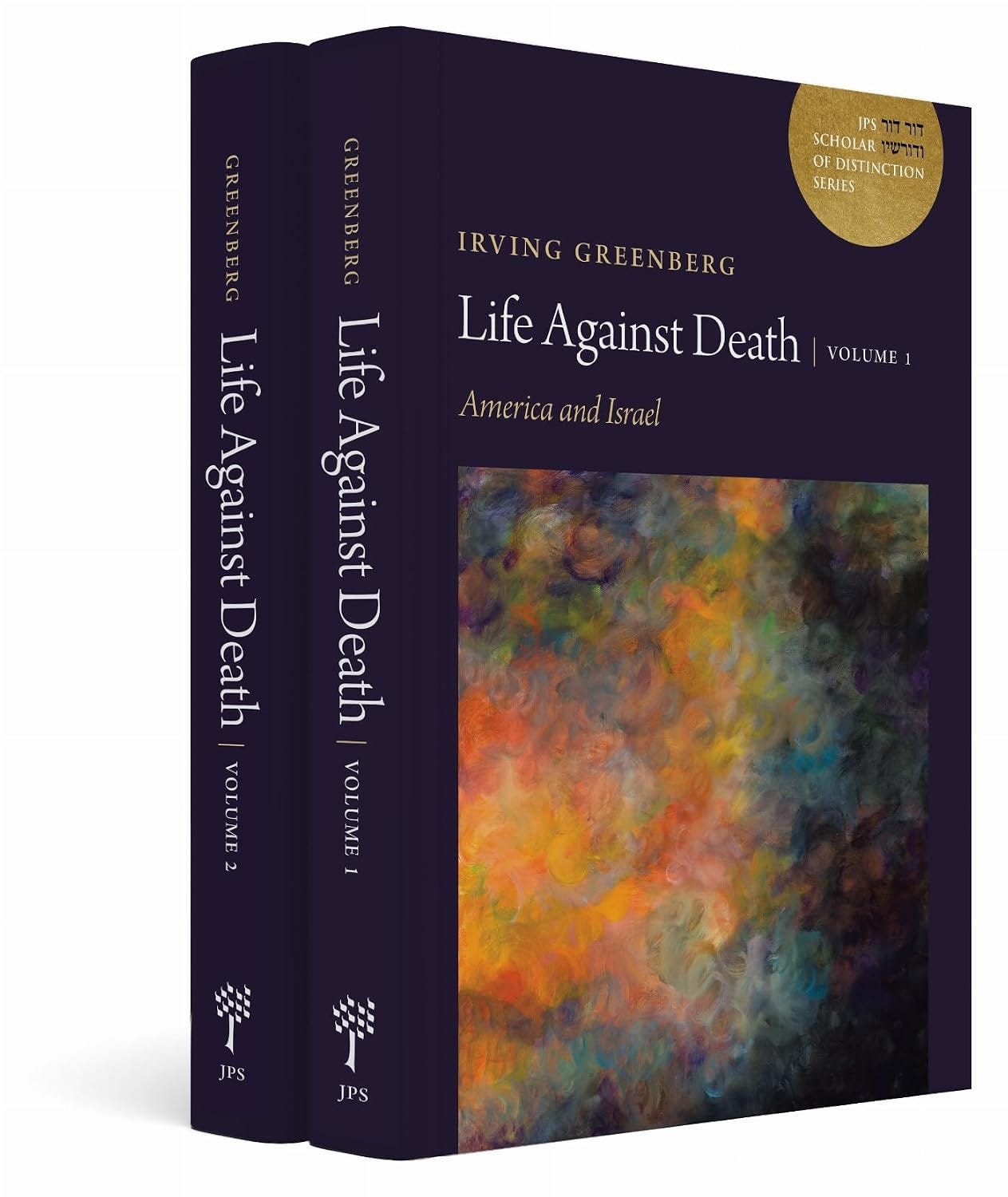
Today: Rabbi Yitz Greenberg on Life Against Death, his new two-volume anthology spanning a lifetime of thought and writing (University of Nebraska Press and JPS).
Tuesday, October 27: A recent appearance on the HonestReporting podcast, where I reflect on the diverging worlds of American and Israeli Jews.
Wednesday, October 28: David Grossman, Israel’s premier novelist, on why he continued and continues to choose Israel—even after the tragic death of his son who fell in battle while serving in the IDF.
Thursday, October 29: David Rosenberg answers the urgent question: Are Israelis actually leaving the country? He unpacks the data and looks toward the future.

Before we get to Rabbi Greenberg, some glimpses from the Israeli press regarding concerns about the voting process. Later this week, we’ll also share some of the arguments that were made in the right-leaning, sophisticated Hebrew press for voting for Netanyahu. They’re smart people writing those pieces. Whether one agrees or not, a lot of smart people are going to vote for Bibi, and it’s important to understand their worldview.

Netanyahu asking Trump for yet another public endorsement:
Yesterday, N12 reported that Netanyahu had asked Donald Trump for another public endorsement. Why the PM believes that would sway Israeli voters is unclear to me, but he is a much sharper reader of politics than I am. Is there not a concern that some voters might view this as an act of desperation? That is certainly the spin N12 (no fans of Bibi) put on it:
HEADLINE: American Source: Netanyahu Asked Trump for Yet Another Campaign Endorsement; President Issues New Post
SUB-HEADLINE: In the middle of the night, the US President posted another endorsement: “Vote Bibi. We have to finish the job.” According to the source, the White House views Netanyahu’s request as a “sign of desperation” and an indication that the PM believes he is losing.
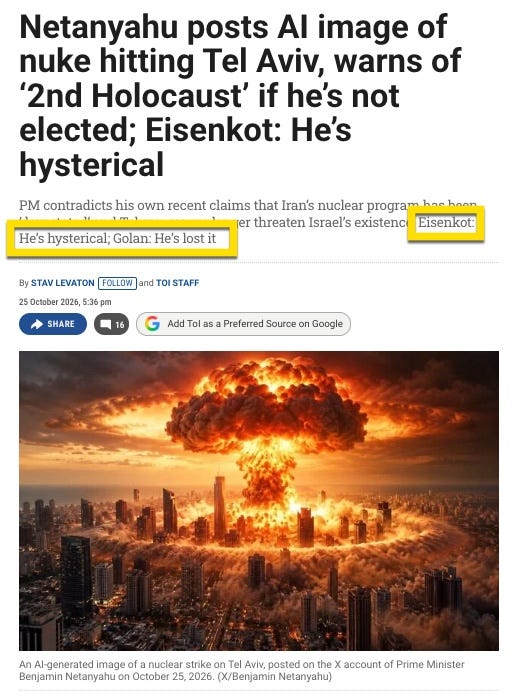
The on a new Netanyahu campaign image—a nuclear weapon exploding over Tel Aviv. As the TOI notes (see yellow), in response to the seemingly silly image, Eisenkot said of the PM “he’s hysterical,” while Golan said “He’s lost it.”
The Times of Israel reported on a new Netanyahu campaign image depicting a nuclear explosion over Tel Aviv. As ToI noted (highlighted in yellow), both Gadi Eisenkot and Yair Golan responded sharply to the seemingly absurd graphic, with Eisenkot calling the PM "hysterical" and Golan declaring, "He's lost it."
Numerous commentators pointed out that the image doesn’t square all that well with Netanyahu’s claim after the Iran War(s) that Israel had eradicated Iran’s nuclear threat.
What makes all of this not necessarily ominous (because we’re now less than 24 hours away from the opening of the polls) but (at least a few days ago) worrisome was the concern that Netanyahu was setting the stage for an attack on Iran before the polls opened (or during election day)?
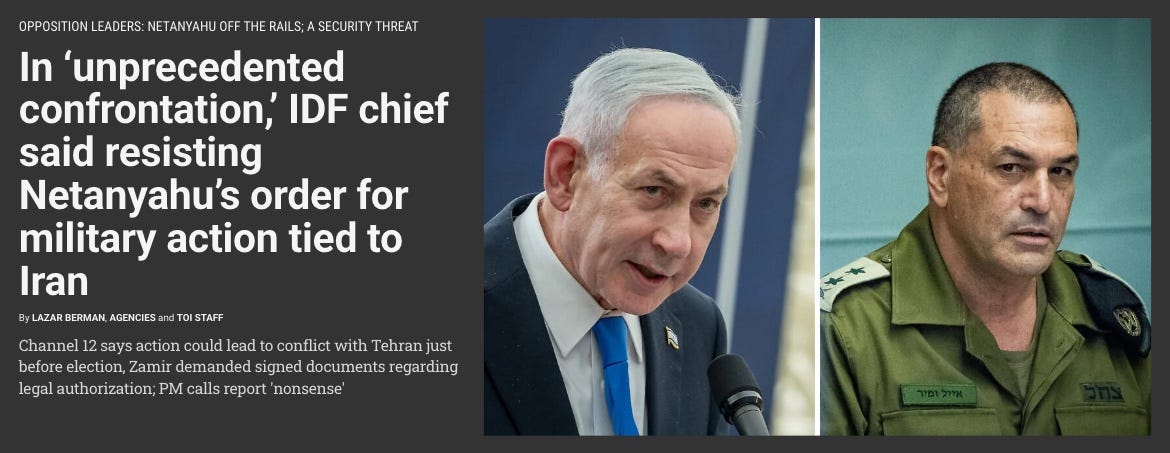
Some opposition leaders used the word “treason” in reaction to these reports from Channel 12. That word, of course, has potentially far-reaching legal implications, should anything actually happen.
What does all this say about the present coalition’s fears of losing? Or at least of not being able to form a government? Are worries about the transparency of the election process over-wrought?
One surely hopes so. We’ll know very soon.

I still remember precisely where I was sitting when I first read the work of Rabbi Yitz Greenberg—and how my mind buzzed with his paradigm of the “Three Great Eras in Jewish history.” Since then, over some forty years, I’ve had the privilege of reading his work extensively, learning from him in person, and now living just one neighborhood away from him here in Jerusalem.
On the occasion of the publication of Life Against Death (University of Nebraska Press and Jewish Publication Society)—his magisterial, two-volume collection spanning decades of landmark scholarship and leadership—we sat down in his home to discuss the central ideas of his life’s work.

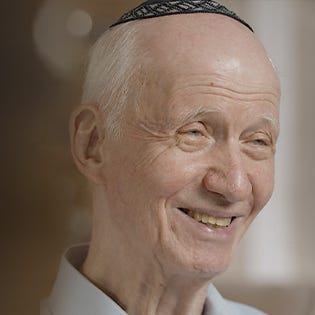
Rabbi Irving (Yitz) Greenberg serves as the President of the J.J. Greenberg Institute for the Advancement of Jewish Life (JJGI) and as Senior Scholar in Residence at Hadar. Rabbi Greenberg was ordained by Beth Joseph Rabbinical Seminary of Brooklyn, New York and has a PhD in history from Harvard University. He has had a long and notable career in the service of the Jewish people.
Together with Elie Wiesel, he founded CLAL: The National Jewish Center for Learning and Leadership and served as its president until 1997. From 1997 to 2008, he served as founding president of Jewish Life Network/Steinhardt Foundation which created such programs as birthright Israel and the Partnership for Excellence in Jewish Education.
Rabbi Greenberg was one of the activist and founders of the Student Struggle for Soviet Jewry in the movement to liberate Russian Jewry. He was a pioneer in the development of Holocaust education and commemoration. He is a leading Jewish thinker and has written extensively on post-Holocaust Jewish religious thought, Jewish-Christian relations, pluralism, and the ethics of Jewish power.
In his new 2 volume set, Life Against Death, Rabbi Greenberg curates, introduces, and reflects on the most important essays written over the course of his lifetime in the United States and Israel, from 1965 to 2025. These influential works recognized as classic in his oeuvre identify turning points in Jewish life, along with policies key to successful Jewish living in the modern world.

This week, a critical time in Israel’s history, we are making Rabbi Greenberg’s conversation about hope, as well as the transcript, available to everyone.

My guest today is someone who I have literally, truly, and I do not use this word lightly ever, revered for 30-something, 40-something years. I actually remember Yitz— we're talking with Rabbi Yitz Greenberg. I remember the first time I was sitting at the JTS library, and I came across a copy of what was then a pamphlet from Klal, I think, about the great epics of Jewish history. I still remember exactly where I was sitting, and I grabbed it off the shelf. I didn't know what it was, and I started to read it. And I knew that I had found, not in physical presence, but very much present in my life, a really important teacher.
And although I've been in Israel for a very long time, you've been in the States, you more recently met Aliyah, your work has continued to influence me and many hundreds and thousands of others as well. And just by way of letting you, of leading up to your telling us a little bit about your life, I'm sure most of our listeners know, but some of them may not. I was in Denver just a few weeks ago, We were awaiting the arrival of a grandson who, thank God, arrived and everybody's fine and it's all good. And I was talking with a friend who I knew from our Wexner days. He was a participant and you and I were on the faculty back then. And he was in Wexner, I think, in 1996 or '97. We had spoken for 5 minutes and he immediately launched into reiterating something that he had learned from you at Wexner 30 years ago. And it is not like he is a Jewish professional who, this is what he thinks about all the time. He is a very accomplished professional. It is not in the Jewish world at all. He is a super smart guy. But I have that happen so many times where I am just talking to somebody and then something that Yitz Greenberg says or said comes up in the conversation. And I will give you one other example. Because thank God we have a bunch of little grandchildren and they wear a bunch of little diapers. And every now and then, a baby gets diaper rash. It is not the end of the world. You take some schmutz, you smear it on them, and that is the end of that. But every time it happens, I remember exactly where I was sitting at an auditorium at Wexner, and your child was crying and you were trying to get some work done. I may misremember this, but if I do, correct me. Your child was crying, you were annoyed, you were trying to get some writing done or some reading done or whatever, and you got up to see what is wrong with the kid, took off his diaper, and he clearly had some diaper rash that was hurting him. And you realize that we live in a world in which you can just fix those things that are wrong. You have a cream, you have a this, you have a that, we can take care of it. And you would have been studying things about the Holocaust. And to imagine all these people who had— it just sort of brought home to you how chasrei onim, I do not even know how we say that in English, but— Chasrei onim. They had nothing. I mean, we know that they were packed into cars, but we just take for granted that if you cannot fall asleep because you have a headache, you pop some aspirin. Or if your baby has diaper rash, you put some schmear on them, and in the morning it is going to be okay. And your association of that simple human parenting moment, which we have all had as parents and as grandparents, and something so profound and horrifying as the Shoah, which you were deeply studying at that point in your life, the association between the two, literally, I cannot change a diaper with a kid, that has diaper rash, and that happens every now and then, without thinking of you and without thinking of that lecture, and literally getting goosebumps at how privileged we are just to have the schmear and to know that he'll be okay or she'll be okay. And so in so many ways that I could go on for, and I won't, you have shaped my life and my thinking and my wondering.
And we are now going to talk about 2 new books that have just come out, really a compendium in many ways of your life's work. You're really one of the most creative, theologians of American Judaism of the 20th and 21st century. There's no question. And it's a huge gift to the Jewish people that these books are out. So I am deeply grateful to you for taking the time right around the Chagim to invite me over to your home for us to sit and have this conversation. It's really a huge gift. Let's just get started. I would imagine that the vast majority of people who are listening to us know Rabbi Yitzchak Greenberg, have probably read things that you've written, and many, many, many have undoubtedly heard you speak or were taught by you in WEXTER and other programs, but some may not. So give us a little bit of a sense of the odyssey of your journey. You moved from kind of classic Orthodoxy to what I would guess I called kind of an Orthodox pluralism or pluralist Orthodoxy. You were very focused on the Shoah at one point in your life, which still obviously impacts you greatly. You've done a lot of thinking about epics in Jewish history. So give us, you know, I mean, you could go on for hours, obviously, and it would be fascinating, but just give us a kind of a brief sense of who Yitzchak Greenberg is from the time that he entered the rabbinate until this beautiful summery day in Jerusalem.
Well, thank you. First of all, I'm going to take a moment and go back to the story you told about diaper rash. My life, like the life, of course, I believe, of the whole Jewish people and of the whole world, was fundamentally challenged and transformed by exposure to the Shoah, which in my case happened in 1961. I was already 28 years old. I was in a PhD and a professor of history. I'm a Bal tchuva. I was an American. I was a child of an American immigrant family. My parents' greatest dream— my parents were observant Jews. My father's greatest dream was his Yitzhak, they never called me anything other than Yitzhak, would become Irving. That is to say, an American, all-American. And I was an American intellectual historian when I stumbled into the Shoah. I tell that story because when I stumbled into it in 1961, we had our first child. And it was an overwhelming and devastating experience. And it still is to some extent. It shattered all my— I was a happy, fulfilled, observant Orthodox rabbi. And thought this is the greatest value of life. And suddenly, you know, I couldn't get my head around it.
I couldn't accept why didn't God stop the Shoah? Why didn't God save the Jews? It was, you know, there were days of total despair and total shock. And yes, and one of the implications of living through that period, I say to this day, it saved me because I spent I had come as an American intellectual historian, but I ended up in that year of '61 spending 90% of my time at Yad Vashem reading day after day. And it was devastating. It was freezing cold in Yad Vashem. They didn't have a good budget in those days. But it was the chill in your body and your soul was 10 times worse. And the scenes of death and torture and suffering were impossible. And yes, it changed every way and every experience. But only thing that kept me alive and kept me sane, and really I would say maybe kept me remain some level of belief, was my family, my wife, living in Jerusalem. I would spend all day reading about death and cruelty and the evil totally triumphant. And then I'd come in the streets in the afternoon coming home and there was As Yirmiahu said, it was the sound of joy, the sound of weddings in the streets of Jerusalem.
It was like a bipolar, unbelievable experience. But then I'd come home and again, Moshe, a little love, was our first child and our little baby was crawling. And yes, I had that little experience and that experience reminded me again, I take for granted, what is it like being locked in a cattle car for 3 days? And you can't move. And the child has this rash only for 3 days. He can't do it. And the child cries. Anyway, the bottom line from my point of view is that every Jew should understand that they are a survivor, just as we were slaves in Egypt. We are survivors of the Shoah. And at the least, they owe an extra measure of compassion and an extra measure of kindness and concern for every Jewish child, every Jewish person. Really, feel for every person in the world in general, that response. And yes, that means, among other reasons, greater patience with a child and greater appreciation of all their needs and so on. So that's what— I'm glad you remember that because from my point of view, I feel in many ways the main purpose or the main— if there's any accomplishment, I'm not sure what the word is— of my life is that I realized then the combination of Shoah and Israel, that I was living in one of the great transformational ages of the Jewish people.
And it changes everything, I believe. The way I put it sometimes is the Exodus the redemption of Israel, of the people of Israel, shapes the whole Bible. The destruction and the exile shapes the whole Talmud. So we're living in an age where both these events, an event greater redemption than Exodus, Israel is a greater redemption than Exodus, and destruction, the Shoah, greater than the Churban Sheini, happened together. So I keep saying, what's going to come out of this? It should be greater than the Bible and the Talmud. Well, put another way, that to me is the message that I've tried to get, which I haven't necessarily succeeded. And I take that back because the bottom line is the Jewish people responded to the Shoah not by collapsing or not by dying. You know, when Eichmann first went into hiding, we— he is reported he was with Wisliceny, his co-murderer, his co-organizer of the destruction of Soviet Hungarian Jewry. So Wisliceny said to him, you know, if they catch us, they'll put us to death. We did this terrible crime. He said, I will, if they catch me, I will leap into my grave laughing. Why? He said, I didn't kill every last Jew, which was my goal, but I've done such a death blow they'll never recover. So he felt he had succeeded. And the truth is he had succeeded. But now it's Israel. It's the rebirth of the Jewish people. It's the renewal of Jewish life in Israel. It's the choice of life in Israel that in effect made him into a liar.
And so I'm arguing that we're living through an age In which, A, the level of ethics and human responsibility should be higher than ever before. I came to the conclusion the only way you can explain this other than saying there is no God, which is what many people tried to say, or what's worth more offensive to me, that the Shoah is God's punishment, like it says in the Torah, if we don't listen to God, we'll be suffering. I reject both those alternatives. So the only thing that made sense to me was that in fact the Jewish people is living through an age of maturation in the, in the Brit. That I believe that looking back, that God, yes, in, in the first stage as a parent rewarded and punished. If you listen to God, it rains. If you don't listen to God, it doesn't rain. But I think Chazal, the rabbis, already grasped that by their time God had self-limited Because he wanted humans to become more responsible in the brit. And therefore the rabbis said, we don't get a mitzvah reward in this world, but in the world to come. But that was their way of saying that we are more responsible. And the destruction of the Second Temple, they argued, was not— was because even though they revolted for God, unlike in the first 2 times, but it was because they were reckless, because the human behavior was irresponsible when the whole point that God was asking was to become more responsible.
So what does it mean? It means, for example, they revolted against Rome, the strongest army in the world, when they should have negotiated a deal as Yochanan ben Zakkai eventually did. It shows that they were, they fought like lions, but they ended up with a civil war fighting each other. And so the human misbehavior and bad judgment led to the destruction. In other words, we're living in a world in which we are partners in the brit and partners in trying to make this world into a Garden of Eden, which is the great Jewish teaching.But having said that, this is the transformation that God has asked humans to take full responsibility. I believe just as the rabbis taught us that God said take more responsibility. So there's no more visible miracles. There's no more prophets telling you what to do. The shifts, Torah Sheval Pet, to the oral tradition, which humans figure out what God wants, and God wants it that way. Now, I believe we're living in a 3rd stage in which God has said, I want you to take full responsibility. The rabbis said that God is hidden in their lifetime compared to the Bible. But you know what? Not because God is withdrawn and remote, God is coming closer. God has dialed down the voltage to be more hidden, to come closer. Now we're living in an age where God is totally hidden, but that means God is closest than ever. And I believe it means what God in the Shoah was suffering and sharing in the ghettos and the concentration camps and the gas chambers, but has asked us to take full responsibility. And that's the heroic age of the Jewish people, when we are taking full responsibility.
Okay. I mean, there's a lot of your lifetime Torah wrapped up just in there. It's amazing. You talk a little bit about the epochs of Jewish history and God's closeness and God's hiddenness and all of that. I'll just say that there are these 2 volumes that have come out recently from the University of Nebraska Press called Life Against Death. And it's a kind of a compilation, but also a significant reworking, it's clear, of decades and decades and decades of work. And really, it covers in volume 1, basically a section on America, the whole American experience, and you started speaking about the Irving days as opposed to the Yitz days in America. Then there's a part which I want to come back to in great detail, which is about Israel, because that's what's really our focus here. Then there's a part on the Holocaust, which you've already spoken about a bit in our conversation today, and there's a part about Jewish-Christian relations. I think you are very unique in the Orthodox world, certainly in the Orthodox world of the 1970s, '80s, '90s in America, of being what I would call a pluralist Orthodox Jew, not in the least bit apologetic or uncertain about your Orthodox commitments, but very embracing of, acknowledging of, you know, I mean, just accepting of the non-Orthodox movements in American Jewish life.
You didn't necessarily agree with them, but you engaged with them, you taught them, you learned from them. And you used to speak about, you know, you should speak more about what embarrasses you about your own movement, I remember you used to say, than what you disagreed about other movements. There's a tremendous amount here that we could talk about. Forever. But I want to focus on Israel, because that's really the piece of— well, that's what Israel from the Inside focuses on. That's the piece of these 2 volumes, which are extraordinary volumes. And they are significant. One's like 250 pages, one's 300-something pages. I mean, these are serious works. I want to talk about Israel and its theological implications. Because you said just a couple of minutes ago that we're living in this era in which God is totally hidden. But God is then closer than ever. And let me put it to you this way. I want to be able to believe that. But on one hand, I completely resonate to what you say. I can look at the news in the middle of the afternoon and become just completely devastated. And then I walk outside the house, and in all the playgrounds, it's teeming with Jewish kids, running around speaking in the language of the Bible. By the way, there's no parents there. And if a kid does fall down, some other parent picks them up and asks them what's the matter, where they are, whatever. I know that when I visit my grandchildren in America and another kid falls, I never touch another kid. I never go near them because it's just such a different set of social assumptions, and I don't want to get interviewed by the police. So I don't— you know, I'm sorry you're crying, but I'm— No, really. I mean, I feel terrible about it, but I don't touch anybody else's kid. So I go out to the playgrounds here and I see this city teeming with kids, and I see the life and the pulsing, and you look at what's going on in all of the cultural institutions of this city. So the news is one very sobering, and then you go, as you said, you go out to the streets of Yerushalayim and it's life reborn. But I don't want to let either of us off the hook that easily. And here's what I want to ask you to speak about today, which is really somewhat not really directly in the book because it's but it is related to things that are in the book, obviously.
I will put it very bluntly. Traditional Jewish religiosity in Israel is increasingly becoming ugly. It is just ugly. There is you, and there is Rabbi Benny Lau, and there is Rabbi David Stav, and there are hundreds. There are hundreds of great rabbeim who really represent something very open, something very embracing, something very loving. But there are thousands— Who don't. And those people tend to attract more talmidim. They tend to attract more lifelong devoted students than what I would call the enlightened religious minds like you and Rabbi Lau and Rabbi Stav. And I could go on. Rabbi Bigman. I mean, it's endless. Rabbi Lichtenstein. I mean, you could keep going on and on and on. I want to know, I want you to explain to our listeners 2 things. writ large, how do you see the religious significance of the rebirth of Jewish sovereignty in the Land of Israel? I mean, other important Orthodox thinkers, I mean, he was really— I think you can call him Orthodox thinker, Yeshayahu Leibowitz. I mean, very Orthodox, very Israeli, very whatever, said it's exactly zero. It has the same theological import that the creation of South Sudan has. A bunch of people wanted sovereignty, they created a government, they had a little battle here and there, And I wish them well, but it has nothing to do with God.
And he was very worried about what I would call, I guess, religiousifying, not a word, obviously, but giving religious significance to Israel, because he thought it would lead us in very bad places. If he were alive today, I think he would point to some of those yeshivot that you and I are both thinking about, and he would say, I told you. I told you. The minute you make Israel into a theological category, you become certain, you become filled with hubris, you diminish your caring about people who are undoubtedly Israel's enemies, that they are, there's no question about that, and you get what you get. And he would have said, if nobody had— people had listened to me back in the day, then we would be in a different place. So I have 2 questions. My first question is, leaving aside the events of the current moment, which we'll come back to, speak to our listeners now about Rabbi Yitz Greenberg's take on the religious significance of the State of Israel. Does the rebirth of Jewish sovereignty in the Land of Israel have theological and religious significance? And if so, what is it?
Well, it's a fair question. And I, I'll start again by saying that everything I say is reflective and part of the impact of the Holocaust. The bottom line is that Israel is the statement of life. Instead of collapsing, instead of giving up, instead of running away from being Jewish, the Jewish people concluded the opposite. To respond to death. And that's the theme of the 2 books, Life Against Death, to respond to the greatest assault of death in our history, to the greatest degradation of the value of life, of Jewish life in history, by not by collapsing and giving up or saying I was wrong, but rather reaffirmation and a reconstruction. And the main way, key to that, that's the first state of religious significance. The Jewish people decided to listen to God, in my judgment, and take power. That, I think, is the message of the Divine, not just to Jews, it's to the whole world. In my judgment, looking back, that was the message of the modern culture.
So let me just say it again, because I want to make sure everybody gets it. So you're saying that the Jewish decision, I guess beginning with the early Zionists, but the Jewish decision to take power into their own hands, is following God's message.
This is what God wants from us. In other words—
God wanted us to have power.
Correct. In other words, and again, I say, we grew up. In other words, there was a whole period when the purpose of the covenant was to help us live through powerlessness. And we developed a great ideal value system, and we developed this, wait for the Moshe, don't give in. But I think that is the point in the development of the relationship to God in the second stage, and now in the third stage in particular. God is asking humans to take responsibility for this world, for making the world the Garden of Eden that we were promised in our religion, the messianism, in other words. So the religious significance of Israel is that the Jewish people, unfortunately, Didn't get this message in 1800, 1900. The sad truth is the vast majority of Orthodox Jews, observant Jews, were anti-Zionist and said you have to wait for the Messiah. Rabbi Soloveitchik's greatness in embracing Zionism was because his family was the leader or among the greatest leaders of the anti-Zionist camp. It took him a lot of courage to say what he said.
Mostly in that essay called Kol Dodi Dofek. which I guess came out in the '50s?
'56.
'56, okay, yeah.
And again, it's his understanding. But I think that, and by the way, in that essay too, he insided that he's responding to the Shoah too. But in any event, to come back to the main point, taking power, I believe, was God's message to the whole world. And in fact, the truth is that where humans took power, mostly it's been overwhelmingly a positive thing. There's been a tremendous upgrading of the quality of life, the quantity of life, of the human dignity, the spread of equality, spread of democracy. There were many good things that came out of modernity. And I believe that this was a response to a divine call to humans to become the managing partner, if you want, of this covenant. The trouble is, the tragedy is twofold. One is that because for many people, humans took responsible, but didn't get the connection to covenant and to God. It became for many people uncontrolled power. And uncontrolled power, we know a famous line, power corrupts. Absolute power corrupts absolutely. Now, I once wrote, that is true, but for the Jewish people, absolute powerlessness corrupts even more. We don't have that choice anymore. So the Jewish people was in part prudential responding to history, but in part responding, I believe, belatedly to God's request, take power to make my world a better world, to realize my dream in the Torah, the Messianic dream of overcoming the enemies of life, of turning the earth into a paradise for everybody. The Jewish Messianic vision in its fullest is for everybody, not just for the Jewish people. So that's the good news.
The religious significance of Israel. So I would say quick, just checkbox, 4 major points. The first is taking power, sovereignty, which again, the prophets said would be one of the measures you'd know that Israel is the God in the world and the Jewish people and that Torah is alive. I would say beyond that, the second is the restoration of the value and dignity of Jewish life. In other words, during World War II, in the worst time, being a Jew was likely— made it less likely to be saved, to be given asylum. We have— Israel has a guaranteed safety haven and automatic citizenship to every Jew or anybody who is even connected to Jews who's persecuted. Right. restoring the value. And, you know, it's a miracle, but you see it now, like in Ukraine.
Right, of course.
If you're Jewish, you get a better deal. You get more concern, more protection. So that's an amazing second step of Israel recreating and restoring the value of Jewish life, which was brought down to zero, next to zero, in the Nazi killing. The third dimension is no less important. I call it the Messianic dimension. Kibbutz Galuyot, the return from exile from all over the world to this land.
The ingathering of the exiles from the 4 corners of the earth.
It also is a confirmation. The prophet said that Kibbutz Galuyot is the start of a process which culminates in the Jewish vision of making the whole world a paradise. So this restoration, this Kibbutz Galuyot, is a signal to us that we're on the right track, that the Covenant is not just something that happened 2,000 years ago, But it's a journey toward repairing the whole world and not just the Jewish world. And that this is a big step. Or another version of this idea would be that they're creating a model society in which this kibbutz Galuyot is going to take place. And that brings me to the 4th dimension of Israel's religious significance. It's the secular. It's the realm of the day-to-day. In other words, the kedusha, the holiness became Shabbat, the refuge, the synagogue, the refuge from the outside world, which was so terrible and which persecuted Jews and mistreated Jews. What Israel means is that building the day-to-day, building the society, business, agriculture, culture, that this is now the major activity of the Jewish people. And therefore it is— this is my thinker of the 3rd stage of Jewish history. That the secular is the place where the holy, or as Rav Kook put it, chadash veyitkadesh the new life, the new development, is a chance to sanctify all of life.
So holiness is not just one day a week on Shabbat, it's 6 days a week of building a society. Now when you make a holy society, it means that you should pay your workers fair wages, you should not cheat, you should not— You should not steal. Pollute and destroy the world. That was one of the problems of modernity. They took power, but they, many of them had no God and no covenantal sense. So they could then take the power and abuse it and use it completely as masters of the universe to pollute and destroy the environment, or in the case of Hitler or Mao Zedong, to overrule and abuse people. So this is a major Jewish statement here, that I believe that we're stating that we are taking power, but we're taking power to create a better daily life, to make holy, that is to say, the value of life and the priority of life in every aspect of life. The Jewish religion promises that we'll overcome poverty and hunger and oppression, inequality. The Messiah says we'll judge The poor equally. So this is what Israel represents, at least in my judgment, the potential.
Okay, but that is the thing, the quintessential potential. I want to put it very directly, very starkly, perhaps for some of our listeners, too starkly and too unfairly. But look, I am pushing back here out of tremendous regard and reverence, as I am sure you know, for you. This is the most right-wing government Israel's ever had. This is the most religious government that Israel's ever had. And this is the most fascist government that Israel's ever had. Not everybody in the government's fascist, but there are elements. The things that get said by Ben-Gvir and Smotrich and the rabbis who associate with them are unadulterated USDA Choice, pure racist and incitement to violence. And we are living in an era now, and here I want to come back to the secular also, because this actually troubles me greatly, and I don't know how to explain it. What's happening on the West Bank is a scourge. And most people who were very hesitant to say it upfront have begun now to say in no uncertain terms that it's terrorism. So I'll give you an example from the Christian world, Mike Huckabee, who was about as good a friend of Israel as the Jewish people's ever going to find, and Michael Oren, who's about as devoted to the state of Israel. And by the way, also Bret Stephens. I mean, those are 3 very different people, but all of whom have now started to use the word terrorism about what's going on with Jews in the West Bank or Judea and Samaria. They didn't want to at the beginning, but they got to a point they had no choice.
Now, look, when we had judicial reform, it was a very big threat. I was very worried about it. I was not opposed to judicial reform at all, just the way that it was being shoved down the people's throats. And I was at that protest every single Saturday night for a very long time when it was anti- judicial reform, I was totally comfortable. When it was anti the Netanyahu government, which I'm no fan of, I was less comfortable because I felt that the protests should be apolitical. They should be about that one issue. But we now have an abomination transpiring on the West Bank, an abomination, a desecration of God's name in every single way. The number of rabbis in this country who've come out about it, against it, is very, very small. And people, the hundreds of thousands of people who got together in Tel Aviv and in Jerusalem and in Beersheba and in Haifa every Saturday night, there are no protests. So I want to hear from Rabbi Yitz Greenberg, who very often is the balm for my soul. Really, I say that seriously. Tell me why this does not get you to say, the train went off the tracks and we are no longer bringing God's vision for what the world should be and for what Yiddishkeit, for what Judaism should be, to fruition. We failed. So the long, shocking recent years for me have been in that way too. In other words, first of all, I always thought of Israel as a Jewish and democratic state. That's what the majority said they wanted. But in fact, I rediscovered in the last few years that democracy itself can be taken over and abused. And you have—
Look at Hungary, look at Poland.
You have the Haredim who are anti-democratic and are prepared to destroy the judicial review so they can have a selfish exemption from the draft and they can get privileges religiously while denying that to other people and so on. We have then Ben-Gvir, who's a racist Kahanist. In fact, this is my sadness. Kahana is another example of responding to Shoah, only he responded not as I believe one should as a Jew, increased compassion, increased responsibility, care for other people because you were abandoned, you realized how evil it became, not abandon others. Kahane's answer was the opposite. The Shoah means anything Jews do is okay. We look out for ourselves and we can violate, we can abuse, we can destroy Gentiles, et cetera.
There were actually 2 periods in Kahane's life. There was the Kahane American period and there was the Kahane Israeli period. And I think the Kahane Israeli period was much uglier and much more fascist and much more racist. He had seeds of it earlier.
Seeds of it earlier. And also, again, he's not our topic today. It was implicit in the beginning. And I think that is, in fact, the crucial question, the justification of the Shoah. Two Jewish students protesting Russian Jewry planted a bomb in Sol Hurok's office, who imported the Russian ballet. It went off and it killed the secretary. Many years later, one of those students was a student in my class in City College. We had a conversation and he says to me, the truth is, he said, yes, of course Kahane encouraged them and told them what to do. At the time they didn't say it and the FBI investigated. It's one of the reasons we left America. But be that as it may, my point is what I said to Meir, we were friends, we were, until he went to the dark side and finally broke the friendship, but we were friends. I said to him, when you kill innocent secretaries, you're not fighting the Shoah, you're continuing the Shoah. And this is the tragedy of the Ben-Gvir types, that the racism and the hostility and the degradation, even toward terrorists, just to look to make their life miserable.
It's a form of— It's a form of hatred and anger justified, I would, here I would invoke Rabbi Israel Salanter. You can be religious, but you can divert it by ego and by self, by wrong motives into the worst kinds of things. Salanter says at one point, you can be a tzaddik and a talmid chacham, and at the same moment you can be a murderer and an atheist. Because people have ability to misuse, and this is one of my tragedies. that the modern Orthodox community, or the Orthodox community, I should say, has not, for the most part, embraced a loving and warm and ethically responsible higher level of ethics. It has become more and more dominated by either Haredi or by Haredal. Now, again, how did that— why did that happen? So one answer, to be honest, is the government endowment, the government investment. The Haredim yeshivot, for example, there are thousands of students there. The government literally has given billions every year. Haredim would have never gotten this far.
But it's not the Haredim I'm worried about yet.
No, but I start with that. But their influence, because it's a kind of a legalism which doesn't take the ethical or the ben ol lechavero with the level. It doesn't understand that God wants not just behavior, but a character, responsibility, human responsibility and love. So that attitude has become so powerful. It has more influence on the religious Zionists than it ever should have had. So I'm saying that's one major factor. And again—
The Haredim are not the ones attacking Arabs.
Keep in mind, you asked Benny Lau, but the answer is That the racist extremist version gets billions of dollars every year underwritten from the Israeli government, whereas the moderate responsible gets next to nothing.
Okay, but the Israeli electorate has allowed that. And let me ask you this, if we were to have this conversation on October 28th and it became clear that we had reelected this government.
What I learned the hard way is that democracy is not a guarantee either, just like modernity is not a guarantee. You take some of the best values and you push them far enough and they become evil. And there's no question, and this is my concern, that the Ben-Gvir's and the Smotrich's and the Haredim have used democracy to get money, to get support for anti-democratic, anti-human racist behavior. And I have to admit that there are more rabbis in that camp than there are in the moderate or responsible camp. So the answer to what do you do?
Right, well, how do we change that?
No, so my answer is, so part of my answer, which, and this is one of my failures maybe, we should have long ago organized a major investment in modern and responsible and ethical Orthodoxy. It doesn't have to be dollar for dollar, but even at 1/2 or 1/3, it would be a major and a better competitor. That's one factor. The second factor, I have to say, and you raised it and it's true, given the cultural setting, young people particularly, and in the yeshiva, they're at the peak of their youth and idealism, and they're at the peak of being susceptible to the influence of the rabbis who are the extremists. And so, yes, they have developed maybe more young people following them. And so you have in Jerusalem, you know, yeshiva boys who spit on nuns and knock them down as part of their frumkeit. So, but Rav Israel Solanter developed the whole mussar movement on this basis. He said that if you don't have self-correction, if you don't have psychological and sociological interpretation that warn, that direct you away, from these self-centered and abusive forms of applying religion, that in the name of religion you can do anything. He said, he has this line, a man is running to catch kedusha and runs and tramples on people along the way. So that's what we're seeing right now. And of course, the apotheosis of this is the settler violence on the West Bank. Which is literally criminal, terrorist, and is being indulged or being protected by government ministers, among other reasons.
And the truth is, again, people say Israel has lost a lot of standing in the world, including in particular in America, among Democrats and Independents compared to Republicans. Well, the answer is it's not all because of antisemitism and because of forgery and false narratives, which is abound, I regret to say that. And Israel, they have successfully put together genocide, apartheid, settler colonial, and totally misrepresenting and degrading the state of Israel. Having said that, there's a lot of people out there who are open and who are influenced by events, acts and events. Israel had this overwhelming support. One of the essays in And the first volume is about the growth of AIPAC, how AIPAC, which was once a mom-and-pop store, became the most powerful lobby in America. So again, the antisemites came in and said, you know, because of Jewish money and Jewish power, that's how it's most powerful. But at the time, I have quoted him, Dom Dyn, who was one of the major leaders in the transformation, said to me, you know why we're the most powerful? It's not because of our influence, our money. He said, we have 55,000 members. Many of them are non-Jews who have no contact with Israel, but from what they read in the papers, from what they've seen, they've loved this country. It's a democracy. It's fighting for its dignity and its rights. And he said, so in Wyoming, the congressman gets a visitor, an AIPAC member in Wyoming, and says, this is the most important country. You have to protect us. That's why AIPAC became so successful. Now, when that Wyoming person reads in the papers, Ben-Gvir mocks terrorists and mocks Gazans and boasts about, or when Smotrich says that they should, or Aryeh, say drop a nuclear bomb on Gaza, their feeling is that this is not the country that I can respect.
Well, what about you? Do you feel it's the country that you feel God's presence emerging in?
Oh, so my answer is yes. Meaning, meaning that I now understand that this is human responsibility that I'm talking about. That means that humans can come and abuse. Just as God gave freedom and the Nazis used that freedom to mount the greatest assault on the Jewish people, so does God give freedom. And here in the name of God, in case, will make it worse, they can assault human dignity and human value and ethical responsibility and democracy for other people. So I now realize it's not a given, and it's something which we have a major responsibility for. And yes, I have— it's one of the great sadnesses of my life that right now Benny Lau or Yitz Greenberg, whoever it is, are the marginal people. But again, I ask 2 things. One is, look at the record of the Jewish people. I think sooner or later they come through. And I do have— when people push me into the wall, I say, I am worried and I'm a little shocked that after October 7th, that the polls show that the Netanyahu bloc still has a chance at 50-50. I can't believe that. I find it shocking or beyond shocking. Nevertheless, and again, what Ben-Gvir taught me the hard way, he never would've gotten there without Netanyahu legitimating him. But that there are in fact 8 That means what, 8% or 7% of the Jewish people in Israel who are racist and who want to see stick it to the Arabs, abuse them. It's all fine with me. But I think the history is that the Jewish people comes through and the dignity and the responsibility will reassert itself. So part of the answer is I'm glad that people like you are speaking up and calling it a spade a spade and calling a terrorist a terrorist. Because I think there will be a response. And I still think it'll be made by a hair's thread. But I think already by the next election, I hope that we'll have the reassertion of a better, more ethical, responsible Israel.
You know, during the war, we went to a shiva. Unfortunately, so many of the shivas were in the religious Zionist community, which has a disproportionate number fighters and devoted people. And I visited the Sussman shiva. And of course, the mother attracted a lot of attention by her eulogy, which was widely reproduced. But I remember sitting and talking with the parents, and they said to us, after this is over, we'll have to make a better Israel. That way his death, his sacrifice will not be in vain. And I think that is my answer, what the next government will have to do. Make a better Israel. Make a better Israel, meaning restore, and not just restore equal dignity and law and stop allowing the murders and the crime in the Arab community to flourish, put a serious investment to stop all that. That I believe certainly. But I say beyond that, it means a government that will be committed to try to reduce poverty, try to upgrade education, which has deteriorated in recent years and so on. So again, right now it's his words. The issue is what will actually happen. But my answer is, A, if you recognize the problem, you should be now getting ready and part of the cure and of the response. And secondly, we have to have faith, even though right now we're at the margin, we have to have faith that given the Torah— I was saying about God, I think really God does want justice and wants human beings to be treated like images of God with value and with dignity, equality. and uniqueness. So I'm convinced that when we assert ourselves, it may be closer to the bone than I was hoping, but it will happen. And I think that's the— this is the moment's challenge. This is the moment's challenge. And I've said all along, this is the heroic age of the Jewish people. But now we have to get those heroes to be conscious of the danger and to step up and make sure the heroism is not just physical risking of death, but spiritual and ethical responsibility. That kind of courage, that kind of responsibility.
I just want to say one more thing again. You said about the parents looking out for other children too. Israel does already have in many areas, and even though this government was incompetent during the war, there were so many initiatives of people to help the wounded, to help the wives of the miluim, and so on and so on. I think those, and another example Israel has of family value and people look out for other people's children. And it has an emphasis on children and impression of children. Israel has a higher birth rate than any other advanced economic OECD country. So I think the germ, the core is still there. We just have to build on it and reassert it. And it's going to be a fight. It's going to be a hard fight. And again, it makes it harder that the other side is able to quote Scripture, the devil quotes Scripture for his own advantage. They are able to present themselves as fighting the battle of Torah. But I think it's a, it's, Soloveitchik says there's Torah and there's Torah Lishma. Torah Lishma means purified, where you remove the evil or human twist, the abuses, twisting of Torah values.
It's a major job and it involves self-correction, self-reflection. self-correction and also involves, in my judgment, greater modesty. You mentioned I was a pluralist, but that to me was, you know, a famous line when Churchill was very boastful and someone said to him one day, why aren't you modest like Clement Attlee, your opponent? He said, he has a lot to be modest about. Well, I think Orthodoxy and the traditional Jews have a lot to be modest about, and we should work on it, and we should admitted. But, and that was my point about the Reform, Conservative, or non-Orthodox secular Jews, that we have a lot more to gain by appreciating their greatness and what they do right, that they are taking— keeping parts of the brit with greater faith and greater commitment than we are. And we learn from them. And yes, if we're willing to listen to them and learn from them, I think they will listen and learn from us also.
Well, that brings us exactly to where we started, because when I picked up that copy at the JTS library 1,000 years ago of your pamphlet from Klal about the 3 major periods of Jewish history, that was exactly it, about human responsibility in that 3rd epoch, post-Hurban and post-Holocaust. The name of these 2 volumes, which are really extraordinary volumes, and although they take on very weighty issues, they are very readable. I am sure you worked very hard to make that the case. This does not read like sort of turgid theology. It reads like a kind of a conversation with you, just like you are doing now. But the title of these volumes is Life Against Death, and your previous book was The Triumph of Life. This is Yitzchak Greenberg's Torah about life triumphing over death, about good triumphing over evil. And I'll just wrap it up. I mean, I would be happy to have this conversation for another 5 hours, but we can't. Let's wrap it up by saying this. I think that we live in a time which is so painful. We live in a time that it's dark. It's dark in Israel. It's dark in America. It's dark to watch the post-Second World War world order collapse. It's dark when you see American-Chinese saber rattling. It's dark when you see Russia saber rattling. People in England are starting to stockpile food, literally. I saw that on the BBC not that long ago. It is a dark time.
And part of what we have to do, I think, as Jews and as human beings, is to kind of face reality and see what we can do to fix it. But part of what we can also do is to keep the dream and to keep the hope alive. And that means reading the right people, and it means learning from the right people. I mean that really very seriously. I mean, there are people that say, I am in a bad place, so I need to go to therapy. There are people that say, I am in a bad place, I need to make sure I work out more, go for runs every morning. There are people that work in a bad place, I need to meditate. We need to know what it is that our soul needs in order to enable our souls to make it through the tunnel of darkness that we might be in, knowing that there, God willing, is going to be light on the other side. And I say the following, not hyperbolically, but very seriously to our listeners. Most people do not pick up books of Jewish theology to try to remind themselves of the innate goodness of the world and the innate power of good to triumph.
And if there's any voice from the 20th and 21st centuries in the Jewish world who stands for that, it's Rabbi Yitz Greenberg. And the appearance of these 2 volumes, Life Against Death, Volumes 1 and 2, from the University of Nebraska Press, is really— it's an incredible accomplishment for you summarizing a life's worth of thinking, but it's an incredible gift to all of us as well. We need this now, perhaps more than we've ever needed it before. So you published 2 books, but you gave great gifts. And for helping us have this conversation today that will alert more people to the existence of the books, to the availability of the books, and hopefully they will get the books and read them and be inspired by them. I am very, very grateful to you for a lifetime of leading and a lifetime of teaching and of learning, and wish you a lot of success with the book. Chag Sameach, may it be a year of b'sorot tovot and much better news for the Jewish people and humanity everywhere.
Thank you for speaking out all the time for a better Israel and bringing the attention of the world. to the people who are trying to make a better life. So it was a privilege to be part of this too. And I thank you for a lifetime of your teaching and your values and your exposure, for that matter, of my views. So we hope— again, I may not be alive here, but remember, you heard it here first. I still predict that the Jewish tradition is right, that the good guys will win in the end, that the people who are true— faithful to God and faithful to the human elements of the Torah will reassert themselves and even win out.
I pray that you are right. Yitzchak Greenberg, Rabbi Yitzchak Greenberg, thank you very, very, very much.