

For the record, I haven’t (yet) seen the movie NAZA. I will, when it’s available, but even without seeing it, there is plenty that can be said.
If you’ve missed all the controversy over the past few days, here’s the gist:
NAZA is a brand new documentary film directed by Israeli investigative journalists Yuval Abraham and Rachel Szor (co-creators of the Oscar-winning No Other Land). Taking its title from a Hebrew military acronym for “pre-calculated acceptable collateral damage” (נזק אגבי, nezek agavi), the film (apparently—again, I haven’t seen it) features dark, anonymous rooftop interviews in Tel Aviv with 24 Israeli military and intelligence “whistleblowers.”
The documentary claims that military operations in Gaza rely heavily on automated, AI-driven targeting systems and that senior officials intentionally authorize strikes despite knowing they will result in mass civilian casualties. The film premiered to intense global attention at the Venice International Film Festival, receiving a record-setting 25-minute standing ovation and winning the festival’s prestigious Special Jury Prize.
Outside Israel, critical acclaim has been near-universal. Take a look at Rotten Tomatoes, where NAZA (as of this writing) has a 100% approval rating based on initial reviews. Critics praised its “chilling, meticulous exposure of bureaucratic warfare,” describing it as “an inarguable and haunting piece of investigative filmmaking.”
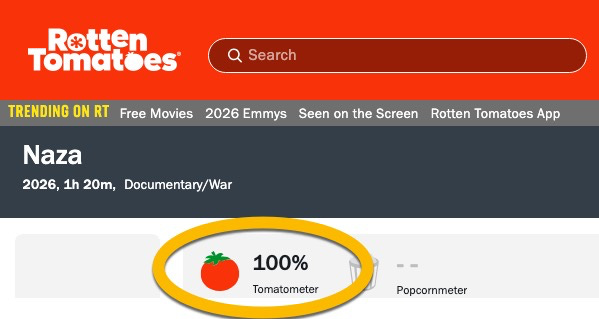
In contrast, the IDF rejected the film’s central claims, denying that AI dictates target selection and questioning the credibility of anonymous sources. Meanwhile, government figures fiercely condemned the project; Culture Minister Miki Zohar (not one of the world’s most sophisticated theorists of liberal democracy) accused the directors of treason, pushed to strip public funding for critical cinema (apparently seeking to out-Putin Putin), and called for revoking the filmmakers’ Israeli citizenship—a demand backed by other right-wing ministers, though predictably denounced internationally and by the film’s producers as an authoritarian attempt at censorship.
As is now par for the course, the discourse about the movie has become binary. It’s either all true, and Israel is monstrous; or it’s all false, and the IDF is still the most moral army in the world and the creators of the film are liars and self-hating Israelis. The (patently absurd) 25-minute, record-breaking standing ovation is either a well-deserved accolade for the bravery of the film’s creators or (my view, in this particular case) a weird Stalin-esque display of “correctness.” Has anyone reading this ever applauded for 25 minutes for anything, ever? I doubt most have ever applauded for 10 minutes—try it—it’s an absurd eternity.
So what’s the truth here? We don’t know yet, as most people who matter haven’t yet seen the film. But here’s what the smart money would say: I’m going to bet that with time, what we’ll discover is the following – some of it is true, much of it is exaggerated, some of it is patently false.
Why do I assume that some of it is true? Well, partly because during the course of this war I’ve spoken to several reservist sons and daughters of friends who’ve told me about the use of AI in the selection of targets over Lebanon. They stated it matter-of-factly, as in “this is much more efficient than having a plane send photos back to base to have a human review them and then select targets, after which either that same plane or a different one takes out the targets.” As they told it to me, the plane takes the picture, AI analyzes it instantaneously and selects targets, and the same plane on the same run just takes out the targets.
And why not? If we’re all using AI to make birthday cards and family calendars, as well as for almost everything else, why would the IDF not be using AI to kill terrorists? Not using AI would be absurd.
Does that mean that it’s also used in Gaza? I’d assume so. Does it mean that humans are not involved in any of the decision-making? I find that implausible. Does that mean that the IDF approved an operation in which it assumed that there would be 500 civilian deaths? I can’t possibly imagine that.
But one day, we’ll know. I may not be around, and you may not be around. But one day, we’ll know.
What we do know, though, is that the screening of the film and the award it received were political theater at its best. What stood out about how the Venice jury handled NAZA was their willingness to elevate a fiercely contentious, politically incendiary documentary to the main competition level, culminating in awarding it the Special Jury Prize. While it’s true that documentary entries at major festivals often receive side-program honors or specialized non-narrative awards, this jury treated NAZA as a premier work of high cinema—which it obviously is not—evaluating it alongside major narrative feature films.
That, plus the ovation, for a movie in which there are only unnamed anonymous sources, and no one goes on record with their name, is suspect in the extreme.
A word about anonymous sources. Years ago, there were several Israeli organizations that became famous (or infamous) for posting “testimonies” of soldiers who “claimed” to have been involved in deeply unethical actions during their time in the army. Naively, in retrospect, I assumed that even if these reports were somewhat one-sided, they must have had an element of truth to them.
Once, in the course of a conversation with a student, this subject came up, and the student said to me that he assumed that most of it was BS. “Why would that be?” I asked him. “After all, they must vet the stuff that goes on the website, no?”
“No way,” he said. And with that, he took out his laptop, went onto the website, and submitted a “testimony” about what he’d “done,” even though in his army service he’d been an intelligence officer who had never once been in the field. He clicked “send.” A day or two later, I passed him in the hall, and he asked to come into my office. He opened up his laptop, showed me the website, and there was his (entirely fictitious) “testimony,” alongside all the others.
Does that mean that all of them were lies? I assume not. Does it mean that relying exclusively on people who won’t use their names is problematic? It does.
What’s the truth here?
One day, we’ll probably know. Maybe.
It’s the inevitably binary nature of the conversation that most people are having that made Dani Buller’s video, a portion of which is above, with the full video just below, so noteworthy. Dani Buller (you can read about his background here) is a well-known and very talented Israeli content creator, whose nuance (in general, and in this video in particular) is well worth noting. Watch his video—even a couple of times, as he moves very quickly.
Note how he acknowledges that his balance will get him “cancelled” by many.
Buller’s video, like Naftali Bennett’s post which we’ll get to below, illustrates that even in an exhausted, angry, divided Israel, nuance still manages to survive, at least in some quarters.

To state the obvious, as Buller points out, one cannot begin to understand this country’s mindset without revisiting October 7, time and again.
Which brings me not to NAZA, but to FAUDA (which Buller also mentions in passing).
Season 5 of FAUDA is now out on Netflix. I’ve seen all the seasons of FAUDA, about which a great deal could be said. It’s good TV, and more importantly, it’s long been a fascinating window into Israel’s mindset and the widely Israeli-acknowledged moral fog surrounding anti-terrorism. So if you haven’t seen it but aren’t in principle opposed, I’d suggest you start plowing through all five seasons. We’ll come back to FAUDA in other posts down the road.
I know many people who won’t watch FAUDA, mostly because it’s violent (yes, terrorism and anti-terrorism are violent).
But I want to urge even those people who would normally not watch FAUDA to at least watch Episodes 7 and 8 of Season 5 on Netflix.
If you’ve never seen FAUDA before, you won’t get all the changes in personalities over the seasons, and you won’t appreciate all the personal, professional, and political subplots that continue to unfold. But in Episodes 7 and 8, you will get, I think, the best recreation of the events of October 7 that has thus far ever been created.
As the third anniversary of October 7 draws close, it’s already apparent that our collective level of shock, horror, and outrage has begun to subside. That’s natural and inevitable. But we should push back. As the world applauds a film like NAZA for 25 minutes, as its score on Rotten Tomatoes approaches 100, and as the vilification of the Jewish state presses on (though strangely, in LEBANON, FAUDA Season 5 is the #1 Netflix show), the events of October 7 do not justify wrongdoing on Israel’s part, but they do remind us of the mindset in which the country found itself in the days, weeks, months, and even years after the war started.
The episodes are (obviously) violent, but they’re not gratuitously violent. There’s allusion to sexual violence, but nothing on the screen. It is simply a reminder of the barbarism to which Israel was subjected by many supposed “innocent civilians” on October 7 – and the barbarism that is still hailed by many people in Gaza, the West Bank, Europe, American campuses, and more.

For another thoughtful response, take a look at Naftali Bennett’s post on X here (read the whole post by clicking below, and if you can stomach it, read some of the comments — they’re not for the faint of heart):

As Bennett notes, the question that no one seems to be able to answer as they critique Israel’s response to the attack and its fight against Hamas is “what would YOU do?”
There are no good answers to that question. Israel had, and still has, no good alternatives. Does that justify anything and everything that Israel could do or might have done? Obviously not.
But should it complicate and temper the rabid critiques of the Jewish state that are exploding all over the world?
It should.
But it doesn’t.
And it never will.

During this holiday season, we will be on a slightly reduced publication schedule through the upcoming holiday season. Weekly podcasts for paid subscribers will continue to appear on schedule, but our other regular content will be pared back as we turn our attention to welcoming the New Year—which we pray will bring much better tidings to Israel, our region, and the world at large.


