


As the Jewish year draws to a close—a period intended for intense, and even uncomfortable, personal and national reflection begins. With that in mind, we open with a brief snippet of a longer conversation (that appeared on Israeli social media here) between the host, Dudu Sa’aday, and his guest, Rabbi Benny Lau.
NOTE, THOUGH:
Even a very brief video like the one above has a great deal of subtext, without which one really can’t understand it. Thus, even if you’ve already viewed the video, take a look at the background below before you watch it again.
First, who are these people, and then, why does this conversation matter?
Rabbi Dr. Binyamin “Benny” Lau is a prominent Israeli Modern Orthodox rabbi, scholar, author, and public intellectual known for bridging religious and secular divides in Israeli society. A scion of a distinguished rabbinic family, he holds a Ph.D. in Talmud from Bar-Ilan University and served as a combat soldier in the IDF’s Golani Brigade.
For 18 years, Rabbi Lau served as the rabbi of the Ramban Synagogue in the German Colony in Jerusalem. He is the co-founder and head of 929: Tanach B’Yachad, a massive national initiative promoting daily Bible study across diverse sectors of Israeli society.
Rabbi Lau represents a liberal, pluralistic voice within Modern Orthodoxy, dedicated to accessible Torah study that engages both secular and religious Israelis. As a frequent media commentator and prolific author, he advocates for reconciling democratic principles with Jewish values, offering a moderate counterweight to political and religious extremism—an example of which we see in today’s video.
The host of the conversation we see above is Dudu Sa'ada. Sa’ada is the Chairman of the Besheva Media Group, which produces the widely circulated Religious Zionist newspaper Besheva as well as the annual Jerusalem Conference. In addition to his leadership role, he regularly hosts digital video podcasts, interview series, and political panels for Besheva Online (of which the clip above is a portion), and Arutz Sheva (Channel 7), a well-known right-leaning Israeli news outlet.
And why does this conversation matter?
What we see here is a highly contested, though polite, conversation between two people clearly identified with the Orthodox community in Israel.
It is critical to note that when Rabbi Lau asks Sa’ada, “Am I in favor of the settlement project?”, the implication is “of course I am.” In ways that are often not clear to Diaspora Jews, even among very moderate, law-abiding, and democratically committed Israeli religious leaders like Rabbi Lau—who is on record advocating for the embrace of Reform and Conservative Jews from the Diaspora—the settlement project is non-negotiable.
Rabbi Lau points out that while it must be implemented in law-abiding ways, the principle and the project itself remain entirely legitimate. After all, from their perspective, isn’t that how most of the country was built? They attack, we defend, we win, we capture land, and we build. End of story. That is how the Galilee became part of Israel in 1948, and that is how Judea and Samaria became Israeli in 1967.
To say that one is opposed to the settlement project is to place oneself squarely outside the vast majority of the religious community in Israel—a rapidly growing segment of Israeli society. To understand Israel today means understanding that reality.
So who is “Zambish”?
Early in the video, we hear Sa’aday say something about how Benny Lau probably only approves of settlements if “Zambish” established them, implying that Zambish must be some left-leaning, anti-settlement personality.
The reality is very different. “Zambish” is the nickname of Ze’ev Hever, who was arrested for his role in a plot to bomb Palestinian buses and other targets across the West Bank. He was convicted and sentenced to prison in the 1980s, though his sentence—like those of several other members of the group—was heavily commuted, leading to his release after serving fewer than seven years.
Hever has not in any way strayed from his drive to expand the settlement project. In recent years, however, departing from his tactics of the 1970s and 1980s, he has spearheaded efforts to establish and expand agricultural farms and outposts aimed at securing large tracts of land. Furthermore, he continues to support connecting major settlement blocs (such as the E1 area connecting Jerusalem and Ma’ale Adumim) and expanding the Jewish footprint across Judea and Samaria.
So why does Sa’aday mention his name with such implied derision? Because Hever explicitly favors working in cooperation with the Israeli government, security establishment, and legal apparatus to build infrastructure systematically, rather than relying solely on confrontation or unauthorized wildcat outposts that risk political backlash.
This establishment-oriented approach has created tension between the old guard—represented by Hever and the Yesha Council—and younger, more radical fringe groups, such as the Hilltop Youth. Because Hever opposes lawlessness and physical violence directed against IDF soldiers or state authorities, more militant elements view the mainstream establishment as overly moderate or compromising, even though their long-term territorial goals align.
What’s emerging here?
It’s been happening for a while, but when even overt settlement supporters in the American government like Ambassador Mike Huckabee have lost their patience and are saying “terror is terror” as they demand that the Israeli government do something, conversations like the one above are bound to become increasingly common. Huckabee and others have managed to engender a conversation that Israel’s government has no interest in exploring.
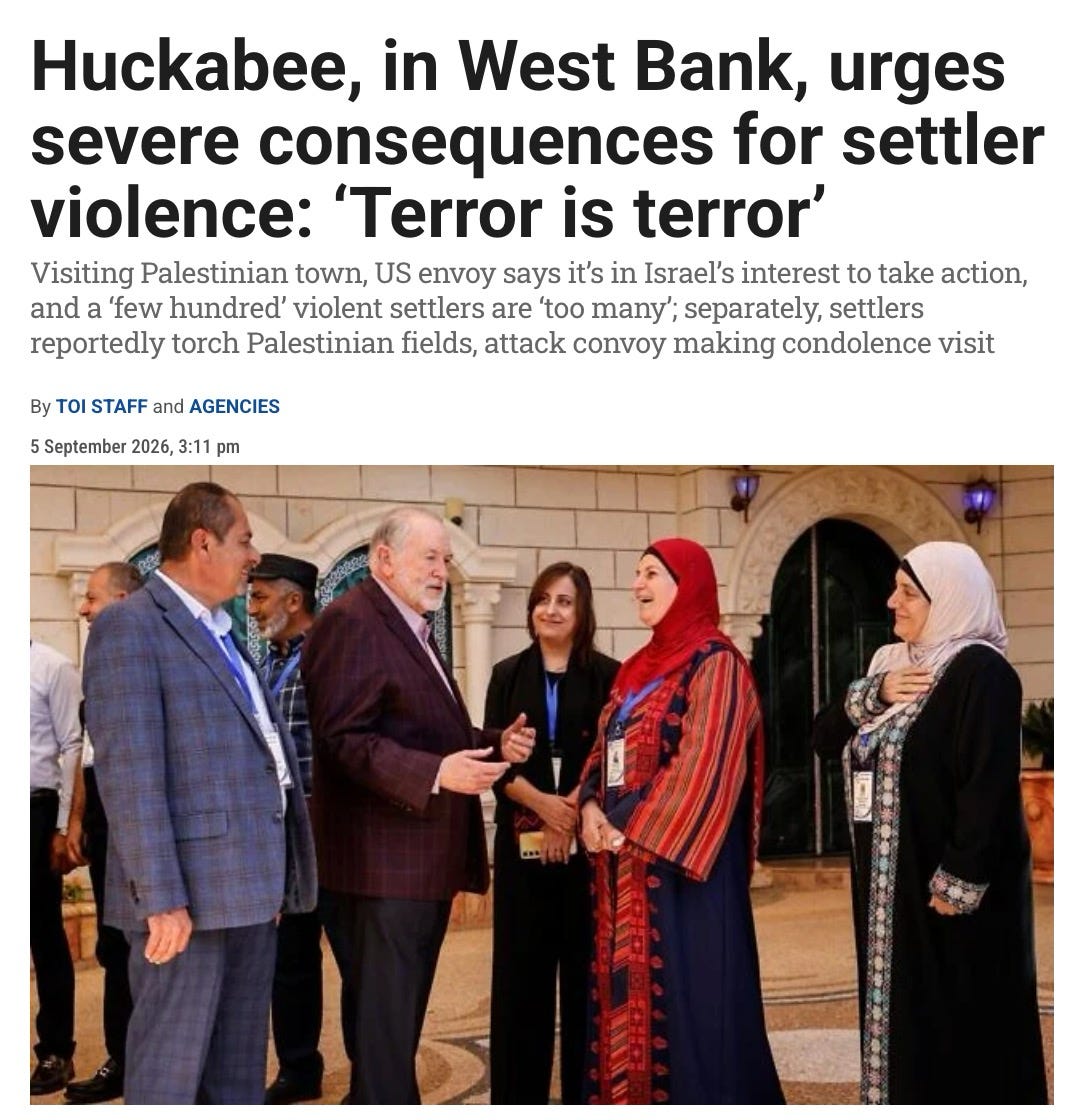
Where conversations like the one we see above will lead, of course, depends almost exclusively on how the Israeli public votes on October 27.

The next video, shared by Yair Golan of The Democrats (formerly the Labor Party), is another salvo in the public feud between Sara Netanyahu and Golan.
The controversy stems from comments made by Sara Netanyahu, the Prime Minister’s wife, during a media interview. She insinuated that Golan—leader of the opposition Democrats party and a former military general—had advance knowledge of the October 7, 2023, Hamas attack. She questioned why Golan was “dressed and ready” early that morning to rescue victims while others, including the Prime Minister, were unaware of the attack. (On October 7, Golan voluntarily drove to southern Israel and personally rescued several people from the Nova music festival site—an act of heroism hailed across the political spectrum.)
Golan denounced her comments as a baseless conspiracy theory meant to turn heroes into traitors and shift blame away from the government’s security failures. He threatened a 2.5 million shekel ($825,000) defamation lawsuit, demanding a full public apology and a donation to Nova festival survivors. Sara Netanyahu refused to apologize, denied alleging treason, and issued her own counter-threat to sue Golan for libel.
Where this will go remains to be seen (the Netanyahu family has been successfully sued for libel in the past). But with that background, we can now fully understand the innuendos of this campaign video, in which Golan seeks to turn the Prime Minister’s wife’s gaffe into a political advantage.
HaYom Harat Olam (“Today is the birthday of the world”), says the Rosh Hashanah liturgy. The beginning of the new year is the beginning of a new world for us, too—a time to reflect on the kind of people we wish to be and the imprint we hope to leave on the world during our time here.
October will also mark the start of a new period for Israel. Whether it brings a change in direction or more of the same remains to be seen. That, too, is ultimately up to us.

With Rosh Hashanah just days away, a quick note that we will be on a slightly reduced publication schedule through the upcoming holiday season. Weekly podcasts for paid subscribers will continue to appear on schedule, but our other regular content will be pared back as we turn our attention to preparing for and welcoming the New Year—which we pray will bring much better tidings to Israel, our region, and the world at large.


