The little clip above, about “If the USA and Iran were people,” is cute. Not hilarious, but still cute. And what it reflects is a deep-seated frustration that after yet another war, this one a really long one in which our kids and grandchildren took much of the brunt, Israel may or may not have accomplished much.
So the guy in the elevator is obviously Trump, with all his bravado. And the guy who enters the elevator is Iran. The US (Trump) threatens to kill him, to “break him into pieces” if he gets into the elevator, but he does it anyway. And what happens?
Nothing.
It is, in a nutshell, how Israelis feel about this war, and it is, in a nutshell, how increasing numbers of Israelis feel about Trump. A lot of bluster, without very much to show for it.
General Tomer Bar, until recently the Commander of the IAF (Israel Air Force) recently retired at the age of 57, after almost forty years in the army. Bar raised some eyebrows when he personally flew several missions over Iran during the recent war—more than a few people wondered if that was very smart. What if he’d been killed? Or worse, captured? Did he really need to get into that cockpit?
But that blew over, because Bar is so widely respected and admired. Yes, the Air Force failed miserably during the first hours (or days) on October 7 and thereafter, but it regrouped, and since then, Bar (who has entirely owned his failure on October 7) has had extraordinary accomplishments. So you might think that the headlines announcing Bar’s retirement would be about … well, Bar.
But no. The headline below is very typical. In the headline, the part that is NOT highlighted reads:
Tomer Bar takes off his uniform
That’s Israeli slang for retiring from the army.
The part that IS highlighted reads,
The IDF is making clear: without a solution to the uranium and the nuclear issue — this was one huge failure.
It’s a comment not about Bar, but about the people he reports to. It’s a comment, in other words about Bibi. The Trump bromance, ostensibly one of Bibi’s unique assets, didn’t get us as much as we thought in the end.


The mindset that gives birth to the video at the very top and to the headline above that can’t even focus on Bar without reminding Israelis that this war might have been a failure, isn’t good for Bibi.
Bibi knows that. And the polls are reminding him of that.
Ma’ariv publishes a poll every week about how Israelis would vote were the elections to be held right now, and though the numbers aren’t moving a lot, there’s a clear picture emerging.
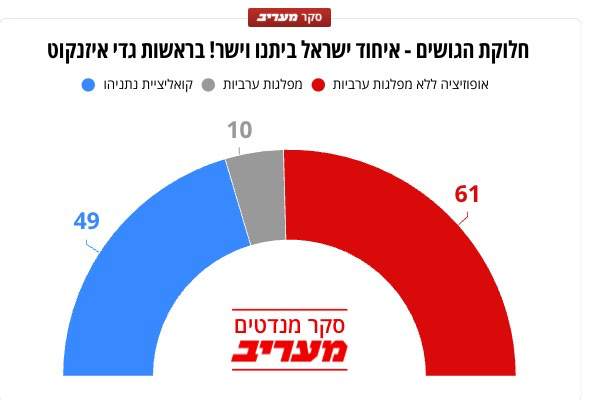
The RED is the opposition: all the Jewish parties that are not part of the coalition. They’re polling, according to Ma’ariv, at 61 seats, enough to form a government.
The BLUE is all the parties that are part of the coalition — Bibi’s Likud, Ben Gvir’s party, Smotrich’s party and the Haredi parties.
The GREY is the Arab parties.
Why list the Arab parties separately? Because the Arab parties are not all Mansour Abbas. Even Abbas’ list, which had him at the top and a few other palatable people below him on the list, included radicals who are opposed to the existence of a Jewish state. The Arab parties include Balad, which describes its fundamental purpose as the “struggle to transform the state of Israel into a democracy for all its citizens, irrespective of national or ethnic identity". In other words, it seeks to end Israel as a Jewish state.
One can certainly understand why Arab politicians would hold that view (though Abbas expressly does not — he is on record as stating that Israel will always be a Jewish state), but one can also understand why many Israeli Jews are unwilling to have Arab parties be part of the coalition.
But it doesn’t really matter now. If the “left” (which is really the “center,” because there is essentially no “left” left) were trying to put together a coalition, the Arab parties could either vote to accept it, or just sit out the vote. Either way, with just 49 seats, Bibi cannot form a government.
There are many reasons for Bibi’s poor showing. Deep dissatisfaction about the war is likely the main one, but the Haredi draft issue is yet another. For many people, continued Haredi exemptions are simply a pill they cannot swallow.
The video (posted on Facebook, we’ve added subtitles)
by Chaggai Luber, whose material we’ve posted on many occasions, shows once again the deep sadness / anger that has seeped into most of Jewish Israeli society about that exact issue.
Add to that anger the deep, unending celebration of those who have made sacrifices, and Bibi’s continued flirtation with the Haredim has got him in trouble.
Here’s the kind of video you see here all the time— when a badly wounded soldier gets out of the hospital or out of rehab, often after numerous surgeries and many months of hospitalization, it’s the custom that those who treated him line the halls as he gets ready to finally resume his life.
The is a country of walking wounded and maimed — or worse. And many people simply have had it with the Haredim, and, because he’s their enabler, with Bibi, too.
Bibi knows that.
And that’s what led some very thoughtful people, like Aviad Stollman here on Facebook, to write the following. It’s way, way too early to count Bibi out — he is not simply the best campaigner in Israel, but is the best campaigner in Israel’s history. It ain’t over till it’s over, and it might not be over.
But Stollman — and increasing numbers of others — think that the “end” might be getting close. Here’s his post, with an AI generated translation:

For some time now, I’ve been making a claim that sounds completely far-fetched to my friends: Benjamin Netanyahu will not run for the Knesset in the next election. He will resign first. Most of them think I’m hallucinating—that Bibi is the last person who would take such a step voluntarily. But in recent days, what was until not long ago beneath the surface seems to be rising into view, mainly through the activity of the President’s Residence, which used to be quieter and is now far more out in the open.
So why would he do it? From my read, there’s a not-implausible scenario in which, in the gifts case (Case 1000), Netanyahu is convicted of breach of trust. It’s not a charge that makes dramatic headlines, but it’s the kind of offense courts do convict on, and under certain circumstances it can also lead to a real sentence, including the risk of imprisonment. Incidentally, it is one of the offenses Ehud Olmert was convicted of as well. Netanyahu knows that precedent very well.
I’m not getting into the question here of whether the cases against Netanyahu are justified or not. My personal sense is mixed: there are elements of obsessive, politically motivated pursuit, and at the same time conduct on his part that is highly problematic—even unethical. In my view, it’s not at all clear this whole story should ever have reached a courtroom, but that’s where things stand.
And from here comes the truly important point. Netanyahu doesn’t need to be certain he’ll be convicted. It’s enough for him to assess that there’s a non-trivial risk it will happen. Once you’re in that position, you’re no longer running just a legal battle—you’re managing risk. The question stops being “how do I win the trial” and becomes “when am I in the best position to determine how it ends?” This isn’t unique to politicians; this is how a great many cases play out. In the end, you arrive at a settlement on the basis of a risk assessment.
And the answer to that question, from his standpoint, is clear: now. As long as he is prime minister, he is operating from a position of strength. He has political influence, public legitimacy, and a real capacity to negotiate—both with the State Attorney’s Office and with Isaac Herzog. The moment he leaves that office, especially if it happens after an election loss or a political deadlock, that position weakens dramatically.
There’s a plausible scenario in which Netanyahu does not win the next election. After all, he barely won the election before October 7. And therefore, if he wants to control the outcome, he has to do it beforehand. If he loses, he won’t be able to offer up his pound of flesh: his retirement.
Within this, you also have to understand Herzog’s conduct. He understands that the continuation of Netanyahu’s trial is tearing the nation apart. Herzog has been working on this for a long time. Among other things, according to reports, he is enlisting figures like Aharon Barak for backing, while at the same time signaling to the State Attorney’s Office that he also has an extraordinary option in his arsenal: a pardon even before a verdict, similar to what his father, Chaim Herzog, did. It’s a complicated move and not legally clean, but as a bargaining chip it carries serious weight. The goal here, it seems, is not necessarily to use all these tools in practice, but to create conditions that will push all sides to the same table and toward an agreement.
Netanyahu is broadcasting business as usual. He continues to govern, to appear, to act, as if there is no other horizon. But in my view, that doesn’t contradict the thesis—it’s part of it. Because anyone in that kind of negotiation cannot afford to look like someone searching for an exit. He has to look strong, steady, in control. Put it all together—the legal risk, the political risk, and the window in which he still holds power—and the conclusion, to my mind, is fairly simple: it is far more likely that Netanyahu will choose his moment of departure in the coming months, before the election, than that he will reach the election and let reality decide for him.
Is Stollman right? It’s way too early to know. But between the war being over and the delicious spring air spreading over the country, people are outside again. They’re traveling again, inside and outside of the country. The sidewalk cafés are teeming with people, the bike paths are crowded again. There’s a bit of a bounce back in people’s steps.
There are lots of reasons for it, but bottom line, much of it is this — after all this country has been through, many people feel that it desperately needs a new start.
Perhaps, just maybe, is that start peeking over the horizon?
A lot can happen between now and October, but still. …. We’ll know soon enough.