

When all seems quiet on most fronts, but isn't ...
With the cannons silent, no hostage exchanges scheduled for now and a seemingly placid period in effect, what is bubbling beneath the surface? PLUS, what's coming on IFTI.

It seems like things are quiet. But beneath the surface, there’s a lot bubbling:
It’s not clear where Netanyahu’s trial is headed, or if the dramatic curtailing of his hours of testimony are related (as some believe to be the case) to a medical condition that has not been made public.
It’s not clear whether or not there is going to be a Stage II of the “deal” or if Stage I might be extended.
It’s clear that the hostages cannot be freed by military action. Eli Sharabi, a former hostage whom we’ll hear later this week, explains why. So if there is no Phase II, how will the country respond to the likely sacrifice of the hostages?
It’s not clear how long the Trump-Bibi bromance will continue, and when Israel might find itself in a position much like Ukraine. …
… Israelis watched that clip of Zelensky being berated in the Oval Office over and over, wondering not only what is going to happen to Ukraine, but closer to home, when Netanyahu and Israel are going to be in that very same hot seat. Some Israelis are pretty sure it’s bound to happen, some aren’t.
But everyone knows that it’s more than possible. That clock, too, is likely ticking. Does Bibi get that? Probably. He just doesn’t have much (any?) wiggle room.
Beware of bear hugs… What they are is a bear with its claws in your back.

Later this week …
Israelis are reeling from the recent Uvda interview with Israel’s eminent journalist (think Israel’s Lesley Stahl) Ilana Dayan and Eli Sharabi, recently released from Hamas captivity. Sharabi, whose wife and two daughters were killed by Hamas in their kibbutz on October 7 and whose brother was later killed while being held by Hamas in Gaza, is the first to give an account of what life (if it can be called that) in the tunnels is like. We’ll post part of the interview (you can find it online) and a few thoughts about it.
Our podcast on Wednesday: Moria Rodal Silfen is an Israeli activist and leader in the fight against human trafficking and prostitution. She currently serves as the CEO and Task Force Director of the Task Force on Human Trafficking and Prostitution (TFHT) in Israel.
This week, we will inaugurate a series of brief essays I’m going to write about Israelis, our souls, our brokenness and our hopes after more than a year of war. A. number of people wrote some very good books about October 7 that can out on the anniversary of October 7 or thereafter, and they are definitely worth reading. Personally, I wasn’t ready to write anything that early — I was still reeling. I’m going to start, though, and we’ll be sharing those essays with our paid subscribers as a token of our thanks for their supporting this project.

On the week of March 23, we will run a three part conversation with Professor Eugene Kandel, an economist, author, head of the Tel Aviv Stock Exchange … and more, who has fashioned a dramatic suggestion for how Israel’s system of government and conception of citizenship have to be completely changed if Israel is to have a chance at surviving.
Professor Kandel, who understands that his proposal is very radical for many, has offered to do a Webinar in the weeks following the podcast. We’ll be making that Webinar available to our paid subscribers who would like to be in dialogue with him.
Now, to the press and social media worlds this weekend, and what’s brewing:

As we often do to start the week, a glimpse at the front page of Yedi’ot Ahronot, Israel’s most widely read paper. What were Israelis reading about this weekend?
A tremendous amount has to do with the earthquakes emerging from the just released IDF report on the failures of October 7. Netanyahu has, of course, so far refused in no uncertain terms to call for a Governmental Commission of Inquiry. Why?
The Agranat Commission in 1973-94 largely exonerated Golda Meir, but the national tumult following its report in April 1974 essentially forced her resignation
The Kahan Commission, established after Sabra and Shatila, largely exonerated Menachem Begin, as well, but he, too, resigned just months after its report.
Why Netanyahu does not want a Commission of Inquiry is not what needs to be investigated. That’s clear.
But the IDF report itself is still causing a tumult, as reflected on this front page. Note that virtually the entire front page is devoted to this issue. A storm is gathering. ….

RED DOTTED BOX, TOP LEFT: What did Netanyahu know before October 7th? New revelations.
PURPLE ROUNDED RECTANGLE: The Next Failure
GREEN ROUNDED RECTANGLE: Too Late
YELLOW ROUNDED RECTANGLE: Heroism and Abandonment
BLACK ROUNDED RECTANGLE: They Missed Everything
RED DOTTED RECTANGLE: The Questions
WHITE DOTTED RECTANGLE: The Failure
GREEN DOTTED RECTANGLE: The Blindness

With the “fronts” mostly quiet and hostage exchanges not happening for the moment, people have a bit more share of mind that allows them to be reminded through the flood of social media postings that Israel is inching back to some of the issues that had the country deeply divided before October 7th.
Here’s one sample post, from Moshe Radman, one of the coordinators of the anti-judicial-reform protests, who continues to be a major player in a number of issues:

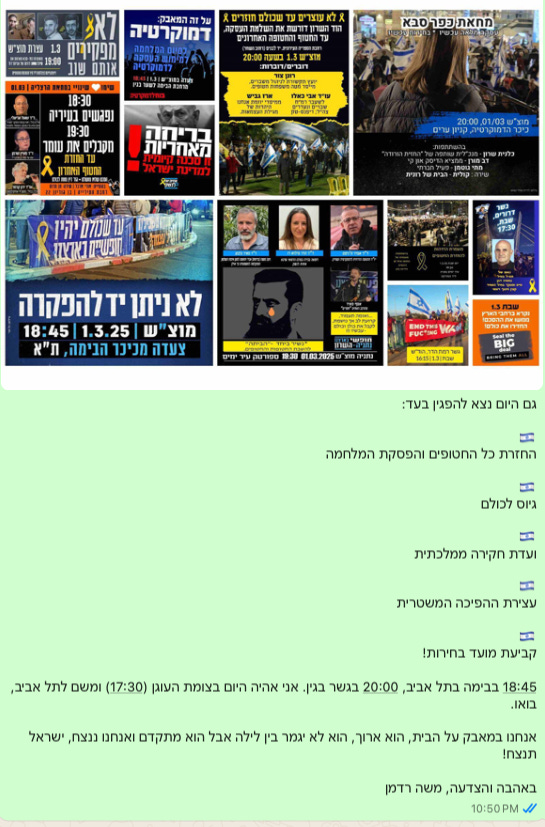
The text of the WhatsApp reads:
Today we’ll also go out and protest in favor of:
🇮🇱 The return of the hostages home and the end of the war
🇮🇱 Military conscription for all
🇮🇱 A state commission of inquiry
🇮🇱 Stopping the police reform
🇮🇱 Setting a date for new elections!
Meet at 1845 at the stage in Tel Aviv, 2000 at the Begin Bridge. I’ll be at Ha-Ogen Junction at 1730 and from there we’ll go to Tel Aviv. Come!
We are in a battle over our home. It’s going to be a long battle; it’s not going to be concluded overnight but we’re making progress and we’re going to win. Israel will win!
With love and a salute, Moshe Radman
If, for whatever reason, there is no Phase II, hostages are left behind, the government does not appoint a Commission of Inquiry, the war does not officially end, Levin and Rothman continue their pronouncements about moving judicial reform forward, etc. — how long before we’re back at the summer of 2023?
We may well soon find out.

Thank you for these insights. It stikes me that it's hard to imagine a left-leaning protest here in the States demanding military conscription for everyone. We definitely do not have a citizen army anymore, and it's a major weakness of the U.S. We need an ethic of national service like Israel has, and it needs to be shared across religion and class (obviously Israel is struggling with this same issue, but even given the Haredi issue, the IDF is much more a shared burden than the U.S. army).
I am really delighted to hear that you have invited Eugene Kandel. He is just outstanding and we so need a serious discussion concerning the political sector and the much needed restructuring. In a similar vein, I am hoping that you might consider interviewing Ben Freeman concerning his new book, the last of his trilogy entitled The Jews: An Indigenous Nation. Just started to read it and it is awesome and very helpful. Thanks so much for all that you are doing.