


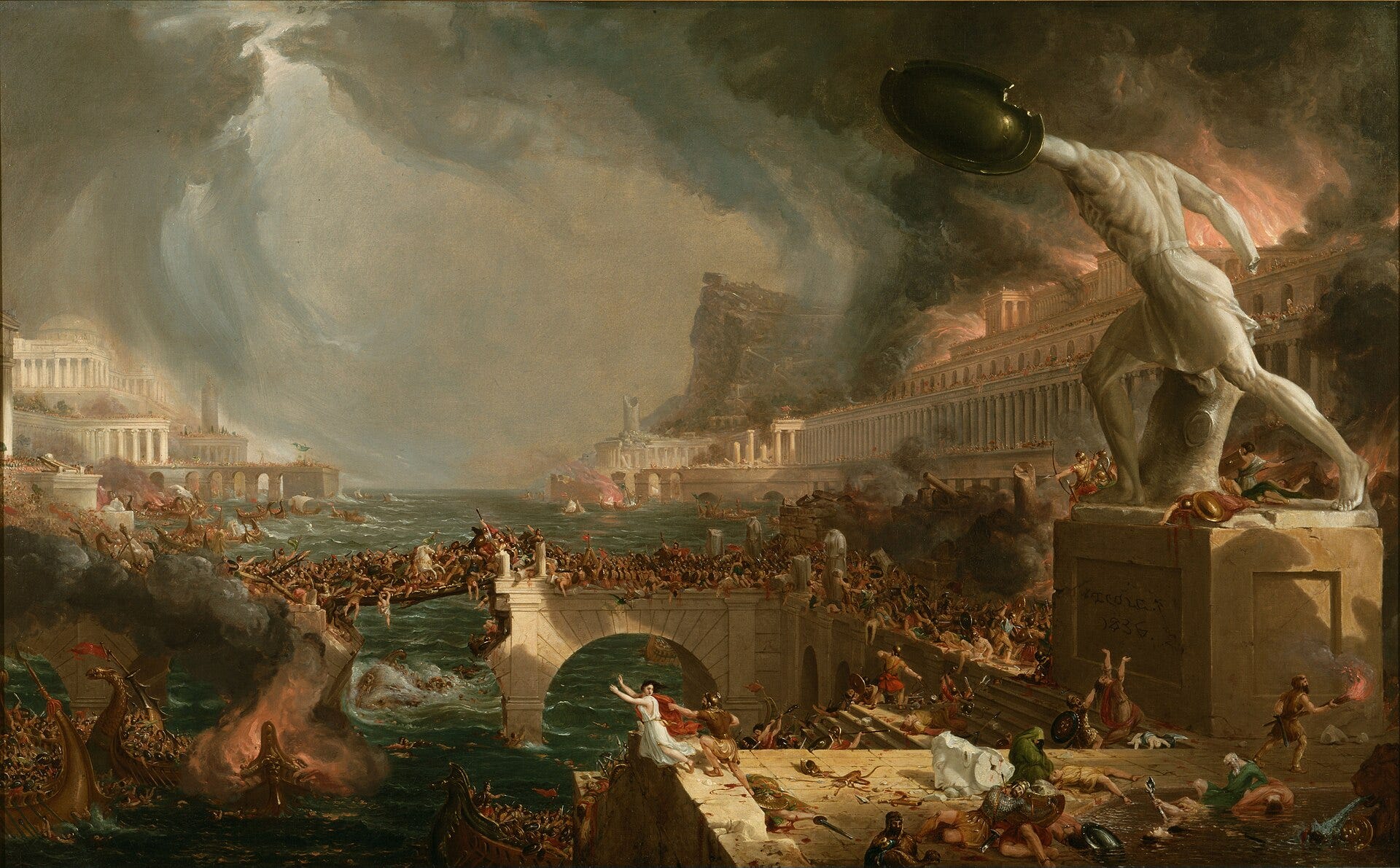
I noticed this week, at the Shabbat table in two different homes, and in a series of conversations at work and around the neighborhood cafés, that I keep hearing people use the phrase “the collapse of civilization.” As in, “what we’re witnessing — in Europe, the United States, and even in Israel to a degree — is not this leader or that party, this issue or that inanity, but rather the (to us) depressing realization that, writ large, Western civilization as we knew it is collapsing.
That’s certainly how I feel. I’ve been feeling it for a long time.
I remember vividly, as if it was yesterday, the day that my wife and I were watching CNN in our family room when the story of the Billy Bush Bus Tape (“grab ‘em by …”) broke.
I looked at my wife and said, “That’s it, it’s over. He’s done.”
She said to me, “Are you sure?”
To which I said, “Of course I’m sure. Come on, you can’t talk that way about women in the twenty-first century and win the nomination of your party, much less be elected President of the United States. He’s toast.”
Ooops. That wasn’t quite right.
When that comment didn’t make Donald Trump an “untouchable”, I began to sense that something deep was shifting about America, and that more than anything, or at least as much as anything, what was changing was the abandonment of norms.
Norms are gone. They’re gone from the Trump Administration. The Netanyahu Administration. They’re gone from how the world used to use soft power. They’re gone from diplomacy. They’re just … gone.
Norms are disappearing from Jewish life, too. Remember how honored Jewish students would have once been to have the President of the State of Israel speak at their graduation?
Or how, even if they weren’t huge fans, they would have known how to comport themselves?
Norms gone.
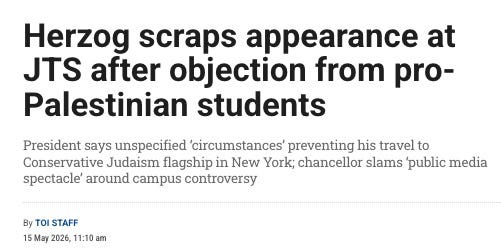
I want to return for just one brief moment to the story of those JTS students who objected to President Isaac Herzog speaking at JTS Commencement. We’ve already covered what’s been said, and there’s no need to go back there.
BUT, what has changed since we posted on that subject is that President Herzog notified JTS that his travel plans do not permit him to go to New York at the present time. One doesn’t have to be Einstein or Freud to figure out what may very well have been going through his mind, or the minds of his advisors. What, the President of the State of Israel is going to go to New York, to one of the world’s great Jewish institutions, and possibly get booed? Or have people hold up signs, however politely? Or walk out, however “respectfully”?
It would have sullied the office of the President.
Is that really why he didn’t go? I have no idea. But everyone has a pretty good guess. Not for naught did the Times of Israel phrase its headline above the way that it did.

But, rather than focus once again on the Conservative Movement, or JTS, or the culture of young Jews, or whatever … it’s worth turning our attention, instead, to Jonathan Haidt.
Jonathan Haidt is a social psychologist at NYU's Stern School of Business, best known for his research on moral psychology and how emotions — rather than reason — primarily drive human moral judgments. He developed Moral Foundations Theory, which identifies several innate moral intuitions (such as care, fairness, loyalty, authority, and sanctity) that vary across cultures and political ideologies, helping explain why liberals and conservatives tend to talk past each other. His popular books, including The Righteous Mind and The Anxious Generation, have brought these ideas to a broad audience, arguing that political polarization and the sharp rise in teen anxiety, depression, and social fragmentation linked to smartphone-based childhood are among the major societal challenges of our time.
Why mention Jonathan Haidt here? Now?
Because Haidt was chosen to deliver the commencement address at NYU’s graduation ceremony, held at Yankee Stadium, and guess what happened ….
Immediately, NYU’s Student Government Assembly Executive Committee condemned his selection, criticizing his “disturbing rhetoric around antiracism, social justice and diversity, equity and inclusion,” and called it “a regression” from previous speakers. They contrasted him unfavorably with past speakers like Taylor Swift (YES, to these NYU students, a world class scholar is a regression from Taylor Swift!!) and Justice Sonia Sotomayor.
More broadly, students objected to his labeling of their generation as “coddled,” his critiques of DEI programs, and argued that his platform did not represent their values.
Who in the world would want to hear from someone who does not represent “their values”? What, we came to a university campus to engage with ideas that might be different from our own?
NYU was quite right to stand its ground and to describe Haidt as one of the most consequential scholars of the 21st century. But the students didn’t care.
Even before Haidt began speaking, he was met with boos from students as he was welcomed to the stage. About three dozen students walked out of the venue in protest.
And here’s a delicious irony: Some students found it “hypocritical” that Haidt’s speech wasn’t required to be recorded in advance, given that the prior year NYU had required pre-recording of some speeches after complaints about a student speaker who spoke against Israel.
It’s unfathomable but also undeniable — Western civilization is collapsing before our very eyes.
JTS students, it turns out, are just students. They are just like NYU students. That may be a tragedy, a sign of the loss of the Jewish values of respect, honoring elders, etc. that used to pervade and shape Jewish life, but the problem isn’t them, or JTS, or the Conservative Movement.
The problem is the world — or what’s left of it.
Now, why begin with all this today? Because our guest today has what is to me a fascinating thesis. Jewish life and Israeli life are also going through dramatic shifts, but Rabbi Prof. Jeffrey R. Woolf argues that at least in the case of Jewish life, one can find in the cracks and failures or some of the collapsing of visions the blossoming of new visions, and often, a re-embrace of Jewish living.
Jeffrey Woolf is a much-admired and lauded public intellectual, and I’m beyond grateful to him for taking the time to share with us his view of how three collapsed dreams in Jewish life have led to rebirth. It’s a very optimistic take on Jewish life, one that — especially with the collapse of so much around us — is particularly good for our souls. For us, in this forum, it’s also important as a window into what some people inside Israel think when they think about the future of Jewish life.

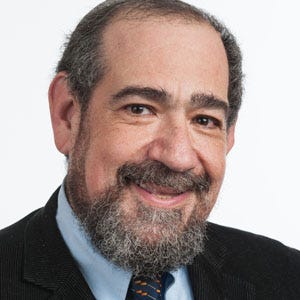
Rabbi Prof. Jeffrey R. Woolf is an internationally known scholar, lecturer and public figure. For thirty years was Associate Professor in the Talmud Department at Bar-Ilan University, specializing in the History of Halakhah, Medieval and Renaissance Jewish History, the Philosophy of Rabbi Joseph B. Soloveitchik, and the inter-action between Judaism, Islam and Christianity.
He received his PhD in Medieval Jewish History at Harvard University and spent two years at Yale University, as a Post-Doctoral Fellow. Rabbi Woolf studied for nine and a half years under Rabbi Joseph B. Soloveitchik זצ”ל, from whom he received semikhah in 1982.
He is a leading advocate and spokesman for Modern Orthodoxy. In Israel, he is a member of the Executive Committee of Maaleh: The Center for Religious Zionism and Chairman of the Board of NGO Monitor. Executive Committee of Tzionut Mamlachtit.
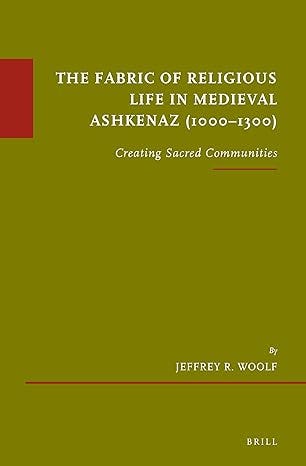
He has also written a great deal, including The Fabric of Religious Life in Medieval Ashkenaz (1000-1300): Creating Sacred Communities (2015).
He and his wife They are blessed with five children and three grandchildren. They make their home in Efrat, Israel.

The link at the top of this posting will take free subscribers to an excerpted portion of today’s conversation.
For paid subscribers, the link at the top will take you to the full conversation; below, paid subscribers will also find a transcript for those who prefer to read, as always.


