

Enough is enough.
The press keeps talking about how we can explain to kids why there's no Purim this year. But there is. It's just a side of the holiday that we seldom talk about, but should.

“I don’t like this kind of war.”
My granddaughter and I were walking up the street yesterday to buy milk (the stores had been sold out the day before, but we’d been told there was now stock)—and to finally get out of the house for a few minutes. The streets were pretty deserted.
“It’s like Yom Kippur out here,” she observed, as she noticed that there were no cars on the roads.
“Yup. People are staying close to home. Just like us, except for this quick errand.”
She was quiet for a minute, and that’s when she said, “I don’t like this kind of war.”
Kind of a strange thing for a not-quite-eleven-year-old to say. Doing my best to curb my irony, I asked her, “What kind of war do you like?”
“You know, the Gaza war. Then we didn’t have to stay in the house or run to the safe room all the time.”
Her family had been abroad during the first year of the October 7 war, so she didn’t really know. And she doesn’t really understand, thankfully, how horrible that war was in myriad ways. I, of course, didn’t bother to explain. We can have those conversations in a few years.
Mostly, what I thought about as she uncharacteristically held my hand the whole way home from successfully finding milk was, in what kind of world does a ten-year-old have preferences as to the kind of war she likes?
It broke my heart.
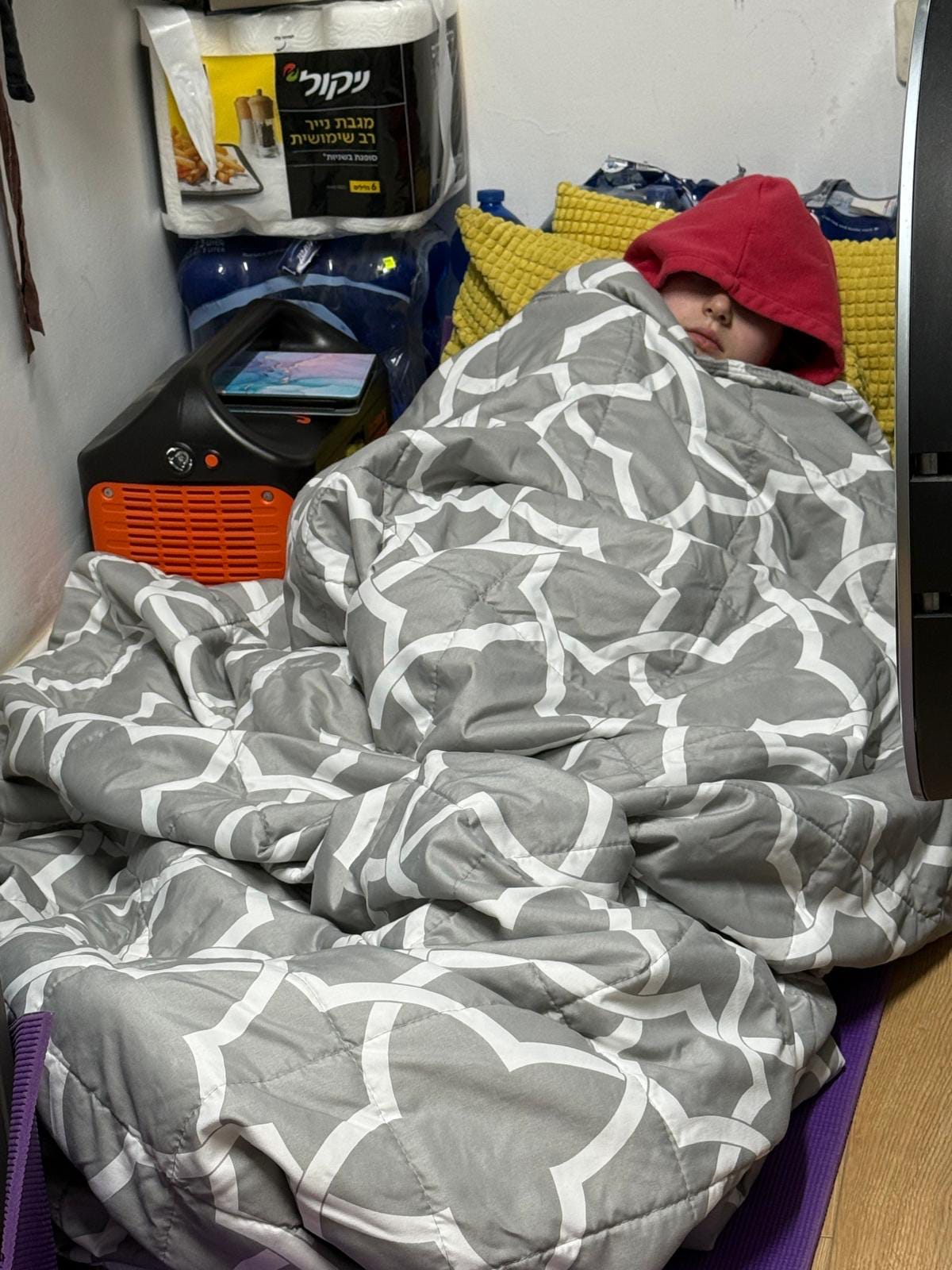
Our daughter sent the photograph above, of our grandson sleeping a couple of nights ago, to our family chat. Everyone got a good laugh (except for the stuffed giraffe, who I’m guessing felt a bit unprotected), though that photo, too, made me sad.
He’s only three and a half, and he doesn’t understand anything, but he can sense it. No school. Everyone home all day. Sirens. Into the safe room. Out. Screeching sounds that could wake the dead from all the phones and watches and laptops and iPads. Back in. Then out. I assume he can feel the stress.
I’m guessing that that’s why he ended up sleeping the way that he did. We can tell ourselves all we want that the kids are too little to be scared.
But that’s bullshit.
Some time after October 7, I interviewed on my podcast a woman who had survived the horrors of that cataclysmic day with her husband and three children in a safe room on their kibbutz. She described how, in order to keep their kids quiet, she and her husband gave the kids their phones. Then they lost power, and of course, the phones eventually ran out of juice. There was no way to charge them. And the room was literally pitch black. They couldn’t see their hands in front of their faces.
But they could hear—the shooting outside, the explosions, the shouting of soldiers that residents should not come out of their safe rooms.
When I asked her what her kids did then, she told me that they went to sleep. All three of them, she said, on the same bed, for hours, in the middle of the day. When soldiers knocked on the safe room door to see if there was anyone inside (and told them not to come out yet, because it wasn’t safe), the kids woke up. And when the soldiers left, they went back to sleep.
When she told me that story, it sounded surreal. Kids would just go to sleep in the middle of all that? How was that possible?
I hadn’t thought of that conversation in a very long time. Until yesterday morning. Another siren. We hunkered down in the safe room and latched the metal door. My wife and I sat on folding chairs with our phones, following the news and waiting to see when we’d get the “all clear,” while our granddaughter got on the floor in front of the washing machine with her Kindle.
And then booms. One loud boom after another, as the incoming rockets were shot down. You could be largely deaf and you still wouldn’t have missed them. Worried that our granddaughter might be scared, I looked up from my phone for a second to make sure she was OK.
She was fine. If that’s fine.
But no, that’s actually not fine. Not by a long shot.
For a while last night, perhaps because we had a relatively long stretch without sirens, YNet ran a piece on its home page showing a boy in costume, looking sullen.

Headline in the red rectangle:
“But Mommy, I wanted to wear my costume!” How to explain to your kids why there’s no Purim this year.
Story in the yellow rectangle:
Going nuts in the safe room? Activities for children without leaving the house.
Story in the white rectangle:
Mommy, is the boom going to come? How to explain the war to your kids.
And in the green rectangle:
Sex.
Life must go on, I guess.
Except that the headline was wrong. Obviously, to the kids, it feels like there isn’t Purim this year. But there is. This year, it’s Purim on steroids. Because Purim is actually—and sadly—the most apt holiday to overlap with this war. Though we don’t often tell our kids this, a major theme of the holiday is “destroying those who seek to destroy us.”
The Book of Esther, Chapter Nine:
And so, on … the very day on which the enemies of the Jews had expected to get them in their power, the opposite happened, and the Jews got their enemies in their power. … So the Jews struck at their enemies with the sword, slaying and destroying; they wreaked their will upon their enemies. In … Shushan the Jews killed a total of five hundred of them.
They also killed … the ten sons of Haman, the foe of the Jews. But they did not lay hands on the spoil. … The rest of the Jews, those in the king’s provinces, likewise mustered and fought for their lives. They disposed of their enemies, killing seventy-five thousand of their foes; but they did not lay hands on the spoil …
In other words, enough is enough.
For forty-seven years, Iran has been saying it would destroy us. For forty-seven years, it had been preparing to do so. If you believe Steve Witkoff, the Iranians boasted to him last week they had enough enriched uranium to build eleven nuclear bombs. How long were we supposed to wait to see if they were telling the truth? Did the world really expect we would live that way forever?
Why in the world would we not attack them? And now that we have air supremacy (which didn’t take very long), why would we possibly not push this until it’s completely done? And now that Hezbollah has joined the fray, why would we possibly stop before they’re gone, too? (That will still leave Hamas, but that story is far from over.)
It’s not for naught that the new “logo” on the Israeli news (in the yellow circle) is יחד כל הדרך.

Literally, it means “Together: the whole way,” but the intent is, “Together, until this is done.”
About that, there’s wall-to-wall agreement here.
Israelis understand very well why 60% of Americans are opposed to the war. It’s incredibly shortsighted, but to be expected. For the time being, though, there’s only one American whose opinion matters for our future.
This war is about ensuring that there is such a future.
Which is exactly the point of the Megillah, and which is why there most definitely is Purim this year.
If there is a minyan present when we read the Megillah (many Israelis will not have a minyan this year, obviously), this is the blessing that we recite at its conclusion.
Blessed are You, Lord our God, King of the Universe, who pleads our cause, judges our claim, avenges our wrong, brings retribution to our enemies and punishes our foes. Blessed are You, Lord, who on behalf of His people Israel, exacts punishment from all their foes, the God who brings salvation.
Here’s a not terribly precise summary of that blessing:
“Enough is enough.”
Before we all went to sleep last night, the news was reporting that the IDF was saying that the rate of Iranian missiles would sharply decrease in the coming days. And sure enough, when I got up at 6:30, it had been a quiet night. “Maybe that part’s over?” I wondered.
Nope.
A couple of hours later, the phones went nuts again, this time right to the siren without the few minutes’ warning that typically comes before.
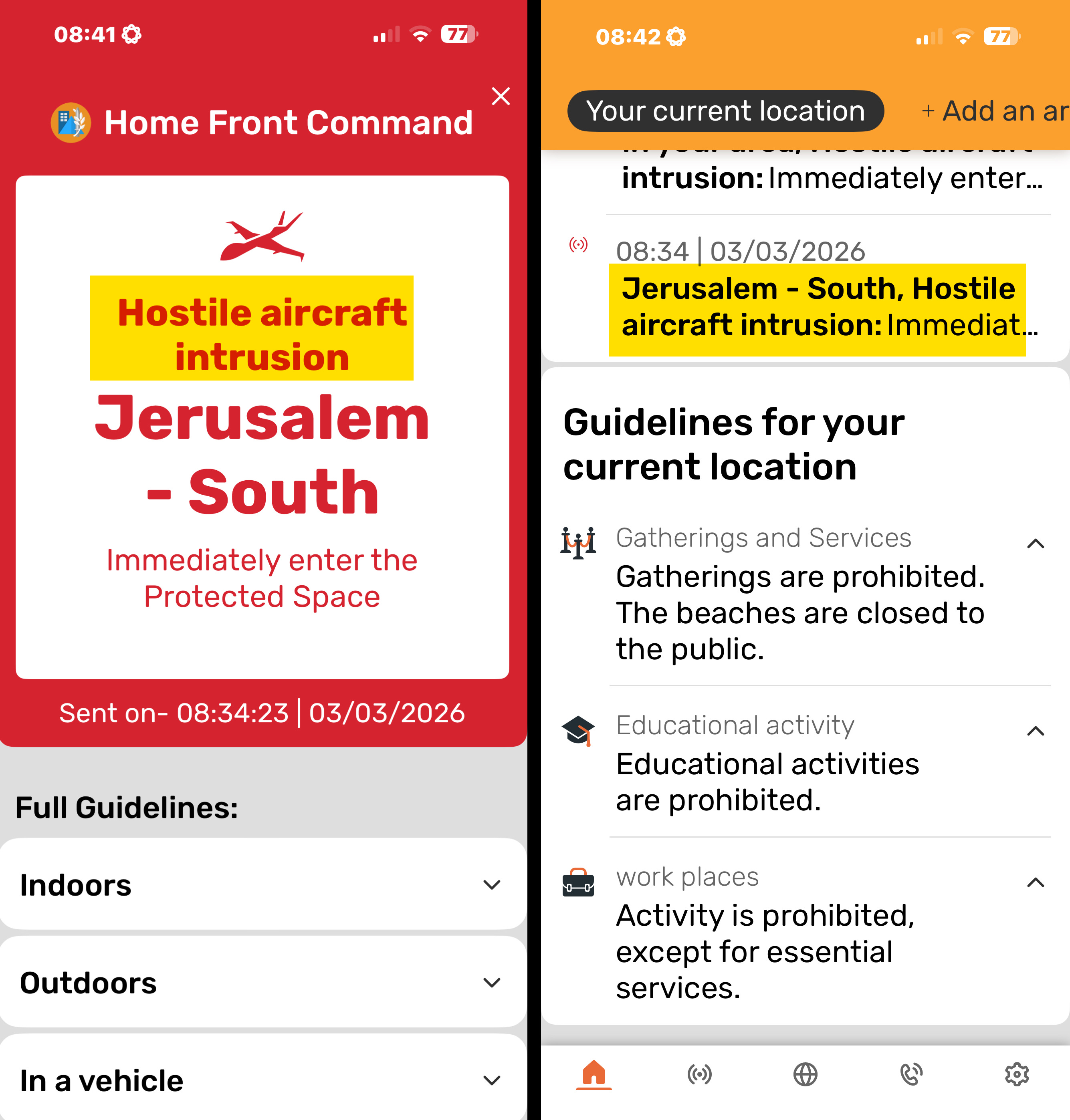
Our granddaughter asked, “How come there was no warning?” Then she looked at our screens, and asked, “What does ‘hostile’ mean?” I told her.
“You mean they have planes coming here?”
“I’m pretty sure it’s drones, not planes. Come, sweetie, get in the MaMad. We’re going to be fine.”
“But big drones, right? Not the little ones that regular people have?”
“Yup. Big drones. But don’t worry. The army will shoot them down. Let’s just get in the MaMaD and close the door.”
“Big drones because they carry bombs?”
“Come on in. We’ll be fine. Why don’t you get your Kindle?”
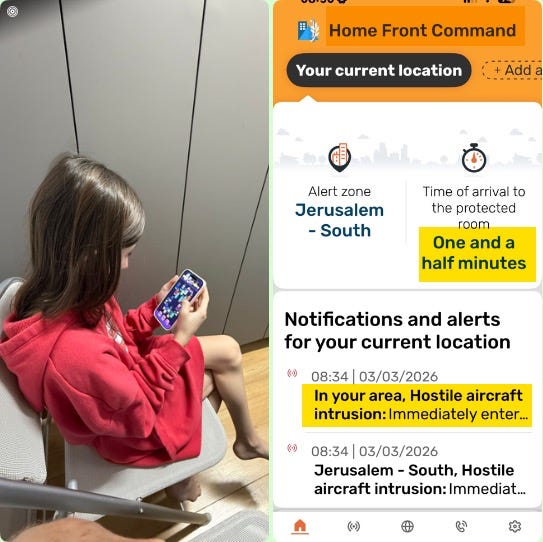
But she didn’t want her Kindle. We closed the door and she took my wife’s phone. Some stupid game. But this is not the week to worry about screen time. I’d much rather a ten year old focused on getting to Level 4 (I checked) than think about planes and drones and bombs.
I confess that the photos that our friends posted online in the last twenty-four hours of them and their kids or grandkids all dressed up, going to shul for Purim and whooping it up kind of shocked me.
Don’t get me wrong. I’m glad that they could do that. I wish that we could, too. It’s just that the difference between the realities that these two (more or less) halves of the Jewish people inhabit could not be more stark.
The Jews have enemies everywhere—in Australia and France and England and Spain and Iceland and Norway and Scotland and Turkey and the United States and here and more. But of all those places, there’s only one group of Jews that’s positioned to take the message of the Megillah seriously. It’s a tragic message, but it’s eternal.
We’re just the ones who don’t have the luxury of pretending otherwise.
Lots of our friends have been writing from the States, telling us they hope we’re safe, and saying they’re praying for peace.
But we don’t need peace, at least not right now. We need victory. We need to put a stop to this. What, is that little kid in the bright red hoodie going to take her kids into the safe room, too?
Peace will come if we win. About that, Jabotinsky was right, a century ago.
Yet Jabotinsky didn’t exactly come up with that idea. Remember Psalms 29:11 (with which we conclude the Grace After Meals)?
ה’ עז לעמו יתן ה’ יברך את־עמו בשלום. “May God grant His people strength [and then] may God bless His people with peace.”
In other words, to paraphrase the book of Psalms: First strength, then peace.
Enough is enough.
And first things first.

There’s not a lot that I can say from the safety of my home in Canada except thank you for sharing your experience. Stay safe.
I really appreciate you reminding us all about the other side of the Purim story… which is where meaning can be found in today’s world. Let’s hope this war leads to peace in the region, and elsewhere.
Shalom.
Strength first, then peace. You are so right, Daniel. Our hearts hurt for our Israeli families but we know, in this, we concur with an American president with whom we don’t often agree.
Yes, stay safe but know we understand the need to persevere.