

"Forgive us that your replacement didn't arrive in time."
Another heart shattering funeral on Mount Herzl this week is a reminder of the egregious fundamental unfairness that we refuse to fix.
I’d thought we were done with Mount Herzl. At least for now.
But we weren’t. Aren’t.
As we walked from our car on Tuesday morning to the freshest section of the cemetery, I tried to remember how many times we’d been there since the beginning of the war. I thought I’d made a complete list in my mind of the people whose funerals we’d attended there since October 7, but as we climbed the steps from the parking area to the first level of graves, I remembered another one.
And when we got to the top of the stairs, I recalled another.
Mount Herzl felt, at that moment, like a mountain with a sickeningly ravenous appetite.
***
At the minyan I attend on Shabbat morning, the pace is serious. We start at 730 a.m. sharp, and one hour and twenty-five minutes later, obviously without skipping anything, we’re done. It works, but there isn’t, to put it mildly, a lot of time for chatting with your friends.
Still, we’re Jews and it’s shul, so we find a way. Two Shabbatot ago, a friend who always sits a couple of seats away from me, a guy whose family have been cherished friends of ours for more than thirty years, leaned over to me and quickly snuck in an update about his son-in-law: “Ran’s getting out on Monday. This time, for good.”
“Amazing. Finally,” I said. “How many days?”
“I don’t know. 350-ish, I think.”
We would find out that it was actually 400.
400 days that his wife, whom we’ve known since she was nine months old, had waited for his return. On her own, worried and scared like all the other wives, first with one child, and then also with a second, born during the war.
400 days of doing it all alone.
400 days of believing, as hard as it was, that there is something called duty, devotion.
***
Ran did, indeed, get out on Monday.
Tuesday morning, though, we got a WhatsApp from those friends. “Please pray for Ran ben Sarah. Ran had a stroke this morning.” By the time we spoke to them, he was in the hospital. Sedated, in a coma. And 32 years old.
We were in touch all week, obviously, but nothing much changed. Then on this past Shabbat morning, in shul once again, my friend told me there might be some cause for optimism. Not clear, yet maybe—but it would be weeks before they would know.
It wouldn’t be weeks.
We were at the “Local Testimony” exhibit (that I wrote about here) on Monday morning when we got another WhatsApp. “Ran passed away this morning.”
It felt hard to breathe. The little girl we’d known at nine months old, whom we watched grow up to be an extraordinary woman, a professional, a wife, a mother, and—like her husband whom she’d started dating when she was in ninth grade, only 32 years old—was now a widow.
In what kind of world does a young man, a picture of health and vigor, survive 400 days of combat to return to his wife and kids only to be felled by a stroke 12 hours later?
In a world in which we ask of them too much.
Chilli Tropper, an educator and currently a member of the Knesset for Benny Gantz’s National Unity Party, is an incredibly prolific, powerful and sensitive poster on Facebook. He posted this about Ran.
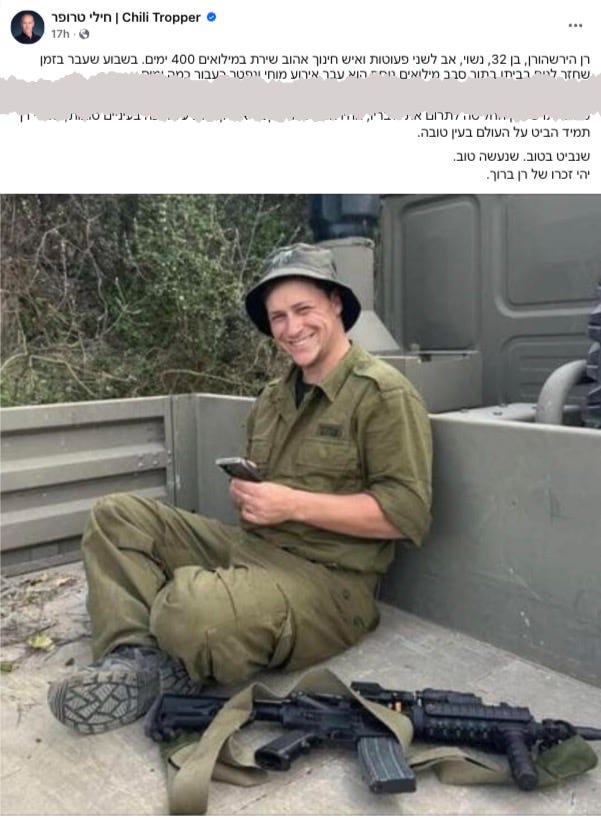
Ran Hirschhorn, 32 years old, a husband, father of two toddlers, and a beloved educator, served 400 days in the reserves. Last week, while returning home to rest during his latest round of reserve duty, he suffered a stroke and passed away a few days later.
When I spoke with my brother, who serves in Ran’s brigade, about this tragic event, he also told me about another one of his soldiers who suffered a heart attack while inside Gaza. Then we spoke about the one who feels constantly exhausted even after he’s already out of reserves, and the one who hasn’t been able to shake off illnesses since his service, and more and more stories.
There are many types of war injuries, even if a clear line cannot always be drawn between things—injuries that do not fall under the definition of “wounded on the battlefield” or under the definition of “post-trauma.” The price of war has so many faces.
The commitment of society toward the Israelis who serve is to understand that whoever returns from war after hundreds of days of reserve duty returns different—both physically and mentally—and therefore, they need us.
The commitment of the state is to expand the ranks of those who serve and not allow many to not serve at all, while it sends the same people again and again until their bodies are harmed or collapse.
When Ran’s mother told him during the war, “Maybe you don’t need to do so many days of reserve duty, maybe let someone else,” Ran answered her, “It is a privilege to serve,” and continued his service.
Indeed, it is a privilege to serve, and blessed is the nation that has such dedicated people like Ran. But the state also has obligations—to care for those who serve, among other things, by reducing the burden on their bodies and souls.
Ran’s family decided to donate his organs. His brother said that whoever received his corneas gained “good eyes,” as Ran always looked at the world with a “good eye” (kindness).
May we look for the good. May we do good. May Ran’s memory be a blessing.
A father of one of Ran’s former pupils wrote the following, also on Facebook, with a bit of an edgier conclusion:
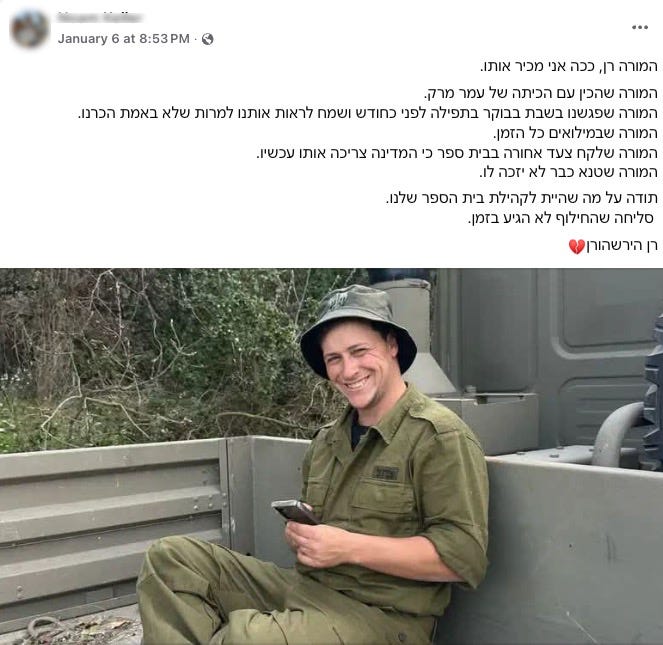
Teacher Ran—that is how I know him.
The teacher who made soup with Omer’s class. The teacher we met at morning prayers on a Shabbat about a month ago, who was so happy to see us even though we didn’t truly know each other. The teacher who was constantly in the reserves. The teacher who took a step back from school [DG - he gave up his position because it wasn’t fair to the kids to have their teacher gone in reserves so often] because the country needs him right now. The teacher that Tene will no longer get to have.
Thank you for everything you were to our school community. Forgive us that the “replacement” didn’t arrive in time.
Ran Hirshhorn ❤️
No, the “replacement” didn’t arrive on time. For many reasons. This is a small country and there are numerous fronts. This is a small country and it’s been a very long war. And because Israel Arabs aren’t asked to serve. And because Haredim refuse to serve.
This just cannot go on, despite the fact that Netanyahu (with the support of his American Jewish enablers) is willing for it to continue forever if that will keep him in office.
It is perhaps not just ironic, but actually instructive, that this week’s Haredi demonstration against the draft, which turned violent (as they often do) ended up with a 13-year-old Haredi kid getting killed when the protesters terrified the box driver as they attacked his bus (no police were there to assist—recall that Ben Gvir is the minster in charge of the police).
The kid stood in front of the bus, and then, when the terrified driver tried to get away, got dragged under it, and killed.
He apparently would have been better off staying home and doing his homework than attending a violent Haredi protest that terrified an utterly innocent Israeli Arab bus driver for exactly no reason whatsoever.
Though, in fairness, he probably didn’t have any homework.
Everywhere one turns, we are reminded—while people like Ran are defending us from our enemies outside, very few people are defending people like Ran from our enemies inside. Here’s a clip I’ve seen going around—we added subtitles:
Can someone explain to me, please, why people like that get subsidies from the government?
Can someone please explain to me why, when their children get sick, a health system that my friends and I support with our taxes, treats them?
“Are you saying we shouldn’t treat their kids?”, you might be asking. Yes. That’s what I’m saying.
“What about if their kids get cancer?”
People die for all sorts of reasons.
Sooner or latest, this has to stop. Sooner or later, this country needs to worry more about the extraordinary people like Ran Hirschhorn more than it does the petty politics of staying in office.
Sometime this year, Israelis are going to make a choice about their future. It’s not at all clear what they will choose. In fact, it’s increasingly looking (for now) like they will choose more of them same.
But if they choose more of what we have, they will have sealed our fate. History will tell a sad story about the best and the worst of this society, of this decade, of this war, and of this country. It’s a that story will sound a lot like a story we’ve told twice before.
Because the truth is, it’s not Mount Herzl that has the voracious appetite. It’s Jewish history that makes those unbearable demands.
Ran Hirschhorn, along with many thousands of others, answered the call. He, like hundreds of others, also paid a devastating price.
Ran Hirschhorn deserved much better. His wife and kids deserved much better. His friends deserved much better.
But will we actually do better?
That is a very open question.
יהי זכרו ברוך. May Ran Hirschhorn’s memory be a blessing.

Heartbreaking..
So unfair. Will the system ever be changed? I truly pray it does.