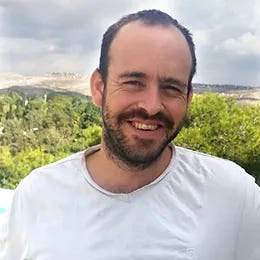
In this week’s episode, we speak with Matan Yaffe, the co-founder of Desert Stars.
About nine years ago, Matan was ambushed by four young Bedouins while motorbiking in the Negev desert. Yaffe tried to reason with the would-be thieves. But when they pulled out a metal bar, Yaffe pulled out his gun. The gang fled, leaving the 25-year-old former IDF officer physically unharmed but furious and frustrated.
“I knew nothing about the Bedouin apart from the stereotype that they are criminals and drug smugglers,” Yaffe related in an interview.
As Israel21C notes, approximately 250,000 Arab Bedouins live in nine Bedouin municipalities and dozens of herding and farming villages scattered throughout the Negev. Tribal rivalries limit interaction and cooperation between them. The birthrate is high; 63% of Negev Bedouins are under age 17, the high-school dropout rate is 29% and only 8.7% have a university or college degree.
Yaffe realized that the Jewish and Bedouin residents of the Negev “are doomed to live together in one shared space with one shared future. The future of my kids very much depends on the future of the Bedouin kids who live next to me. Something big needed to be done to move the needle.”
In our conversation, Matan shares his personal story, and then describes the route he has taken to make for a better future for both Bedouin and Jews in the Negev.
The link above will take you to our conversation, being made available today, along with a transcript for those who prefer to read, to paid subscribers to Israel from the Inside.

We have had a series of conversations in recent weeks, and everyone who follows Israeli news has seen in recent weeks that the issue of the Negev and specifically the challenge of two very different populations, the Jewish population, and the Bedouin population, sharing the Negev, has become much more of a hot potato than it's been in a very long time. We have heard from people in the past, like people from HaShomer Hahadash, the new shomer, people who are the new guardians who have gone out to the fields to help farmers protect their lands. We've heard from other residents of the Negev, but somehow, in the light of these most recent Israeli elections, and particularly Itamar Ben-Gvir’s quote unquote, promise to restore order to the Negev, the issue of the Negev has risen in its importance in Israeli discourse and in foreign discourse about Israel as well.
Not long ago, we aired a conversation with someone from the organization called Regavim, which has a very clear attitude that Israel is losing sovereignty over huge parts of the Negev, by the way, and the Galilee and the West Bank, which they call Judea and Samaria, which many people call Judea and Samaria. They have a very clear sense of the Negev that Israel is losing sovereignty and what it needs to do is to take sovereignty back. There are people who are equally involved and equally committed to the Negev who have a different take on how Israel should respond to the challenges of the Negev. And we are privileged and I'm really personally thrilled to have an opportunity today to be in conversation with Matan Yaffe, who is the founder of Kochavei HaMidbar- Desert Stars. And so, we're going to hear from Matan in a second about his how he grew up in Israel, what he did, and then a specific incident which got him to be involved in life in the Negev, and then we'll take it from there. So, Matan, thank you very much for joining us.
Thank you for having me.
And Matan, you're in Cambridge now, and I'm in Jerusalem. Very often, it's the other way around. You're probably in Israel, and I'm very often in Cambridge because we have kids there. But that's the way it is today. And in any event, just tell us a bit before we get started tell us a bit about yourself, how you grew up, where you grew up, and all of that.
Sure. So, as you said, my name is Matan Yaffe, and I'm saying Yaffe because I'm fifth generation in Israel. So, I'm coming from a family with a very Israeli ethos of Zionism and the establishment of the state.
Let me just get it straight. If you're fifth generation, what year did they come, your family?
Very beginning of the last century.
Very beginning of the 20th century. So right around the time of Herzl, more or less, give or take.
Yeah, that's kind of the origin. My mom's family was even there before through the Turkish Empire. But the narrative I was born into is a very kind of Zionistic narrative. My grandfather established the Palmach together with its Yitzhak Sade. He was one of the first three platoon commanders over there. So that's how I grew up. I'm saying that because I think that Israel above all and it's kind of maybe the punchline, but above all the politicians and about all the kind of divergence that we see at the moment, Israel is an idea. And I was born in many ways to serve this idea. Now, I think we're very far today from realizing the idea that the founders of Israel actually meant for it to be. But nevertheless, the idea is still sacred and important. And for that idea, I'm willing to give everything I got in order to realize that. So that's the narrative I was born into. I grew up in Jerusalem, had kind of a normal childhood, middle class, Ashkenazi, secular guy. Growing up in Israel, I was in the youth movement in the tzofim all of my life. I finished that. I joined the IDF. I served for six years as a combat officer, finished my army service, went overseas, traveled the world for about three years. Very off the beaten track, mainly Kamchatka, Mongolia, Siberia, all kind of random places. And that's it.
Places that Jews used to pray they would not get sent to is the place that you chose to go to.
That's also a way to see it.
Whenever my students tell me, by the way, that when they finished the army, they went to Vietnam, I try to explain to them that for my generation of Americans, the idea that a person would voluntarily go to Vietnam is so counterintuitive. But for them, of course, it's a beautiful, fascinating place.
Times are changing. And it also relates about our conversation about Israel, because you will continue to do your job and pull me towards Desert Stars, and I will continue to do my job and pull us towards the idea. And Israel today is an independent state, as it should be. And with this independency, some responsibilities merges. We are a strong sovereign state. We should acknowledge that. I'm thankful for that. But I also wish to put a question mark on, how does that… how should we behave as such? And that's it. I came back to Israel. Much of my army service was in the Negev. So, the Negev, you either fall in love with it or you hate it. So, I am quite a romantic guy. So, I fell in love, and I knew that that's where I'm going to live my life. And until today, the Negev is my home. About a decade ago, I lived in the Negev in Ashalim with Aviv, who then was my girlfriend, but very quickly became my wife, and we have five boys today together. But back then, we didn't have kids, and I used to travel a lot on an off-road motorbike, kind of roaming around the desert. And in one of these trips, I saw a Jeep traveling alongside with me, and I said, whatever they travel, I travel, it's all good. It took me two minutes to understand that they're not traveling, but actually chasing me down. They got to me quite fast and took me off the path and out of the Jeep came out four young Bedouin, probably kids, 16-17 years old, and kind of started negotiating my bike, hassling me a bit, give us the bike, we'll do this, we'll do that. I tried to talk my way out of the situation. It didn't work out very well. At some point two of them went back to their Jeep and brought kind of a metal bar. So, in the middle of the desert, they are four and I am one. It’s quite unpleasant. What these guys didn't know is that when I travel alone, I carry a gun with me. So, I see the metal bar, I pull out my gun, I tell them, if you want to be violent, I can probably do it better than you can. Go home, let me go back to my life. I think I was slightly less calm than I am now, but the general message was that. For them, it wasn't a planned ambush, it was an opportunity. They understood it's a bad opportunity, went on their Jeep, drove off while I went on my motorbike, went back home, and I hated all of them. I didn't know Bedouin beforehand, but I did have stigmas on them, like, unfortunately, most Israelis have, because we don't know each other. We think we know everything about each other, but truth is that we don't know each other. So, I had stigmas about them, and these stigmas got a face. So, for a year, I was also full of hatred and anger. But then time passes like it should, and anger comes down like it also should, and I started asking myself very practical questions. All the ideology that cannot turn into reality, I have less affection for. And when I thought about it, and when I asked myself, I'm not going to leave the Negev, but will they? And the answer is. No, they're not. That's their home for hundreds of years. They're not going away. And if that's the case, it doesn't matter what this politician or that politician is saying at a given time. The only thing that matters is that our destinies are integrated into one another.
We are going to be neighbors no matter what. And if so, then we might as well have a better story. We might as well build bridges, because if we build walls, it doesn't help. It's not sustainable. I don't know when the last time is you've been to the Negev, but when you go there, all the Jewish villages… we don't build villages in the Negev. We build fortresses. We surround ourselves with fences and barbed wire and patrol. And this is not to protect ourselves from an external enemy, someone who is across the border. This is to protect ourselves from ourselves, Israeli citizens with the same identity card and passport like I have. And this is ridiculous. And the fact that we do not understand that our future is one and not two different stories is insane in my eyes. So, I said, Something needs to be done about that. And that's kind of the origins of Desert Stars. I understand that even if hating or being angry kind of relieves these hormones within ourselves that make us feel good, as if we're doing anything, it's not practical. It counts to nothing, actually just does damage. But trying to create a new story, a better one, when we can each see a common future and work together towards that future is a much better story and a much more sustainable one and a much safer story than the story of walls.
Okay, so you have this very unpleasant, potentially very dangerous, but thankfully, in your case it did not end badly, very unpleasant, very frightening awakening experience with these guys in the desert. Had you not been armed, it could have ended very differently. And you said, like everybody else, you had a tremendous surge of anger and resentment and so on and so forth. But you took this to a different place, and you founded Desert Stars. Tell us about the organization, what it does. You have a Bedouin partner in your work at Desert Stars with whom you're working very closely. Tell us, was it easy to find a Bedouin partner? Did the Bedouin trust the Jews more than the Jews trusted the Bedouin? How did this whole thing come to be?
So around a year after this incident, I said, all right, well, something needs to be done because I have no intention of leaving the Negev, nor do the Bedouin, so we might as well get along. And I left everything I did. And I was quite young back then. I was 26 or 27. And Aviv and myself took a loan. We didn't have money, so we took a loan from the bank of 31,000 shekels and I kind of started mainly spending it on petrol and just driving like a crazy person. I went out on Sunday, I told her I'll be home late, and I got back on Friday. So, I was kind of a very kind of totalistic person. I spent a lot of time doing that. And basically, what I was trying to do, I understood I had a very strong intuition. I always have this intuition that leadership is the key for everything. Eventually, when you have the right people in the right position doing the right things, miracles will happen and when you don't, systems will fall apart. And I felt that I can add value to this equation of leadership. And I started going and meeting people and kind of hearing ideas and hearing thoughts. And I knew that leadership, authentic leadership, can only come from within. I cannot lead the Bedouin society because I'm not a Bedouin. But I can help to create the platform on which Bedouin will receive the same conditions to develop as I received back home in Jerusalem. So that was kind of the core idea of Desert Stars, because when you look at reality so as I said, we do not build villages anymore, we build fortresses. And the only way we won't be able to build those fortresses is if internal Bedouin leaders will rise and will lead their community to be in a better place. When I lived in the Arava region, for example, every week or two we would get an email with all the burglaries that happened, regarding agricultural equipment, regarding petrol, regarding cattle, whatever you want. But every fence that will build, someone will find a way to go through.
And that's why it's not sustainable. And I understand the logic of it because obviously if on a square mile or kilometer in Israel you have such different societies, one being at the very top of the socioeconomic measure and one being at the very bottom of it…I know that because intuitively I would do the same probably if I would be hungry and next to me, I would see so much wealth, then I would be frustrated as well. Now, this is not to say that that is positive, I'm just trying to be pragmatic and not emotional about that. And I said, all right, you know, we need to change this equation. We need to better people's life in order to create some sense of equality. And as I said, I understood that this needs to change. And I started kind of wandering around and I understood that I must find partners because again, it needs to be from within to be sustainable. And I met many, many people… But I was very convinced that we must create this platform for local leaders to emerge and to acquire both the values and the skills to go back to their community, take leadership positions and from there changing their society and leading it to a better place. And to be honest, that was, and still is the theory of change of Desert Stars. To take young boys and girls from all the Bedouin tribes, which is a big issue for itself, equipping them with the right values and skills and escorting them while they go back to their communities and lead change to become a successful part of what we call the Israeli state. So that's kind of the theory of change. I will say that apart from what we always refer as the problem between the Bedouins and the Jews you have much more problems between the Bedouins and the Bedouins. And this is kind of a crucial component of the story because the Bedouin society is a tribal society and historically, again, there are very good explanations for why it developed as such as they were nomads in the desert and that was the defense mechanism.
But integrating with the state, it became very complicated and we never kind of helped or escorted or offered assistance in doing this transformation from being an organic society to being a modern society. And in many ways, even when we had good intentions, we did it in a very poor way. So, for example and I think that that's where the conflict begins because if we look at the history, the Bedouin were a crucial part of the establishment of Israel. They helped us in everything and it's not something far away. They were us. We were them. We were together. And your generation remembers that. My father remembers it not from stories. He was there. He worked with them. So, in the case of the Bedouins, unlike other minorities in Israel, which we can talk about as well but in the case of the Bedouin, we actually lost them. They were completely with us, and we did not do the right things in order to keep this joint story and this joint future. So I met again many people. All of them explained to me why this would never happen. And at some point, I met, as you mentioned, my partner Muhammad al-Nabari. He was then the mayor of Hura, a super impressive person, has a PhD in organic chemistry and it was kind of a love first sight, even though we were coming from very different backgrounds. And that is crucial to the story because again, I never disguised my interest in this. My interest is to strengthen the idea named Israel. And Muhammad's interests are different. He wants to take care of his community. But the action that we need to do is one it's the same action and we get both of our interests’. So I went to Muhammad, told him my story, he told me I'm super busy, I'm a mayor, et cetera. But to make a long story short, after two days we talked again, and he told me I'm involved in so many organizations and so many projects. This is not another organization. This is the organization that we've been waiting for decades and the rest is history. So, Muhammad and myself established Desert Stars with the goal of empowering young Bedouin boys and girls from all the different tribes and again equip them with the values and the skills to lead their community.
We started with a gap year program that included a very intensive wilderness education chapter. I love the wilderness and kind of brought Kamchatka and Mongolia into an educational platform, which is tremendous because people today, they speak about values in the classroom. But unfortunately, that's not how you give values. You give them through friction with life and in the wilderness. It's a three-month wilderness program. We create this very intensive friction both internally between each individual and himself and as a group between all the people from the different tribes. So, it takes them a minute to forget that they are from different tribes because they start doing things together and working together to achieve common goals and friction with the wider Israeli society. They suddenly meet everyone everywhere. And some incidents are more pleasant, some are far less pleasant. But you need to work out through all of these in order to also understand what leadership is. And basically, leadership is to be able to keep moving forward no matter what. So, some people say nasty things. Sometimes you see hardships. But you need to be very consistent in your moving forward and understand how as a team you are stronger than each individual alone. And that we can demonstrate very good through the wilderness. Then we also have entrepreneurship chapter educational program which basically means transforming from a very static state of mind of I don't have this, this has been taken away from me, et cetera, to a proactive state of mind saying there's a problem here and I am part of the solution. The first step of the solution, actually, and how can I lead a change? Then we have identities program. I'm saying identity is in plural, not by mistake, it's by design because none of us have one identity. You are American and you're Israeli and you're Jewish and you're the son of your parents and you're a thousand things. And we need to acknowledge this complexity especially. I want to be very frank and honest. To be an Arab, a Muslim Arab, in the state of Israel, is super complicated. And we do not need to be afraid of acknowledging that it's complicated for real. And if we'll ignore that, or if we'll be fearful of that, then we won't be able to communicate. You cannot speak to people at eye level if you do not acknowledge their narrative.
It doesn't mean that you should give up on your values. It does mean that we should be able to listen to the other side and understand and show empathy to their story. So we work through all of that. Their narrative, our narrative we try to show. Because when I look at the leaders today, unfortunately, what I see is superficiality in the highest level one can imagine. And it's disgusting, to be honest. I'm not a politician, I don't need to be polite. I see these people who speak and I'm ashamed. I'm ashamed. I'm now, as you said, live in Cambridge and I see some of the sayings of our parliament members, it's disgusting. I'm ashamed. But because people, leaders, the responsibility is not to minimize things, but to actually help the people understand the complexity of the stories and how we can create a better reality. So we do this through the identities program. And the last thing is that we do academic preparation. We have a very strong interest for our graduates to go to academy. And in that program, we saw a massive gap. We did it with the Ben Gurion university and we were able to see that the academic gaps they finish with in the Israeli educational system with is unbridgeable. They finish sometimes they have very good grades in English and they do not speak the ABC. You have to understand how ridiculous it is. And it's not only me and the head of the Mossad know, everyone know that the educational system there is broken from within for a variety of reasons. It doesn't matter. I can tell you exactly each and every reason. Some are our responsibility as a state, some are their responsibility as a community.
In my narrative, because I'm the majority and I am the state, then it's mainly when we were officers in the army, we learned to do this movement. You can't see it through podcasts, but it's like three points towards yourself, one towards the other, and one towards God. So first of all, we as a state, we need to ask ourselves what is our role in developing, in helping them integrate into our society in a successful manner? Not to help them survive but help them thrive. That's what we need to do. That's our interest from a national security standpoint of view. Even so, we understood the gaps are too big. I went to my board, I told them, I can't fix it in one gap year program even though it's dormitory, the gaps are too big.
I told them we need to establish a high school. To be honest, back then I didn't know anything about formal education. Like, I never went to university, now I’m in Harvard, so people might think I'm a scholar, but truthfully, I'm really not. I finished my bachelor's degree the day I needed to apply to Harvard. So I'm kind of a classic entrepreneur in that sense. But I understood that we need to go back in time and establish a high school. And so, we did. It wasn't easy, but in nine months we opened Desert Stars Leadership High School. And over there we have boys and girls from all the different tribes getting the best education the state of Israel can offer. We also established in parallel to that third educational system, which we call Rawafed, which basically gives them all the extra curriculum a child needs today. So, the same people, the same organization. We kind of developed this very innovative educational model because we start with them at the age of 14 and we see them throughout their entire life.
We escort them at the day, through school afternoon, in the youth movement that we have for them, and in the courses in the extra curriculum, then in the gap year program. And then we established a fourth educational program. We call it the Graduate Program, where we escort them as students. It's not an escort that is very loose. We don't meet them once a month and see how they are, we escort them throughout their participation in the Israeli academy because we want them to succeed. So, we support them in every way you can imagine financially, academically, emotionally, socially, et cetera, et cetera. So, this is a very intensive program. It grew quite fast. As fast as I speak today, Desert Stars has about 100 employees on a 13 million NIS budget. About half of it is governmental and half of it is philanthropical. So, we still, in order to grow and mainly in order to be creative and innovative, we need philanthropy quite heavily to help us because, and especially in this current administration, getting funds from the government will not be a very simple mission, but that's what we need to do. And with that we were able to again, to really invent an educational process that takes them from one point and very quickly does quite a dramatic turnover.
So, in terms of numbers, the Bedouin average for bagrut (matriculation) diplomas is also not accurate because of many very bad phenomena that are happening within their educational system it’s about 50%. Our average is about 80%. Bedouin above high school age that go to Israeli colleges is about 7%. Desert Stars graduating 65%. So, we are about ten times more into academy. And obviously, as you intuitively can understand, participating in academy in Israel especially, I had many privileges… I'm a white Ashkenazi with green eyes. I never needed college. But to make it in Israel as a Muslim Arab, then going to university is crucial. And we're very happy that the vast majority of our people are actually going. Yesterday, the Marker published their 40 people under 40.
Yeah, 40 people under 40 who are worth watching…
And of them is Diabel Galban, who was our participant. He participated in the gap year program eight years ago at the very first year, and then he grew to become an instructor. And then he went out and completed his degree and went to other organizations and gained some experience. And today he is back to be the manager of the gap year program that eight years ago, he was a student at. So, we're super proud of him and of many others. There's a network of over 200 graduates. And I'm telling you very honestly, that not all, because it can never be all but a very high percentage out of these people are doing a magnificent way in their ability to be a bridge between the Bedouin Society because they are authentic leaders from the Bedouin Society to the Israel Society because they are equipped with the skills and the tools to communicate to us all. And this is a key component in changing Israel's future. I will say, as the last thing, maybe, that we understood that we want to broaden our reach. So, we started the establishment of the Jusidman Campus for Bedouin Leadership, which will be an actual campus we're building today, an educational campus of about 25,000 square meters. It's one of the largest educational projects in Israel by far. The total cost is about, just to understand it's, about 240,000,000 NIS. 140 we've raised from the state and another 100 million we need to raise from philanthropy. About 50% of it is already secured. The majority of it is by the Jusidman family. That's the name of the campus. So, this is also a magnificent project because this will anchor in a very central location next to Beit Kama Junction, a leadership campus that I'm telling you, our vision is for it to be the Harvard of leadership education for minorities and in general so people will come all the way from Japan to LA to understand how this can be done. And if this is not being light onto the nation, then I don't know what is. That is our role. Israel has a role in the world, and the role is to be the good guys and to demonstrate how impossible things turn into possible. And in many levels, that's what Desert Stars does.
It's unbelievably inspiring. So let me ask you a couple of questions. Back in the 60s and 70s, the rate of Bedouin going into the army was pretty high. I don't know what the number was, but it was fairly high. Today I think it's very low
Correct.
What are you seeing among the graduates of your high school program? Are more of the graduates going into the army than used to go into it? Or is that not the direction?
No, it's not a direction at all. It's not a mission for us. It's not a goal, it's not a KPI. I think, truthfully, that their contribution to the future of Israel is far greater in being an authentic Bedouin leader that has a crowd and is able to lead others than doing anything else.
Now how are they being received, let's say by the other… You're only obviously able to work with a small fraction of the people at any one age, right? You're only working with a small fraction of 18-year-olds or a small fraction of 16-year-olds or 20- year-olds or whatever. That's the nature of the beast. How are the 16 or 18- or 20-year-olds that you are working with being received by the other people in the various villages and various tribes who have not had the opportunity to go through these programs?
So, first of all, we are fortunate enough that Desert Stars, even though I speak here with you, we are a very authentic Bedouin organization. The chairman of the board is Mohammed Alnabari.
70% of the board members are Bedouin doctors, engineers, CEOs. So very amazing people next to amazing Jewish leaders such as Rivka Carmi, the president of BGU, Nitzan Alon, the former major general in the IDF, who commanded Sayeret Matkal. So, we are a very diverse team, and therefore we have kind of the ability to really create a strong system. And our graduates and our students feel that they are part of a very elite group. I do think that serving elite is needed in order to kind of pull society up. So, Desert Stars is not a quantity organization. It's a quality organization. We take people, we heavily invest in them. They are, if you measure it, per student. We are a very, very expensive program, again, by design, not by mistake, because we want to make sure that we create a strong enough network within the veteran society who are able to work together and that their power is immense. Because in some ways, you know, I'll share a small story, just to kind of answer your question.
One of our graduates got married. I went to the wedding, and you see, half of the wedding tent was his family, all of his tribe. The other half was all the rest of the Negev. 100% of them were Desert Stars graduates. The father came up to me and told me, how can my son be so strong that he was able to bring all the tribes of the Negev to his wedding? And for me, that exactly demonstrates their status within their society. They are very powerful. They are connected both to each other and to us. They are connected to my network. They can tap into Nitzan’s and Rivka's networks. So, their ability to actually create reality or change it is immense. And they do so and that's the beauty of it. They already are very actively changing things for their tribes. And I try to be very honest with life. People are selfish. One of the reasons I was able to actually pull it off was that at the beginning, the Bedouin community didn't necessarily trust me. From day one, they asked me, no, what's your incentive? And I think they were used to meeting many people who came to save them and told them, this is not right, et cetera. I wasn't like that. I told them, I'm a very selfish person. I understand that if you suffer, I suffer. I don't want to suffer. So, I understand that we need to bridge the gap, not because I'm such a good person, but because I want to live a peaceful life. And until you won't live a peaceful life, I won't live a peaceful life. And again, that was able to convey deep trust with the parents, with the participants, and obviously with the board of Desert Stars, because there was something very real about it. So, yeah, I think today the demand for Desert Stars is way higher than we can answer, for every seat we have between five- seven applicants. So obviously, that's the best measurement to see the acceptance of the community.
Yeah, that's an enormously important indicator. This is unbelievably fascinating. It's also very inspiring. And it comes at a time in Israeli history when we can all use some inspiration. So, I actually want to come back to where we started, which is the notion that Zionism is an idea. You said at the beginning, I'm going to keep pulling you to Desert Stars, and you're going to have to remind me that you want to talk about the idea. I am a big believer in the idea, and I actually think that Zionism as an idea is something that we've actually, as a world Jewish community, forgotten. It's not a political project, it's not a military project, it's not a high-tech project. It's an idea. And I want to leave Desert Stars for a second and I want to leave the Negev for a second. But I want to speak to you simply as an Israeli who believes deeply in the idea, whose a fifth generation Israeli, whose grand grandparents came more or less from the time of Herzl give or take, who've been here from the very, very beginning. The idea has taken a hit not only in the past few weeks and months, the idea, I think, has been eroded for a very long time, but it's taken a big hit in terms of some of the extremism that we're seeing being brought to the fore as a result of the new government. It doesn't matter whether one voted Likud could or didn't vote Likud. The idea has taken a hit. Just you as an Israeli. Can people like you and me and we don't know each other all that well, so I don't know what we agree about and what we don't agree about, but it doesn't really matter. Can people like you and me get it back? Whether we're religious or secular or this or that, can those of us who want an open free society that will be a light unto the nations, we're going to be quote unquote, as you put it, the good guys? Is it in the capacity of Israel's population to reclaim that, to recoup that, to make this what it was decades ago?
So, I don't want to be optimistic, and I don't want to be pessimistic. I want to be pragmatic and tell you how I see the hit as you describe it. I think the good news is that we can. The bad news is that it won't happen by itself, it won't happen organically. So, for me, what we see now, the result of the elections, not in the political party point of view, but in the terms of the conversation we allow our leaders to hold in term of the values that we choose, is first and foremost a failure of the Israel educational system. And it's not about this or that, a political party. I'm no longer the CEO of Desert Stars. I handed it over to a replacement from the Bedouin community, which we're very proud of. And now already a new generation of CEOs enter. And again, as an Israeli about two and a half years ago I understood that I already felt the heat, as you said, because it's not new. Now every day we see new symptoms of it, but it's definitely not new. And I started searching for a wider answer because I felt that in many levels what is happening is that we are winning some of the battles. Desert Stars, as a battle that is, I think, all through time is doing a very positive impact. And it's not alone. Many good, amazing people devote their life in civic society, in Israel, to improve the state. But if we look at the state as a whole, are we moving forward or backward? My answer is not good. I see very worrying processes internally. Israel, forget all the politics, all right, Iran, et cetera, we don't really have an external existential threats. I'm not saying there aren't any threats, but there aren't existential threats. When you speak to all of the last chief of staff or all the security top of Israel, you understand that the one and only existential threat is internally. And it is 100% our responsibility, our ability to actually hold society united, to have a shared Israeli story to work together to understand that we do have a role in this world. And every time the Israeli nation didn't have a story, it collapsed. And now our story, from day to day, very quickly becomes hating each other, disagreeing with one another, and that is leading us to a catastrophe.
I am in the service of the idea of a better Israel. I am devoting my life to this idea. Happily, I was able to find some partners who also understand that the local wins are simply not good enough. And we must be way more courageous both in our ability to dream big and in our ability to lead a full-on change. I don't think that the pluralistic people lost this election. I think they didn't even play. The field is empty. We complain, we say what's wrong? What needs to be different, but we don't do enough. And that's why the bad news, as I said, is that we need to do I intend, together with Ziv and David, who are my partners, to change that. I don't know if we'll make it, but I know that what we want to do is to now create a movement, a real civic movement that is based on actions, not on speaking to each other, on creating a much wider solidarity base. The educational system, as one example. The budget of the educational system in Israel is more than our defense budget. And it's not that it's such an amazing something to be proud of.
When you look at all measurements, we are at the very bottom of the OECD, that's not sustainable. The one thing that kept Israel as what it is, is all of the startup nation that we like to brag about. It's all due to investments that were made 30 - 40 years ago. It doesn't reflect today's reality. And when you go to the failure, to the deep failure of the educational system, it's not happening just if you vote to this party or to that party, it's to 100% of the citizens. We do not equip the younger generation in the abilities, nor the relevant knowledge, nor the ability to dream big, nor the ability to execute in a very changing world. And I think that around that we can create a very wide movement that will start changing Israel as a whole. And that's what I want to devote my life to. And I invite you to help us with that. And maybe we can do another podcast just on that, because it's not just a vision, it's understanding how we can be of real service to the idea of Zionism. Because truthfully, the word is the same. But Zionism 100 years ago, when my grandfathers came to Israel, and today it looks very different, it behaves different, and we need to redefine it and we need to be as determined as they were 100 years ago. And the problem today is that we suddenly have all these alternatives, and we say, we can live here and we can live there, we can move, and we must be of service to this idea. We cannot feel too good about our reality, and we cannot be desperate about our reality and to say everything is over. I do think that we are in historical times, and I do think that this is a wakeup call for everyone who believes in the idea of Israel. We have a role where every generation has their own role. My grandfather once before was to bring this idea alive. Ben Gurion’s generation was to make Israel not just a Jewish state, but a strong Jewish state, financial wise, military wise, and all of that was amazing. But for the past 20 or so years, we don't have a story, we do not have a unifying mission. The establishment of Israel is far from over. And that's our generation's mission. And that's what I want to do with the rest of my life.
Well, we're going to definitely have that conversation because that's a critically important conversation to have. I just want to remind our listeners that for those people who at this particular junction, the end of the period of forming the government and so on and so forth, are feeling a certain amount of desperation, it's just really important to remember that there are reservoirs of talent and of devotion and of belief in the idea of Zionism, of people like Matan and many others who actually just take reality by the horns and make change and make a difference. And what you're doing in the Negev with the Bedouin is extraordinary. And if we can scale that both for the Bedouin and the Negev, but also then scale it for the country beyond, it will have an enormous impact. It's a privilege for all of us to get a chance to hear about you and your work and the impact that you're having, the vision and the love for the idea of Zionism that you have. I very much look forward to our next conversation. And in the meantime, thank you very much for your time and for sharing with us your life's work so far.
Thanks again for your time.
Thank you.

Impossible Takes Longer, which addresses some of the above themes, will be published this April. It’s available now for pre-order on Amazon and Barnes & Noble.
Music credits: Medieval poem by Rabbi Shlomo Ibn Gvirol. Melody and performance by Shaked Jehuda and Eyal Gesundheit. Production by Eyal Gesundheit. To view a video of their performance, see this YouTube:

Our twitter feed is here; feel free to join there, too.