
Due to the Labor Day Weekend in the United States, we didn’t post on Sunday or Monday. This week we’re posting The Week’s Essay today, and the weekly podcast tomorrow, on Thursday.

Ever since the new National Library of Israel building opened at the end of October 2023 (talk about timing…), the NLI has become a deep wellspring of culture in the capital, a city that was already rich with culture but now even more so. There’s a virtually never-ending array of lectures, films, concerts, and other performances … and at least in our experience, every single one has been excellent. Summers at the NLI wind up with a festival called DocuText, a documentary film series, each one, though, with a twist.
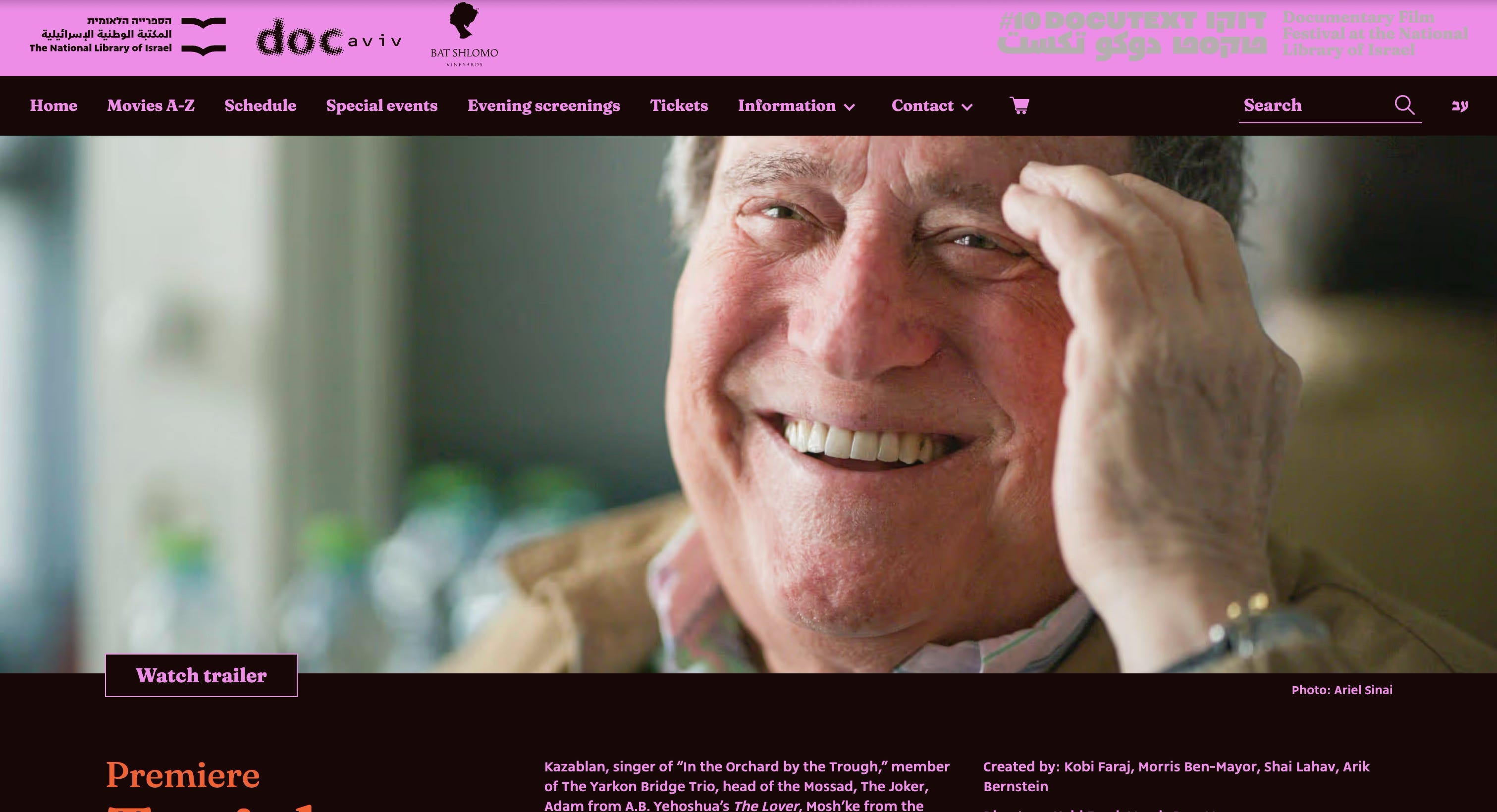
On opening night, we went to see the premiere of a movie about the life of Yehoram Gaon (the much larger than life Israeli actor, singer and composer, whose oeuvre fills “Israel’s playlist” to this day). That evening, the “twist” was that Gaon himself was there and spoke (more on which below). We went to “We Will Dance Again,” the documentary about October 7th, the twist being that the director, Yariv Mozer, was present and discussed the film (and made a point, several times, of saying that the Hollywood partnerships that had made that movie possible would never happen now; today, no one in Hollywood so much as takes a phone call from an Israeli).
And there was the closing event, a screening of “Leonard and Marianne: Words of Love,” a film about Leonard Cohen and his tortured, famed and much-sung-about relationship with Marianne Ihlen (a beautiful movie worth finding where you can).
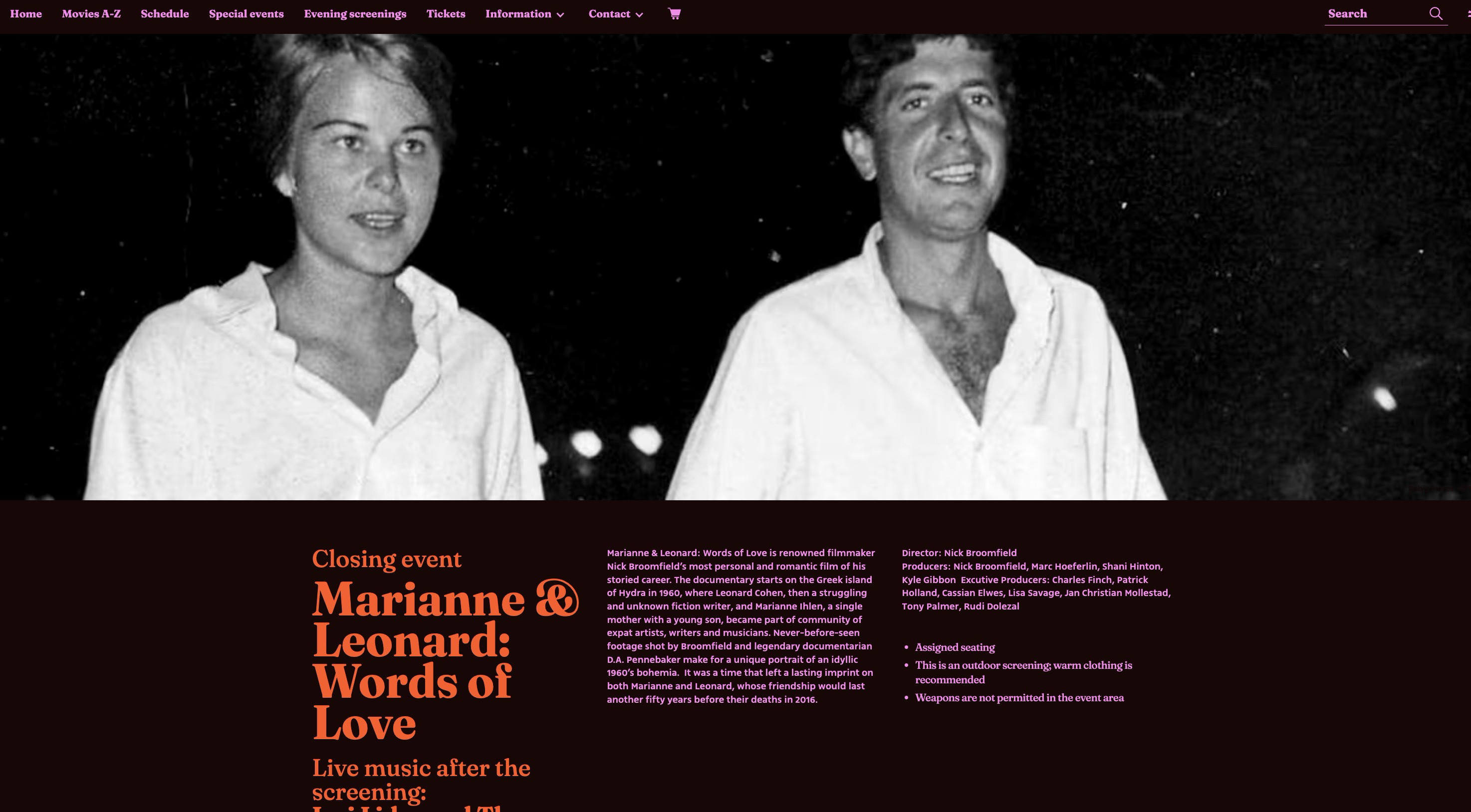
On that night, the “twist” was that after the movie, Ivri Lider, a hugely popular Israeli singer, sang Leonard Cohen’s songs, accompanied by The Israel Camerata Jerusalem.

(Since this column is mostly about the Yehoram Gaon event, we’ve added a clip of the Leonard Cohen evening at the top, Ivri Lider singing Hallelujah, just to afford a sense of the gorgeous music and the evening as a whole at the NLI’s outdoor theater).
Back to Yehoram Gaon.
A few years ago, Shalem College awarded Yehoram Gaon an honorary degree. Those were the years when I still sat on stage at Graduation (from which I have blessedly been excused, a perk of slowly retiring), and as it happened, I was seated next to him for the hour and a half of the ceremony.
We chatted a bit before the Processional and then stole a few words here and there on stage when attention was focused elsewhere, when a few sentences wouldn’t be terribly noticed. He was lovely, and considering his virtually god-like status in Israeli society, incredibly down-to-earth and unassuming. Someone else got their honorary degree and gave a speech. Then Yehoram Gaon received his honorary degree and delivered a speech, then student speeches, and then, finally, student degrees. Graduations in Western countries, I guess, follow some of the same rubrics no matter where you go.
The rubric at Shalem’s graduations is slightly different, though, not only from graduations outside of Israel, but even from most graduations inside Israel—because we end by singing Hatikvah. Now, the notion that an Israeli college or university might not end by singing Hatikvah might sound counterintuitive, but this is the country for which the word “counterintuitive” was probably created.
In 2017, for example, a brouhaha erupted when Hebrew University cut Hatikvah from a graduation ceremony so as not to offend Arab students (no comment on my part, for now). Hebrew University was not alone, by the way. Haifa University had made a similar decision in 2013, with one representative of the university explaining that “we are not a Zionist university.” Tel Aviv University made the same decision in 2017.
Anyway, we’ve digressed. Shalem College does conclude Graduation by singing Hatikvah, and as an unabashedly Zionist college, always will, I hope.
So the MC instructed the audience that we were going to rise for Hatikvah, following which everyone should please stay in their places until the Recessional has passed. Dutifully, we stood, a few notes of introduction were played, and we began to sing Hatikvah.
And then, I heard a sound that I couldn’t identify. It was Hatikvah, but it was so rich, so robust, so gorgeous, so unlike anything that I’d ever heard, that I couldn’t figure out where it was coming from. I looked around; it was coming, of course, from the mouth of the man standing next to me, Yehoram Gaon. For as long as I remember anything, I’ll remember that moment.
Now, though, given the evening at the NLI, I’ll remember even more. Over the years, Yehoram Gaon has gotten the reputation of being a right-winger politically. That was probably somewhat true, though he was far from an extremist; today, I assume, many of his views now seem obvious to most Israelis.
I knew that there was a lot about Gaon’s life that I didn’t know, so I was very much really looking forward to the movie. We love the setting of the NLI’s outdoor event space, even though, I’ll confess, the plastic chairs zip-tied together so that impetuous Israelis won’t move them to allow themselves a bit more room, are too close together and more than a bit uncomfortable (but we’ll return to that).

During the movie, in which Yehoram Gaon reflects at length about his life, he said, at one point, “We haven’t had a lot of wars in Israel; we’ve had one long war, with some breaks in the middle.” His comment echoed an evening we’d had along the Gaza border, almost a quarter of a century ago.
We’d been invited to dinner at the home of friends in Sha’ar HaNegev, just on the edge of Gaza, probably towards the beginning of the Second Intifada. In the midst of the standard dinner chit-chat, we suddenly heard an enormous boom, and the entire house shook. I looked at my wife, she looked at me, but no one said anything; we just kept eating our fish, sipping our white wine and talking. A few minutes went by, and again, an enormous boom—and once again the house shook. No one so much as acknowledged what was obviously a tank firing away just a few hundred meters from where we were seated.
We’d never had dinner to the sound of tank fire when I was growing up in suburban Baltimore, and eventually, I couldn’t quite sustain the nonchalance. “What is that, exactly, that we’re hearing?” I asked, trying to sound as calm as our hosts appeared.
Listen to this episode with a 7-day free trial
Subscribe to Israel from the Inside with Daniel Gordis to listen to this post and get 7 days of free access to the full post archives.