

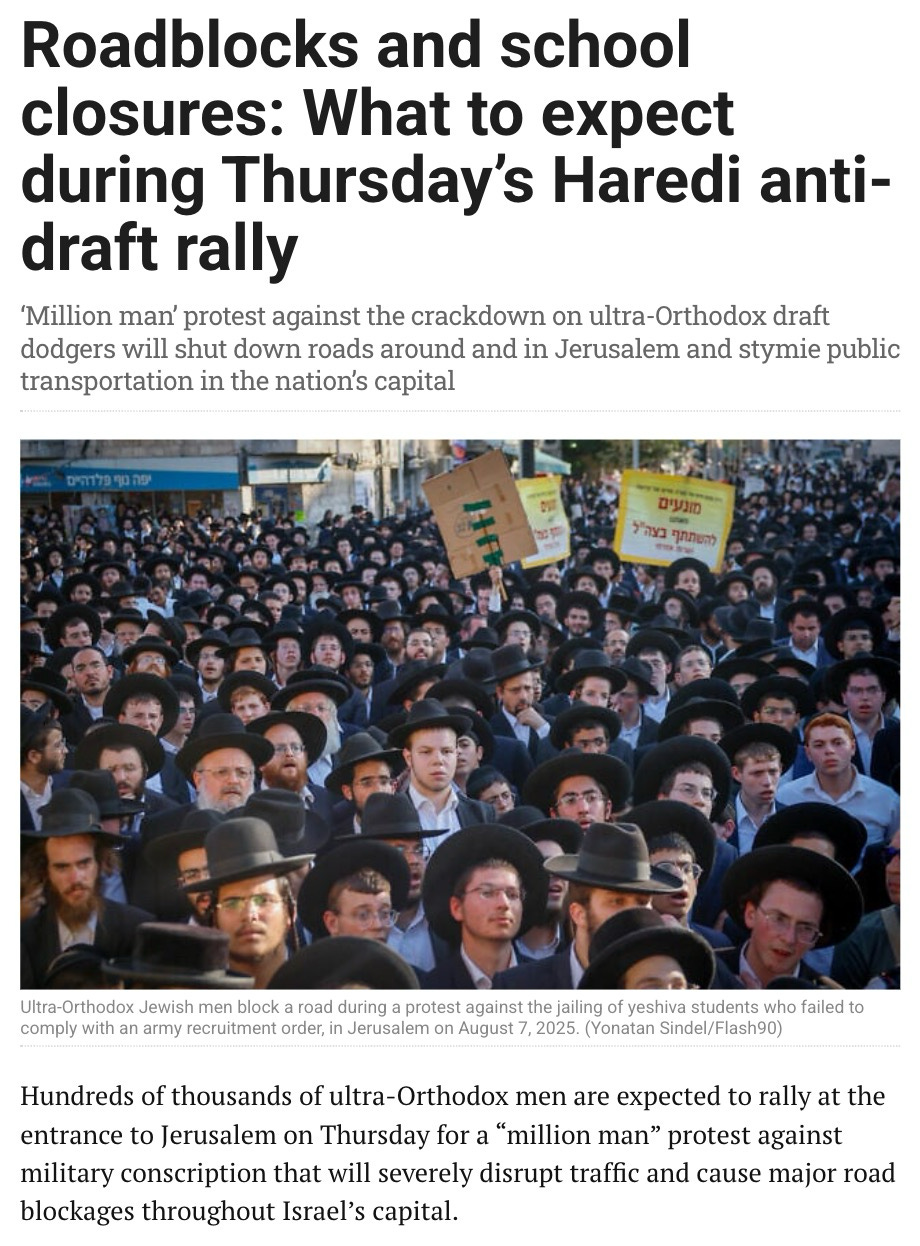
You do not want to be driving to or from Jerusalem today, or anywhere near the entrance to the city. With the government apparently pushing forward a bill that would continue the Haredi exemption from the draft (a bill the coalition needs to pass in order not to lose its Haredi factions, which would bring down the government and trigger elections), public furor surrounding the issue is brewing again.
The Haredim have decided on a massive show of force (in numbers) as a way of reminding the powers that be that they should not be trifled with. The impact on traffic everywhere hear the capital is the subject of newspaper articles across Israel’s press today.
I may be naive, but I find it very hard to believe that even religious non-Haredi Israelis, who lost sons and fathers and brothers at horrifying rates in this war, will swallow the pill that Netanyahu apparently thinks he can sweeten. Many people speak of a new coalition of former rivals, encompassing “those who served.” Ie, “let’s first get us all together and resolve this Haredi non-service abomination, and then we can deal with the differences between us.”
There was a period not that long ago when that was considered likely. One hears less about it now. Then again, elections haven’t been called, so it remains to be seen how this will play out politically.
In the meantime, the idea of a huge anti-military-service rally is so startling (to some) or obscene (to others) that the issue is all over social media. The press itself can’t really convey the depth to which this is roiling Israel.
For that, we need peeks into social media to get a sense of the national mood.

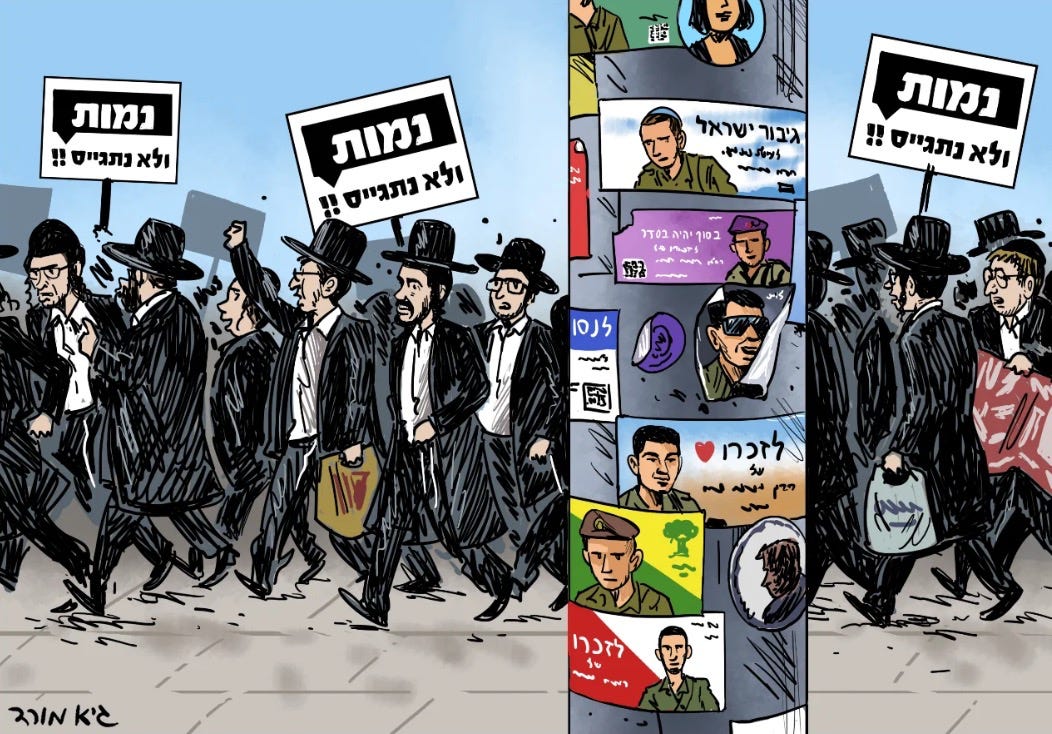
Guy Moran, a very popular and talented political cartoonist, posted this drawing on his Instagram page. It shows the multitudes of Haredim making their way to the protest, walking by a street pole that is adorned (and most of them still are across Israel) with the stickers have have the faces of those who fell.
Their signs, which they’re holding as they walk by the stickers, say “We’d rather die than serve.”
The bitter irony isn’t exactly subtle.
Neither is the irony of this actual video of the Jerusalem train station this morning, with all the Haredim coming to the city while the soldiers are heading down to the trains to head to their bases.
I first missed this when I saw the video, but a friend pointed out to me that one of the soldiers in the foreground is a son of Rabbi Avi Goldberg, a revered teacher at a Jerusalem school and father of eight who was killed in the war. His son is now serving as the Haredim ascend to the street to hold signs that say (as in the drawing above) “We’d rather die than serve.”
Some people are dying. Just not them.
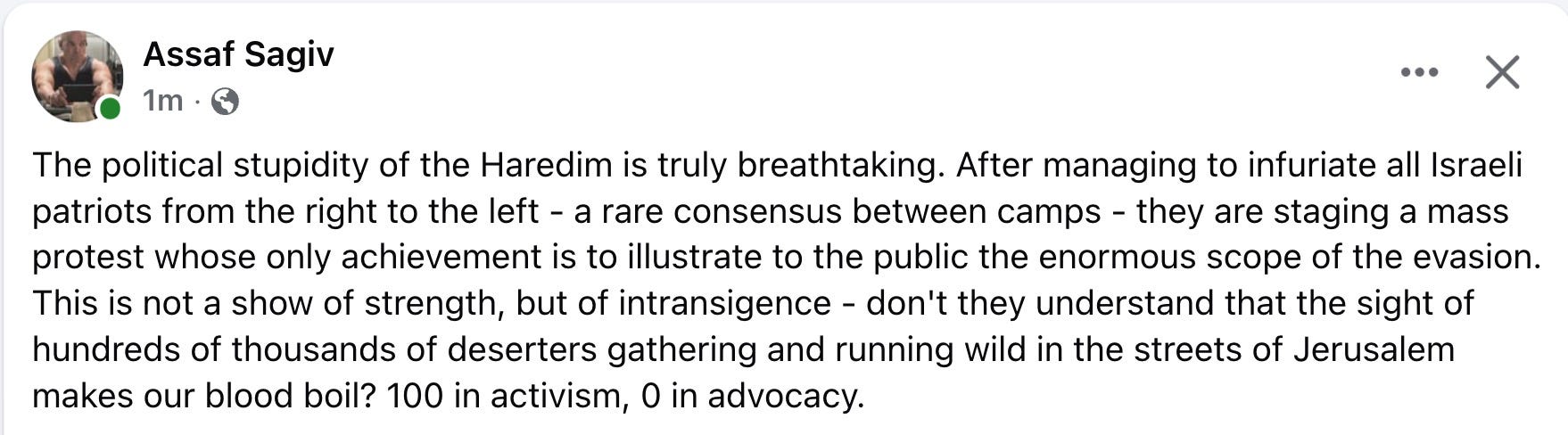
I’m hardly the only one who wonders if this public stunt isn’t going to backfire on the Haredim and on the government that is trying to shield them from the obligation to share in the burden of defending this country. Assaf Sagiv, one of Israel’s leading conservative public intellectuals, whom we’ve quoted often before, posted this earlier today (Google translated here):
All of which brings us to the video at the very top of this post, which I saw on a dozen WhatsApp accounts earlier today. It shows the Haredim flooding the Jerusalem train station (always identifiable by its very distinctive escalators—the train platforms are very, very far underground because the maximum grade that a train can climb is insufficient to get to the surface of high-up Jerusalem), as a soldier, likely on his way to his base, is playing the piano.
There are grand pianos at many of the train stations in Israel. I don’t know the origin of that, but it’s cool. People—many of them very talented—are always playing them. The pianos are all covered with those stickers of fallen soldiers … If you look carefully at the top, you’ll see a row of stickers just above the keyboard, facing the pianist.
He’s playing whatever he’s playing, but then realizes that the Haredim descending on the escalator are singing something different. So he waits a moment, figures out what they’re singing, and then plays along.
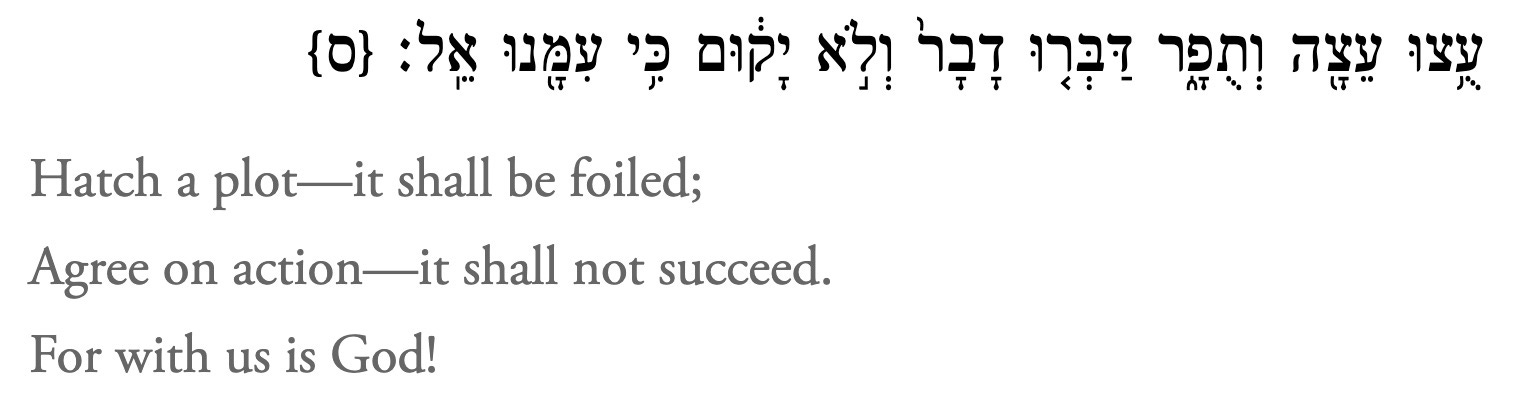
The whole thing drips with irony. The words of the song they’re singing are from Isaiah 8:10, and read as follows:
The tune of “עוצו עצה ותפר” (Utzu Etza) is generally traced to the Hasidic Jewish communities of Eastern Europe. It reflects the musical heritage of Ashkenazi Hasidic traditions, which originated in regions such as Poland, Lithuania, and Ukraine. These communities developed distinctive nigunim (wordless melodies or melodies with spiritual texts) that were used in prayer and communal singing, often to bolster their spirits or calm their souls.
As far as I was able to learn, there is no singular small town or exact village attributed to the melody, but it is well rooted in the Hasidic tradition from the general region of Eastern European Jewry. Over time, this melody became part of the Israeli and global Jewish musical repertoire, popularized and preserved by yeshiva students and Musar/Chassidic groups, particularly those connected to Chabad and Slonim Hasidic sects.
So what’s the irony? In Eastern Europe, the words (which made their way out of Isaiah and into the liturgy, and which in traditional prayerbooks are found immediately after the Aleinu prayer) were sung as a way of strengthening resolve when the Gentile authorities had issued some rule or proclamation designed to make life miserable for the Jewish community. What did these Jews assure themselves, quoting Isaiah? “You can hatch a plot against us, but it will be foiled, for God is with us.”
To whom are those words addressed today? Not to the Gentile authorities, but to Israelis. To the government. To the families of the soldiers who fell by the hundreds. To the families of the tens of thousands of wounded soldiers, in body and soul, who will never again be whole. To the actual soldiers in the train station on their way to defend the country.
And what about the soldier in uniform playing the piano. Does he not get it? I’m sure he did.
So why’s he playing?
Because that’s how Jews are. That’s what Jews do. When some sing, everyone joins. That’s who we are as a people. Your song is my song.
At least when it comes to melodies. When it comes to defending the country, not so much.
Where’s this headed? We’re likely to find out much sooner than we might think.



