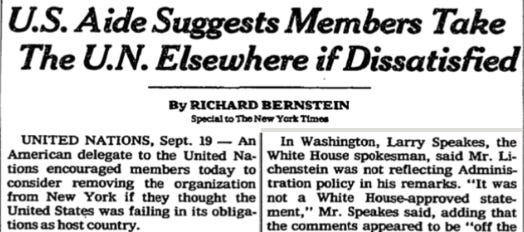
In September 1983, in response to a Soviet diplomat’s question about why the U.S. had to be the country in which the United Nations was situated, Charles M. Lichenstein, who was then serving as Deputy U.S. Ambassador to the United Nations, responded that he would be more than happy to see the UN leave America’s shores: “The members of the U.S. mission… will be down at dockside waving you a fond farewell as you sail into the sunset.”
I hadn’t thought of Lichenstein in a long time, until United Torah Party chairman Yitzhak Goldknopf said a few weeks ago that if Israel insisted on moving ahead with drafting the ultra-Orthodox, the Haredim would just leave. His stern warning: “Israel will be left without Haredim.”
It’s impossible to describe the fear that rippled through Israeli society—because there was none.

For the moment, at least, the Haredi issue is not much in the top headlines. For now, Israel is focused on the issue of the humanitarian crisis in Gaza, Israel’s military plans in Gaza (or lack thereof, if one believes Bezalel Smotrich, who may well be right about Bibi’s plans this time) and Israel’s increasing international isolation.
With the cabinet having approved plans to take over Gaza and to invade Gaza City (which many are warning could well lead to the deaths of some hostages, while others respond that it’s not as if not entering Gaza City is getting the hostages out), people are focused on how many soldiers will be called up (apparently some 250,000 once the operation reaches its peak) and whether the mere threat of invadingGaza City might just tip the scales and get Hamas to negotiate.
Another reason that the Haredi issue is not in the headlines is the simple fact that the Knesset is on summer break, so there’s no legislation being passed anyway.
But there is no doubt — the issue will be back, and in tomorrow’s podcast, we will hear from an Israeli American-born Haredi rabbi, Rabbi Yitzchok Adlerstein, who has views that may strike some of our listeners as very surprising.
Before posting that interview tomorrow, though, it felt important—especially as the issue is now fairly far removed from the headlines—to remind us all how explosive the issue has become, especially among the national-religious crowd (but not only, of course), who are carrying more than their share of the burden of this war.
If staying in power is Netanyahu’s chief concern (and I don’t know anyone who does not think that it is), then — just as is the case with Gaza — he has no good options. Exempting the Haredim from the draft would unleash a firestorm in Israel, one that even Bibi might not be able to weather and that army might be able to withstand. So, too, though, is not exempting the Haredim from IDF service almost certain to unleash a tsunami—from the Haredim.
The Haredim have already essentially declared war on the idea that they should do their share in defending the country:
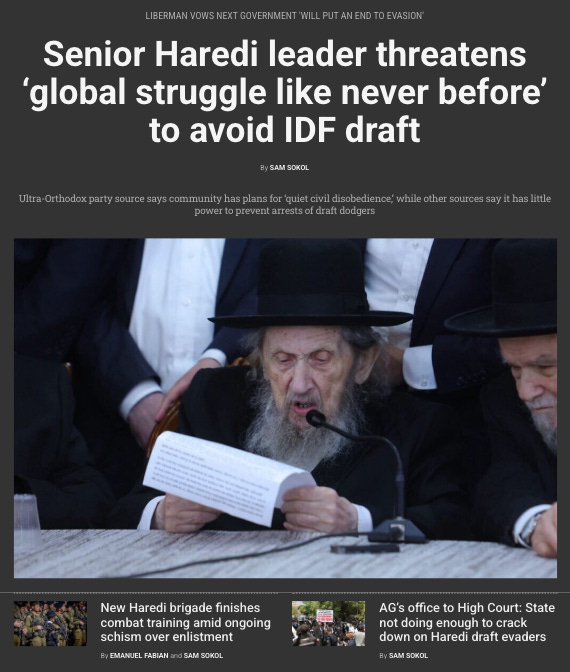
Those sorts of headlines do make non-Hebrew press, but what is much less accessible outside Israel is the social media firestorm now being unleashed by those who have simply had it with the government’s caving in to the Haredim, as their own husbands have been called up again, sometimes for their fifth tour of duty in this war.
As we hear from the enraged, cynical speaker at the Knesset meeting in the video at the top, these soldiers’ businesses are collapsing, their marriages are hurting (and in some cases, crumbling) and —though she does not mention this — PTSD cases and domestic violence have both dramatically increased. In her instance, the issue at hand was the financial support for the Haredim and not for the tends of thousands of reservist families who desperately need it.

There are dozens, probably hundreds, of such videos on Facebook, Instagram and throughout Israeli social media.
For some people, though, it’s not the issue of funding (as it is in the video at the top of this post) as much as the government’s refusal (for decades now) to finally get the Haredim to serve. And like Goldnopf (who threatened that the Haredim would leave Israel), the speaker below also makes a threat. Here is a religious woman speaking to Israel’s first religious coalition, saying, “We’re going to get rid of you.”
Unlike Goldknopf, she’s serious. And unlike Goldknopf, she and her community can actually do it if is opposition voters join together—and more on that in a moment.
And when we get to a seasoned speaker like MK Gilad Kariv (Democrats Party), the rhetoric is even more heated (and eloquent):
It doesn’t come through in the papers, but the rage is real, and it’s wall to wall. It’s muted now, perhaps, because until the Knesset returns from recess, there is no legislation to pass anyway. But when the MK’s do return to work, this issue is going to be THE issue in Israel — and almost no matter what happens, it could well explode.
Which brings us back to Goldknopf’s threat that the Haredim will leave Israel. They, of course, will not leave, for they will suddenly discover that other countries require people to work in order to get a salary. They will discover, in other words, that “job” is not just the name of a book in the Bible.
They’re not going anywhere, and they know it. Everyone does.
So why might the threat of greater Haredi resistance actually be good news?
Because for once and for all, it might just give non-Haredi Israelis a cause around which to unite. For things to change, what has to happen is clear: Israelis of all walks of life, religious and secular, right wing and left leaning, in favor of annexing Gaza and against, those who believe that Israel is in some ways responsible for the humanitarian situation in Gaza and those who do not — will all have to decide that THE issue around which they will coalesce as voters in the next election is not left/right or any of the other divides, but served/didn’t serve. If those who served, and want everyone to serve, can unite, the days of the Haredi stranglehold might be over.
Can Israeli voters do that?
That is very far from certain. Above all else, it would take a charismatic candidate who can give a wide swathe of Israelis the confidence that s/he gets them, cares about their worldview and wants to help shape a Jewish state in which they all feel they have a stake and a future.
Is such a person out there? Israel’s future might well depend on the answer to that critical question.

Tomorrow, as noted above, we explore the issue of Haredim serving in the army in a podcast conversation with Rabbi Yitzchok Adlerstein, who holds views that many may well find surprising — and refreshing.


And still, as sobering as all the above is, the daily news is also filled with reminders of the indomitable spirit that still pervades this country.

The above photograph, of a rabbi performing a wedding ceremony, appears entirely ordinary. But there was nothing ordinary about the wedding, about which YNet reported.
The rabbi performing the ceremony is Rabbi Tamir Granot, head of Yeshivat Orot. The bride, Roni, had been engaged to Rabbi Granot’s son, Captain Amitay Granot, who was killed by a missile fired by Hezbollah.

According to the YNet article, Roni and Amitay got engaged during Sukkot, a few days before the October 7th attacks. Shortly thereafter the war began, they spoke on the phone and agreed to get married as soon as Amitay got a few days off from the army.
He was killed that very same day.
At his sons’s funeral, Rabbi Granot spoke to the woman who was to have become his daughter-in-law, and told her it would be hard, and it would take time, but “choose life, choose life, choose life.”
She did. And earlier this week, he performed her wedding.
As for why the photo in the story is of the rabbi and not the couple, the last sentence of the article makes it all clear. Her new husband “A”, is an officer in “an elite unit.”
After all she’s been through, she’s married a soldier whose position is too dangerous to even mention.
It is people like her who are the reason that so many of us — despite the heartbreak of this present era and the even more difficult times that likely lie ahead — are so confident of the future of this place we call home.